
Tungeneset — the Edge of Senja
In late September I spent two weeks driving through northern Norway. The plan was loose: follow the coast, photograph what the light offered, and see how far north the days would carry me before winter closed in. Somewhere along the way I made a decision that might puzzle a few people — I skipped Lofoten entirely.
The reasons are best discussed over a beer, but the short version is that Lofoten had become, to my eye, more a stage than a landscape. Senja, its neighbour to the north, carries the same mountain drama — the same jagged coastline, the same light — without the traffic. It is also, for what it’s worth, home to the world’s largest troll — but since I was there for the landscape and not the folklore, I’ll leave that particular attraction to the tourist brochures.
I had come to Senja to photograph its coastal landscapes — places like Tungeneset, where the Okshornan rise straight out of the sea.
Tungeneset sits on Senja’s western coast, where a flat tongue of coastal rock extends into the Norwegian Sea. It is one of those places that earns its reputation within seconds of arriving. The view from the outcrop is direct and unobstructed: the Okshornan — a serrated ridge of dark gneiss peaks — rise sharply across the water, their jagged profile cutting against whatever sky the evening decides to produce. The peaks look like the teeth of a broken saw blade, angular and uneven, and they dominate the horizon with a kind of quiet authority.
What makes Tungeneset particularly interesting for landscape photography is not just the view but the foreground. The tidal zone in front of the outcrop is a network of shallow channels and pools carved into the rock, filled and drained twice daily by the tide. Seaweed clings to the dark stone in patches, and when the water is calm, the pools become mirrors.
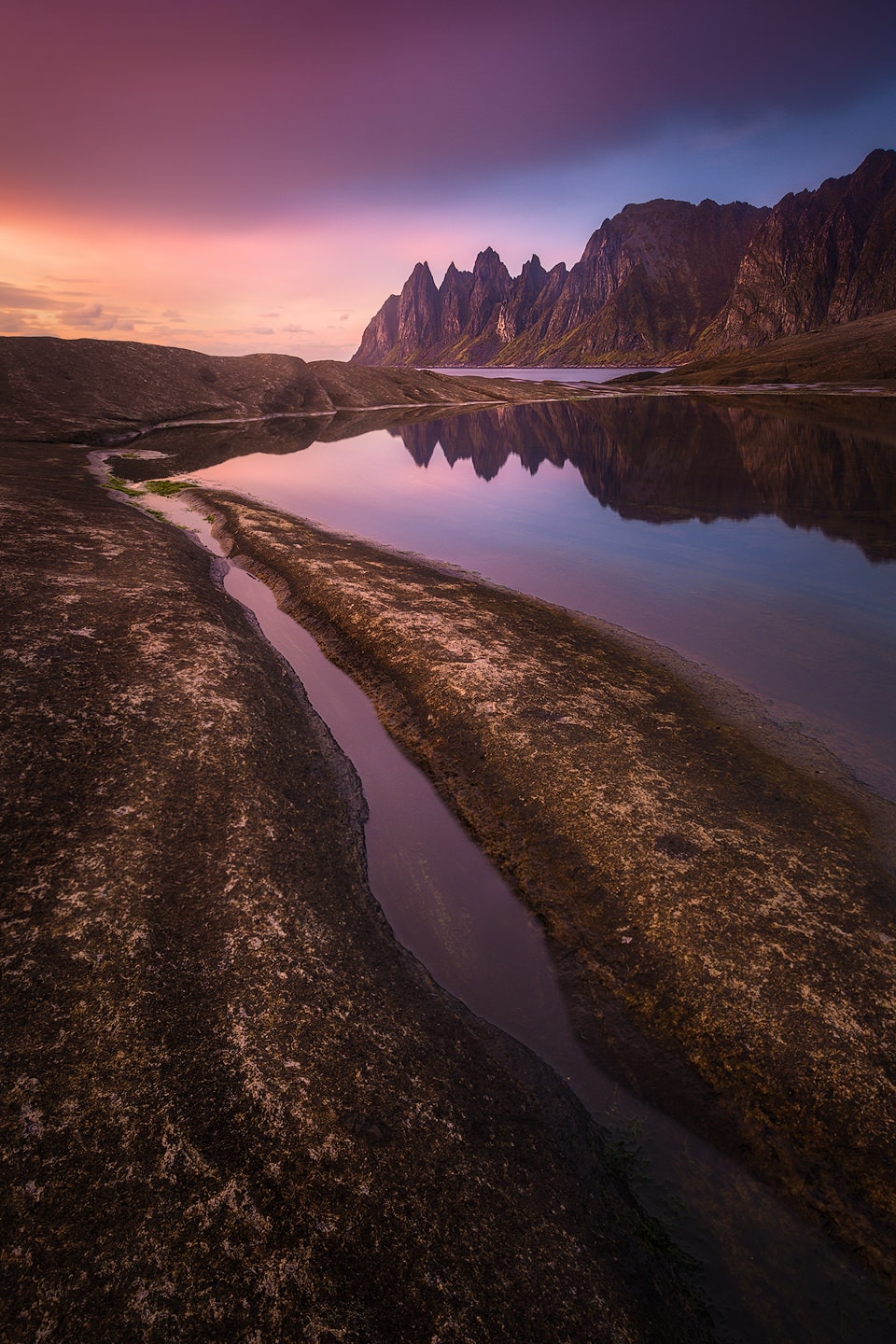
In northern Norway in late September, the sun is already low well before it sets, and the evening announces itself early. On this particular evening, it did so generously. The wind had dropped to nothing. The tide had pulled back to expose the full rocky foreground. The sky was settling into a long autumn sunset — purple deepening overhead, warm orange and pink near the horizon, the Okshornan catching the last direct light. The reflection in the largest pool was near-perfect. Everything was holding still.
The problem was that the composition I could see — the one that used the curving water channels as leading lines into the reflection and up toward the mountains — only existed at ground level. From any normal height, the foreground flattened and the lines led nowhere. The image was down there, at the surface of the rock. Or it didn’t exist at all.
My Own Reflection
Getting a tripod to work at ground level on a coastal slope is an exercise in creative compromise. I have tried various setups over the years to get as low as possible and have yet to find one that keeps the camera entirely steady and me in a dignified position. This was no exception. With the legs splayed as low as they would go and the camera barely clearing the rock, I ended up flat on my stomach — feet pointing uphill, elbows braced against wet stone, face close enough to the tidal pools to see my own reflection underneath the lens. Composing from that position meant live view rather than viewfinder, the screen tilted at an angle that suggested the frame more than confirmed it.
Everything had to hold. The water couldn’t ripple. The camera couldn’t shift. I couldn’t move. The rock was cold and rough beneath my jacket, and the smell of salt and kelp was suddenly very present — the kind of detail you notice when your face is fifteen centimetres from the ground. A wrong move would nudge the tripod and shift the frame. A boot touching the surface would break the reflection. Both were centimetres away. So I held my breath. Not as a technique. As a necessity.
The exposure ran. The sky continued its slow deepening. The Okshornan stood exactly where they had stood for millions of years, doubled in the pool below them. And for those few seconds, lying flat on the wet rock of Tungeneset with my jacket soaking through, nothing moved. Not the water. Not the air. Not me.
The Cost of the Frame
There is a particular kind of field decision that has nothing to do with reading light or timing the golden hour. It’s the decision about what you’re willing to do with your body to reach a composition you can see but can’t access from a comfortable position. Kneeling in snow. Wading into cold water. Lying face-down on wet tidal rock on a slope, feet higher than your head, because the frame only works from there.
These are not dramatic sacrifices. Nobody gets hurt lying on a wet rock for a few minutes. But they are genuine commitments — small, physical, made in the moment without much deliberation — that determine whether an image exists or doesn’t. The distance between a good composition and the right one is often not measured in metres but in how far you’re willing to lower yourself to the ground. It is not the kind of thing you plan for. No composition guide tells you to lie flat on wet rock. But the awareness of where the image actually is — not where it’s convenient, but where it lives — comes from time spent in the field. And acting on it requires a willingness to look slightly absurd.
For this photograph, the cost was a damp jacket, an aching neck, and a few minutes of trying not to breathe. The return was a frame where everything converged — the rock channels, the reflection, the sky, the Okshornan — into something that could only have been seen from exactly that position, at exactly that height, in exactly those conditions. A few centimetres higher and the leading lines disappear. A few minutes later and the light shifts past its best. A single breath at the wrong moment and the reflection breaks.
Have you ever found yourself shooting in a position your body quietly objected to? I’d love to hear your story.
Landscape photographer
Vienna, Austria
Comments