
Autumn Photography in Patagonia
I arrived in Parque Nacional Los Glaciares in December 2015 and stayed until July. Seven months in and around El Chaltén, living out of a tent for most of it, with a short break for Peru and the Chilean Altiplano somewhere in the middle. By the time April came and the lenga forests began to turn, I had spent three months being frustrated.
The frustration was not with the place. Parque Nacional Los Glaciares is among the most dramatic landscapes I have ever worked in — but the first months taught me something I had been avoiding. I was showing up and hoping. Walking to viewpoints in good weather, waiting for something to happen, and leaving when it didn’t. The results were decent. Occasionally beautiful. Never honest. The images looked like what anyone would take if they stood in the same spot on the same morning. I was recording the place. I was not photographing it.
What changed was not technique. It was commitment. At some point during those months — I cannot pinpoint the exact day — I stopped asking whether the conditions were worth the walk and started walking regardless. I stopped treating bad light as wasted time and began paying attention to what the landscape did when the light was ordinary. By April, when autumn arrived, I was ready for it in a way I would not have been in January.
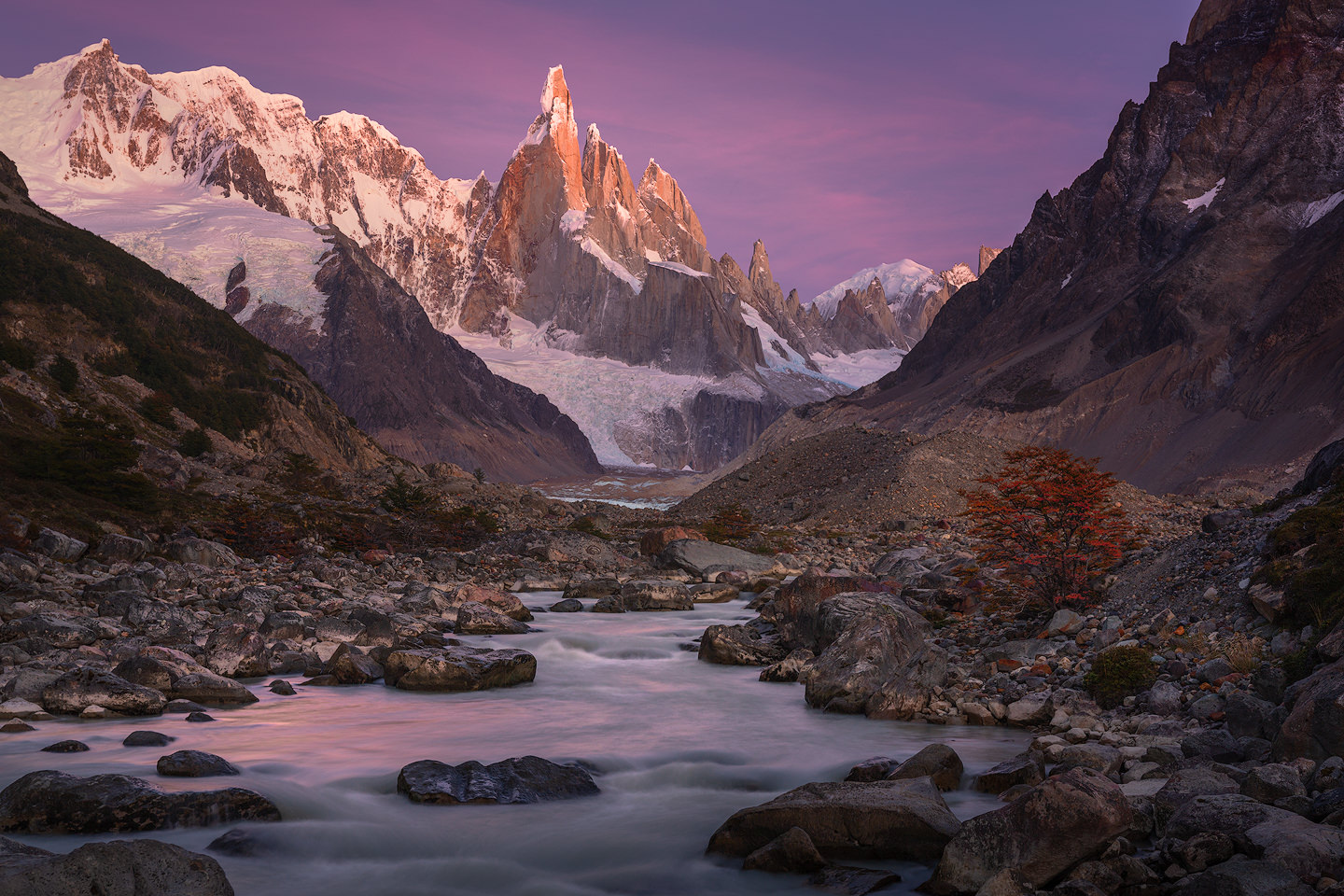
Autumn in Patagonia is not a long season. The peak colours in Los Glaciares appear sometime between late March and mid-April, depending on altitude and the year’s weather. The lenga beeches turn first at the higher elevations, the red moving downward through the valleys over a period of days rather than weeks. Fresh snow on the peaks arrives at the same time, and when the two coincide — red forest below, white granite above, the light low and warm — the window is brief and unmistakable.
Cerro Torre in Autumn Light
The photograph was taken about two hundred metres downstream from the outlet of Laguna Torre, along the river that drains the lake toward El Chaltén. I had walked this stretch many times through the summer, but in April it looked different. The lenga trees along the banks had turned a deep, almost burnt red. Cerro Torre stood at the head of the valley, its summit catching the first light while the forest below was still in shadow.
The river was low and quiet — glacial melt reduced by the colder nights. The water moved slowly between dark stones, softly reflecting the sky. I set up at the water’s edge, on top of a large boulder , framing the river as a path leading the eye upstream toward the peak. The composition wanted depth — the near stones, the water, the forest, the mountain stacking behind one another in the cold, still air.
The light arrived slowly that morning. No drama. A gradual warming of the upper rock, the ice on Cerro Torre turning from grey to pale gold, the red of the lenga intensifying as the light reached the lower valley. It was the kind of light that autumn in Patagonia produces when the conditions are calm — not spectacular, but honest. The sort of morning that rewards the walk without announcing itself.
What Autumn Taught Me
For three months I had wanted the place to perform. I had looked for the decisive moment, the dramatic sky, the conditions that would justify the effort. What autumn taught me was that the effort is not justified by the result. It is justified by the willingness to keep going when the results are ordinary.
April was different because I was different. I walked to Laguna Torre before dawn not because the forecast was promising but because I had agreed with myself to go. The question that had derailed so many earlier mornings — is it really worth it? — had lost its power. Not because I had conquered it. Because I had stopped engaging with it. The answer was always the same. Go.
The morning I made this photograph was not the best morning of that April. It was not the most dramatic light, or the most vivid colour, or the most spectacular sky. It was a quiet morning — cold, still, the river in slow movement, the mountain receiving the light with the patience of something that has stood there for twelve million years. I set up, I worked, I stayed until the light moved past. And when I sat down afterward with a thermos and looked at what the valley was doing without me — the shadows shifting, the colour slowly draining from the lenga as the sun climbed higher — I understood something I had not been able to see in December.
The season had changed. And so had I.
Autumn in Patagonia lasts days, not weeks. If you’ve ever planned around a season — or learned the hard way that you should have — I’d like to hear about it.
Landscape photographer
Vienna, Austria
Comments