
A Winter Sunrise on Fitz Roy
The streets of El Chaltén were empty that winter morning, hours before the sun would rise over Fitz Roy. Not the quiet of an early morning — the silence of a town that had largely packed up and left. The season was over. The hikers, the day-trippers, the guided groups that fill the trails from October through March had gone home. What remained was something closer to the real El Chaltén: a small cluster of buildings at the edge of one of the most dramatic national parks in the world, standing in the dark with nobody awake.
I had stayed. And that alone was not enough. Getting out of a warm bed before dawn is its own negotiation — one that I lose more often than I’d like to admit. I have skipped alarms, turned back on the doorstep, and abandoned walks halfway when the dark or the uncertainty became too convincing. The problem with pre-dawn landscape photography is that the outcome is never guaranteed. The only way to know if it’s worth it, is to go.
What kept me honest that morning was an arrangement made the evening before. Andrew Waddington — a photographer I had run into in town earlier that season, and one of the few others who had chosen to stay through winter — had suggested we head out together for a sunrise shoot of Fitz Roy. Someone waiting for you at a corner in the dark is harder to let down than an alarm clock.
With fewer hikers on the trails and colder, more stable air, winter in Parque Nacional los Glaciares provides a rare combination of silence and clean light — but also far less certainty when it comes to conditions. Capturing a sunrise image of Fitz Roy in winter is a completely different experience from doing the same in the busy summer months.
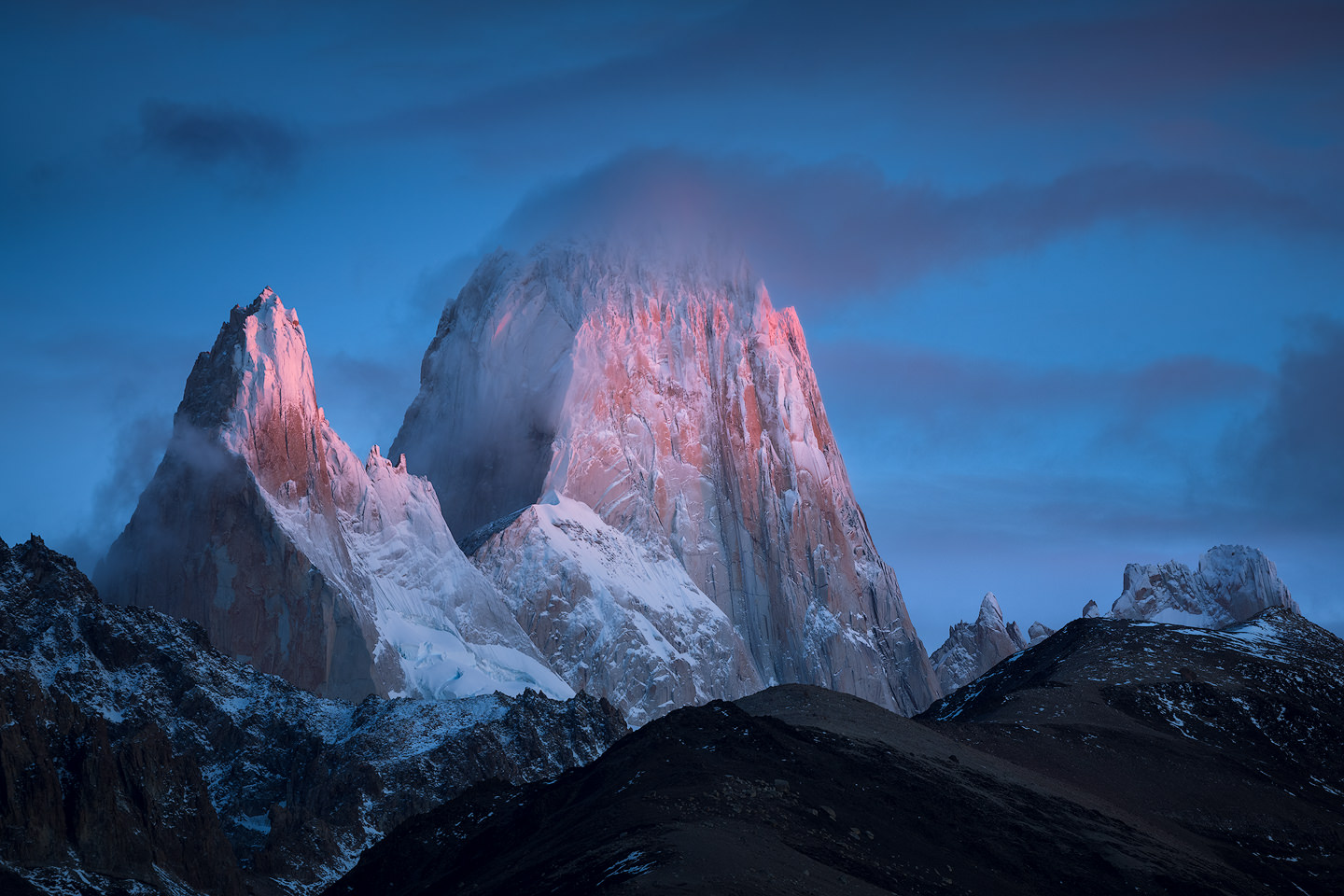
The notorious wind that can make El Chaltén feel relentless during summer had quietened to almost nothing. The peaks had collected a fresh dusting of snow, the granite of Fitz Roy and Cerro Torre edged in white where the previous months had left it bare. And along the trails, the Lenga beeches had dropped their leaves entirely — their pale trunks standing like ghosts against the sky, stripped down to line and form.
For landscape photographers, winter in Patagonia offers something the high season rarely can: solitude, stillness, and light that behaves differently. Winter sunrise arrives late and moves slow. The deep blue of the pre-dawn sky holds longer than in summer, and when the first light finally touches the peaks it comes warm against cold stone — a brief collision of colour that the longer days don’t produce in quite the same way. The trade-off is obvious: fewer opportunities, harder conditions, and nobody to tell you it was worth it if the sky stays gray. Most mornings, it does.
But the mornings it doesn’t are the reason you stay.
El Chaltén Before Dawn
We left town in the dark. The streets were deserted, the only sound our boots on hard ground. As we entered the park and moved into the Lenga forest, the bare trees became shapes in the beams of our headlamps — branches reaching upward without leaves, the whole forest reduced to shadow and skeleton. Underfoot, the frozen leaves crackled with each step. The air was perfectly still.
We reached the meadow long before the light. I had not been to this viewpoint before — Andrew had found it earlier in the season. From the middle of the open ground, the valley stretched west toward the mountains. Cerro Torre on the left, Fitz Roy on the right, both still silhouettes against a deep blue sky.
Despite the cold, sweat had formed on my forehead from the walk in. I wiped it away with my sleeve, pulled a down jacket from my pack, and exhaled. The hard part of this work — the decision to go, the walk in the dark, the uncertainty — was already behind me. What remained was out of my hands. We set up and waited.
The light came quietly. First a shift along the horizon — the deep blue pulling back — and then the peaks beginning to separate from the darkness. The fresh snow on Fitz Roy caught the first red of this winter sunrise before anything else. A single band of cloud clung to the summit, holding there as if the mountain had called it. Behind, the sky stayed that deep, almost blue-hour blue — a contrast that winter mornings produce for minutes at most. I found the frame: the mountain filling most of it, the snow lit in that brief warm light, the cloud still holding. I shot.
The Walk You Take Before Sunrise
There is a version of landscape photography built around certainty — confirming conditions the night before, optimising for the best odds, eliminating as much risk as possible. I understand the appeal. In a place like Patagonia in winter, though, that version is rarely available. You go out in the dark, and you find out what the sky decided to do without you.
I would be lying if I said I always go. I don’t. The resistance before a pre-dawn start is not something I’ve conquered — it’s something I negotiate with every single time. Some mornings the warm sleeping bag or bed wins. Some mornings the uncertainty is too strong and I turn around halfway. That honesty matters to me, because the mornings I do go are not the result of discipline or routine. They are individual decisions, made in the dark, against every reasonable argument for staying in bed.
This was one of those mornings. Andrew was waiting. The streets were empty. The Lenga trees stood indifferent to our presence along the trail. And when the light finally arrived — red on fresh snow, cloud clinging to the summit, the sky still holding that deep winter blue — it was not a reward for effort. It was simply what happened.
Some mornings you’re not there. This morning I was.
Have you ever talked yourself out of a sunrise — or into one? Tell me your story.
Landscape photographer
Vienna, Austria

Comments