
High in the eastern Himalaya, deep inside Khangchendzonga National Park, the first light of day reaches the highest summits long before it touches the valleys below. Long before sunrise, the landscape is still hidden in shadows, but the peaks already begin to separate themselves from the dark sky. The first rays of the day cast a spotlight onto the terrain, highlighting ridges, faces, and snowfields — and in this case onto the spectacular peak of Kabru South.
Kabru South and the Kangchenjunga Massif
Kabru South, an impressive pyramid of ice and rock rising to more than 7,300 metres, forms part of the Kangchenjunga massif along the border between India and Nepal. Though overshadowed by its higher neighbours, the Kabru group remains one of the most beautiful mountain formations in the eastern Himalaya.
Within Khangchendzonga National Park, the peak is visible from several high valleys and trekking routes. From the right vantage point, its broad summit pyramid catches the first sunlight of morning — often minutes before the surrounding landscape emerges from darkness.
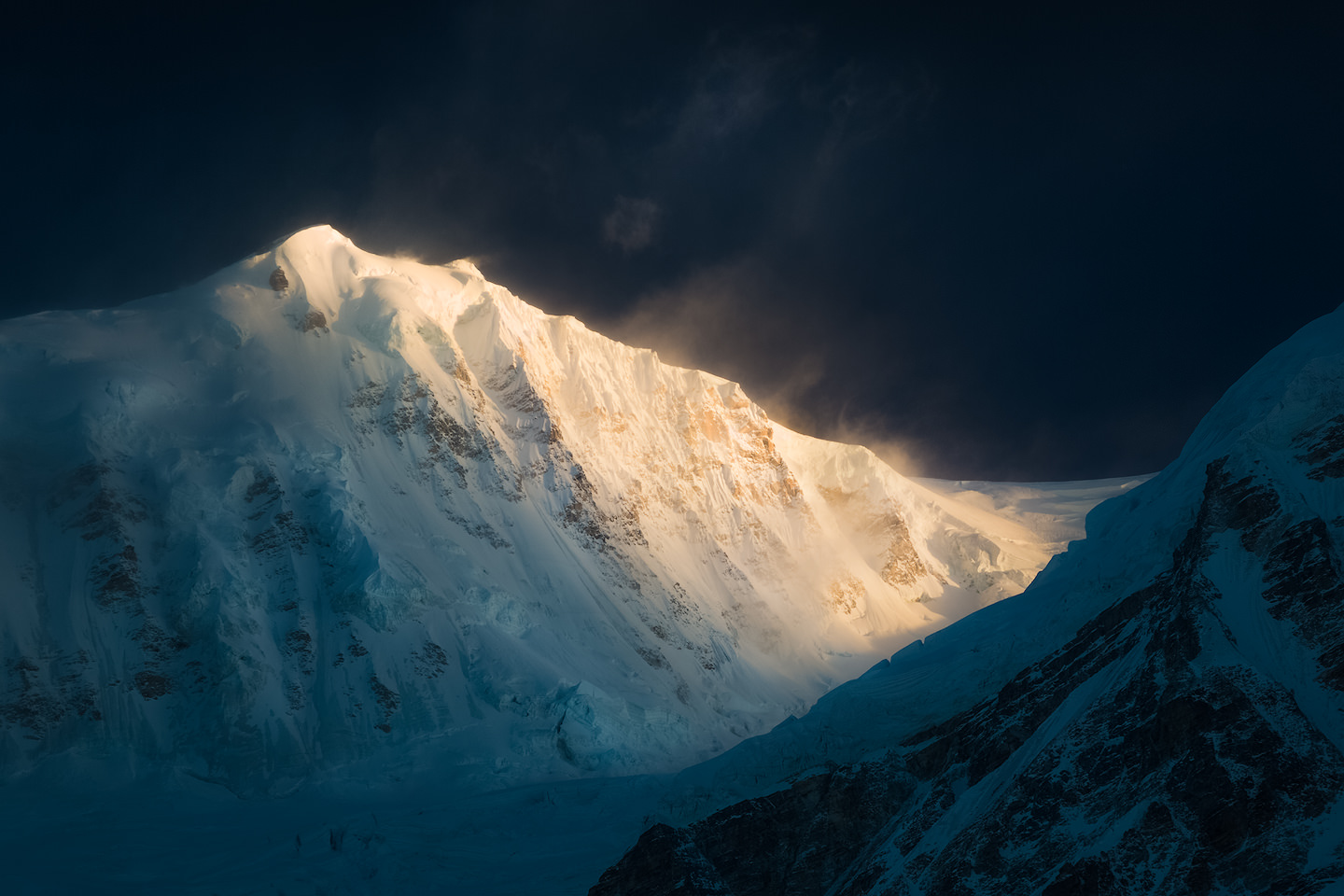
During my 13 day on the Goecha La Trek, I reached a campsite along the Rathong River. From this spot, Kabru South was framed beautifully in the pre-dawn light. The mountain stood quiet and distant in the cold air, its upper slopes barely visible against the fading stars. Morning in the Himalaya often unfolds slowly, but for photographers, this brief window between night and sunrise can reveal some of the most striking light conditions in the mountains.
Alpenglow on the Peak of Kabru South
It was freezing cold, and soon after I had finished shooting Himalayan Twilight, I started packing my gear. Fog came creeping up the valley from behind me, blocking the sun, and I was more than keen to crawl back into my sleeping bag. I was just about to peel off the ice that had accumulated on the legs of my tripod when I noticed that, amidst the fog, Kabru South’s southeastern face had begun catching light. Within moments, the pale grey of night turned to deep yellow, and for a brief minute, the peak seemed to glow from within, suspended above the shadowed valleys of Khangchendzonga National Park. The rest of the landscape remained dark and cold, but the mountain’s upper face sparkled in golden alpenglow.
Alpenglow is one of the most fascinating forms of mountain light. It occurs when the sun is still below the horizon and the highest peaks are illuminated indirectly by scattered sunlight passing through the atmosphere. Because the light travels through a thicker layer of air, shorter wavelengths are filtered out, leaving the warm reds and oranges that give alpenglow its characteristic colour palette. The effect is subtle and fleeting. Sometimes it lasts only a few seconds.
Back to one: I grabbed my camera and long zoom lens from my bag, attached it to the tripod, and quickly composed a shot. Wind whipped snow across the ridgeline as the sun’s first rays painted their warm glow onto Kabru. The light was intensifying with every passing second, but somehow the scene still lacked contrast — the window was closing fast. My fingers were numb, stiff from the cold, yet I knew I had to get my polarizer on or risk losing the perfect shot.
My filter bag, hanging from the tripod as usual, had iced over, and every moment spent fumbling with it felt like stolen time. I had to be careful handling the bag and the filters, knowing that a single smudge or drop of moisture would ruin the shot. Attaching the filter took longer than I usual, my heartbeat racing with the fading light. Just as I secured it and pressed the shutter twice — the magic moment was over.
The Shapes of Sunrise Light
When it happens, it happens quickly. Moments like this rarely last. As the sun climbs higher, the delicate colour of alpenglow fades, and the mountain returns to its usual shades of snow and stone. This fleeting transformation of the landscape is something I explore in more detail in my article about how photographers work with the shapes of light, where this image of Kabru South appears as one example of how alpenglow can briefly redefine an entire mountain.
Rathong Valley
Khangchendzonga National Park
Sikkim
India
Canon EOS 5D Mark III
Canon EF 70-200mm f/2.8L IS II USM @ 200mm
ISO 100, f/3.5, 1/250
Gitzo GT1541T
Polarizer
3. April 2013
Sunrise
Do you have anything to share — a memory, a photo, a question? I’d love to hear about it.

Landscape photographer
Vienna, Austria
sir, i am going to sikkim in feb 1st week.right i am doing intern at national geographic channel
my gears will be
nikon D7000
nikkor 50mm/1.8
tokina 11-16/2.8
tamron 70-200/2.8
which polariser or filter shall i use and which lens will work better in that condition
and last Q ( where did u stayed to take such an astonishing pic?)
thanks ,
ashish