
Nightscapes in Patagonia
Patagonia is famous among landscape photographers for its spectacular sunrises and sunsets. When the first light hits the granite spires of the Cerro Torre massif above Laguna Torre, or any of the other peaks of Parque Nacional Los Glaciares, the entire landscape can glow with colour. Many plan their days around those brief moments of light. Night photography, however, is a very different experience.
Reaching the most spectacular viewpoints around Cerro Torre often involves long hikes across rough terrain, sometimes stretching into the night. Carrying heavy camera gear through darkness transforms these journeys into a far more demanding endeavor. Add early-morning starts and nights in tents, and it becomes clear that photographers get little rest — the effort behind each nightscape is as intense as the landscapes themselves.
Weather plays an equally important role. Landscape photographers often rely on clouds to create the most dramatic images, and in Patagonia there is rarely a shortage of them. Fast-moving weather systems regularly sweep across the mountains, producing the spectacular skies that make the region so famous. But when the clouds finally clear, night photography becomes a compelling alternative — a chance to capture the mountains beneath a sky filled with stars.
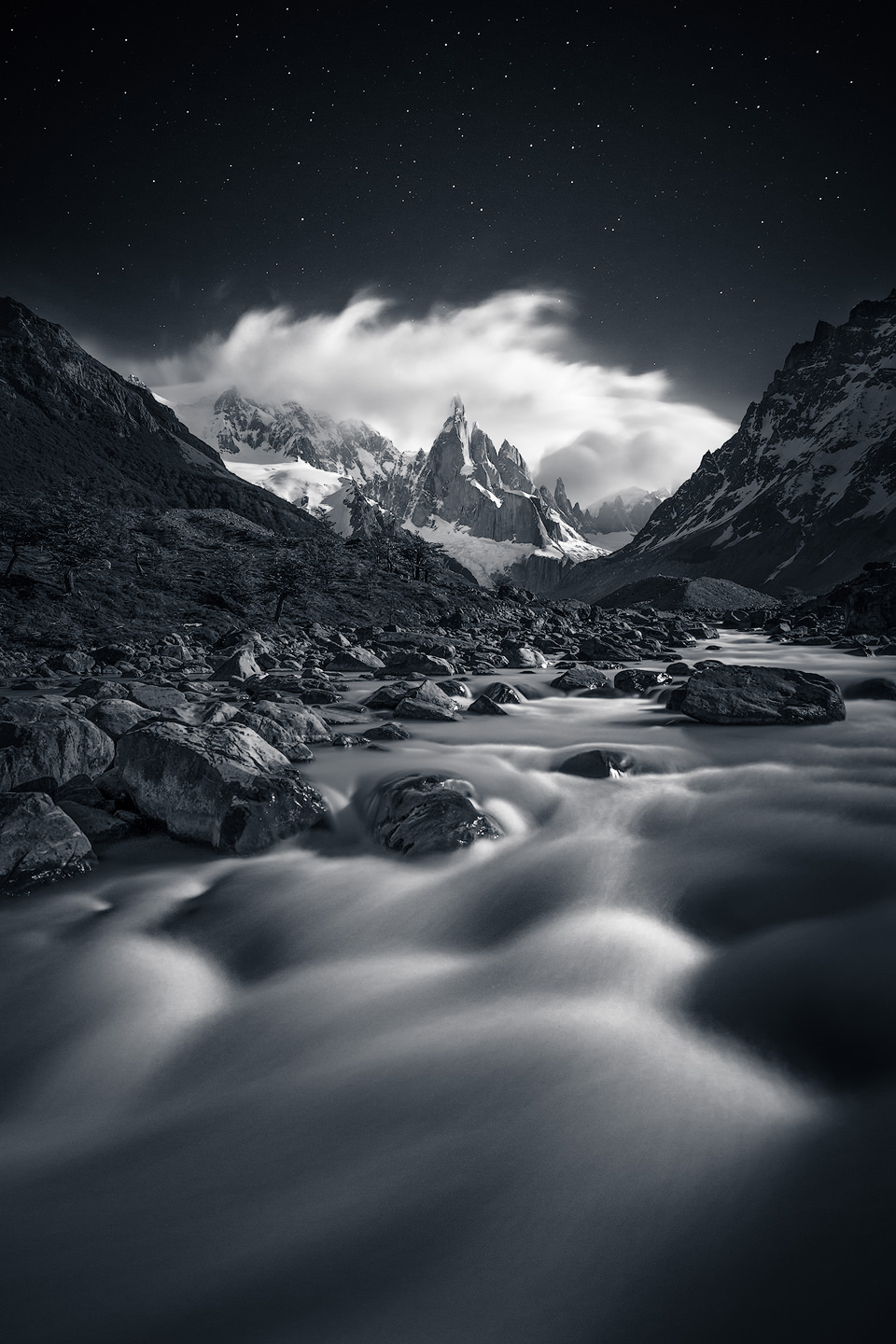
Far from major cities, Parque Nacional Los Glaciares offers remarkably dark skies. In places like Patagonia, where the atmosphere is exceptionally clear, even a small amount of natural light can transform the scene into something magical. On calm nights the stars seem to spill across the entire sky above the glaciers and granite spires. And while standing in the silence of the Patagonian night, there is always the quiet awareness that these landscapes are still truly wild — a place where an unexpected encounter with a puma is not entirely impossible. For those drawn to night photography, that wildness is not a side note. It is part of the image.
Photographing Mountains at Night
Photographing mountains at night is unlike any other kind of landscape work. During the day, we chase colour, clouds, and the drama of shifting light. At night, everything slows down. Shapes, contrast, and the subtle glow of starlight become the language of the scene. A peak like Cerro Torre no longer competes with fiery skies or dramatic clouds — it stands as a silhouette against the vastness of the universe, and suddenly the simplest forms can feel monumental.
I’ve written before about the way I respond to light in my work — how shapes of light guide the composition of an image and shape the way I experience a landscape (see how light shapes the landscape in photography). At night, those shapes shift entirely. Long exposures smooth movements, the stars become compositional elements, and bright glows — from glaciers or distant snowfields — emerge in ways invisible during the day. It is these qualities — stillness, contrast, and the interplay of light with dramatic forms — that make nightscape photography so compelling, and hint at why this image of Cerro Torre under the stars resonates in a way that daylight rarely can. The simplest forms can feel monumental, and the quiet of the night amplifies scale, solitude, and the sense of wildness.
Working at night demands a different kind of awareness. Without the usual cues of daylight, every detail requires careful attention. Time seems to stretch, and even small movements in the landscape, while being smoothed out, feel amplified. In a way, photographing at night teaches you patience in the same way hiking Patagonia does: the landscape only reveals itself to those willing to wait, to observe, and to adapt.
Moonlight on Granite
If you woke me in the middle of the night and asked me about my favourite mountains, Cerro Torre would almost certainly be among the first I’d mention. Ever since I first saw a photograph of its impossibly sharp granite spire rising above the glaciers of southern Patagonia, the mountain has fascinated me. The dramatic silhouette, the violent weather, and the long and controversial climbing history have given Cerro Torre an aura that few mountains in the world possess.
But as striking as the peak is during the day, it is at night that it reveals a completely different character. When the wind finally drops and the sky above Parque Nacional Los Glaciares clears, the granite needle rises into a sky filled with stars. In those quiet hours the landscape feels almost unreal — glaciers glowing faintly in the darkness while the mountain stands like a shadow against the universe.
Interestingly, despite being one of my favourite mountains, I don’t think Cerro Torre’s beauty and grandeur easily translate into photographs. I’m not saying striking shots aren’t possible — I’ve captured them before, and so have many others. What I’m trying to convey is that the real essence of the mountain, the sensation of standing in front of it, is difficult to capture. Wide-angle shots risk dwarfing the peak among surrounding ridges, while telephoto close-ups tell only part of the story. Unless you’re into serious mountaineering, ice climbing gear, and permits, your choice of dramatic angles will remain limited.
Yet it’s not just a question of viewpoint. Summer sunlight often hits the peak straight on, leaving little shadow to define its ridges, while sunsets tend to render it as a silhouette — striking, yes, but one that simplifies its form. Even in Patagonia, where weather can create extraordinary light, conditions rarely align perfectly with the mountain itself.
The idea behind this photograph was simple: to capture Cerro Torre under a sky filled with stars. It doesn’t overcome the limitations of distance or viewpoint entirely, but the night offered an alternative. Moonlight illuminated the granite and ice, revealing the mountain’s ridges, while fast-moving clouds created a dynamic backdrop — hinting at the relentless Patagonian wind. The river in the foreground, smoothed by a long exposure, provides a subtle leading line without drawing attention from the peak. Like a natural vignette, the scene is framed by dark ridges, the river, and a night sky sprinkled with stars.
It is these qualities — contrast, subtle illumination, motion captured over time, and the quiet drama of the night — that make this mountain nightscape so compelling. Even from a distance, this image aims to portray not only the form of Cerro Torre, but the atmosphere of being there: the solitude, the scale, and the raw, untamed beauty of Patagonia under a star-filled sky.
When the Mountains Fall Silent
There’s a rare stillness that settles over the Patagonian peaks once night fully descends. The landscape seems to pause, the air grows dense with quiet, and even the mountains feel suspended. In that space, everything else — the planning, the effort, the anticipation — fades, leaving only the sense of being present in a landscape that is both immense and delicate. The dark ridges, the soft glow of glaciers, the distant stars overhead — all of it reminds you why you chase these moments, why you carry your camera into the cold, and why some experiences can never be fully captured in an image.
Night photography, in this way, is less about the image and more about presence — a meditation on time, light, and the untamed beauty of the natural world.
Have you ever stayed out at night to photograph mountains? I’d love to hear about it in the comments.
Landscape photographer
Vienna, Austria
A master class picture Joerg. I love it, un abrazo
it comes as no surprise to me that you’re the first to comment again. thanks for your continuous support, amigo! un abrazo!
p.s. i hope you’re cautious enough with the waves these days.. 😉
One of the best I've seen of this glorious, iconic mountain.
Despite I've not been in Patagonia, I have the same conclusion than you: it's not easy to have "the perfect" frame on Cerro Torre (and even in Cuernos del Paine I'd say).
The your is one of the bests I've seen from this area.
Daniel Álamo
thank you for actually reading – i wasn’t sure if anybody would understand what i was trying to say! and you’re right – it’s kinda the same thing with the cuernos del paine and maybe even more so the torres del paine (here you can at least get close and low).
cheers,
joerg
This shot is absolutely stunning. Looks like something the eye can see once adjusted to the night, with the grandeur of the mystical mountains (shown from the long exposure)
thank you! at night you get to see and experience things that are very different from what we are used to seeing during the day. it’s definitely worth it to be out there.