
Sunset Light at Laguna de los Tres
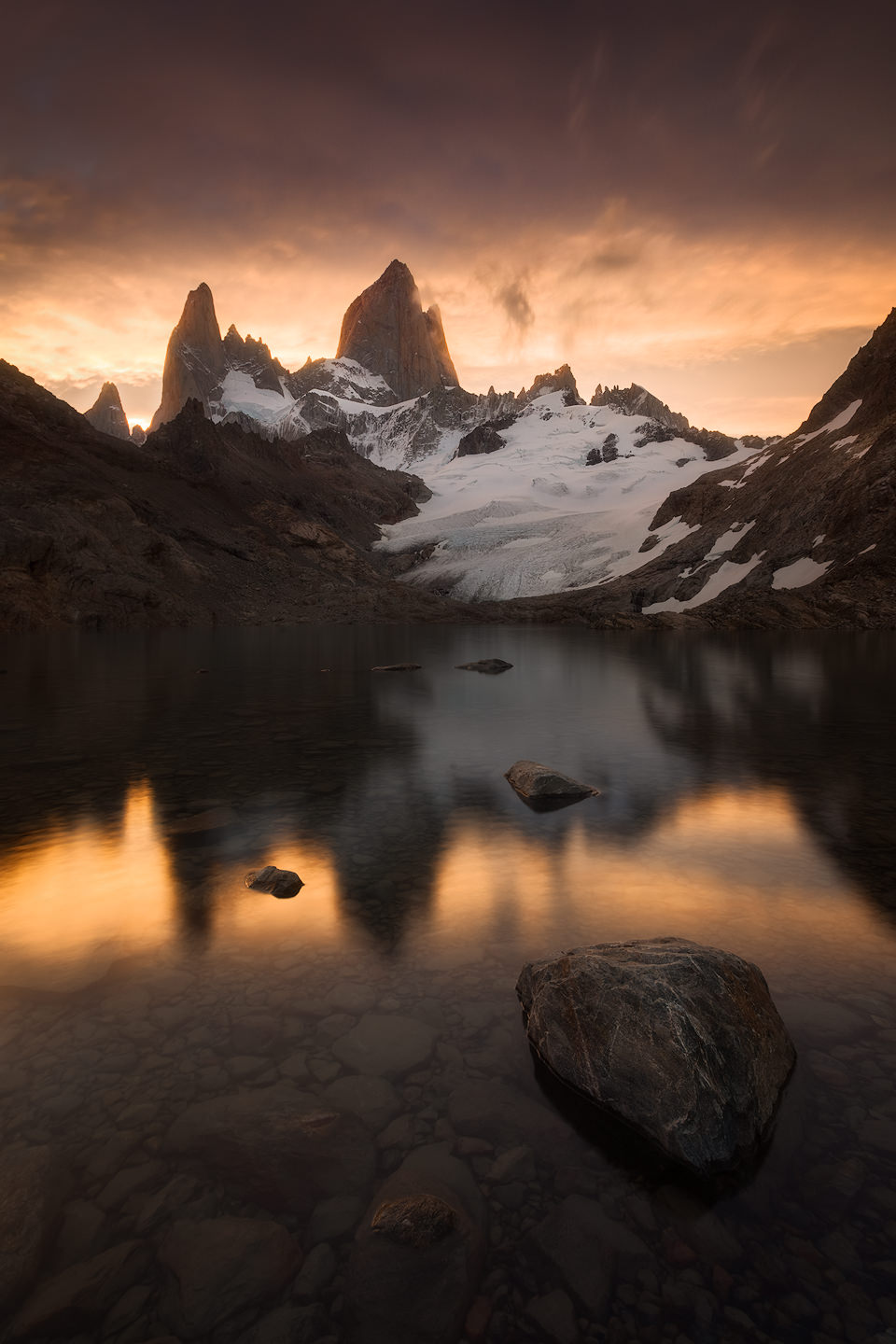
Laguna de los Tres sits beneath Fitz Roy’s east face, and that single fact decides almost everything about photographing it. At sunrise the granite takes the light head-on and turns red for less than a minute — the frame everyone knows, the one that put this lake on every poster of Patagonia. At sunset the sun drops behind the massif instead, and the mountain does the opposite of what you came for. It goes dark.
I was there at sunset, in February 2011, on my first trip to Patagonia. My first time at the lake, walking the classic three-day circuit out of El Chaltén, with no real expectation beyond wanting to stand in front of it.
At 1,170 metres, the lake is close enough to Fitz Roy that from the shoreline you are looking almost straight up. Laguna de los Tres is the most photographed viewpoint in this part of Patagonia and it earns every frame — but nearly all of that attention arrives at dawn. By late afternoon the traffic thins out. The place belongs to whoever is still standing in it.
I came up from Campamento Poincenot carrying camera gear and one warm layer, passing a steady line of people walking down. The wind that had pushed at us all day had fallen to almost nothing and it was unexpectedly warm for the hour. By the time I reached the water there was hardly anyone left.
I worked along the shore rather than shooting down from the moraine. The lake was low and clear enough that the stones on the bottom came through the shallows, and boulders stood out of the surface at useful intervals. I set the tripod low and close to the water and built the frame around the largest of them — near enough to read the cracks in it, angled so the smaller rocks behind ran back toward the mountain.
Then the light arrived, and it arrived backwards. The sun went down behind the range, so it never touched the east face at all. What it lit instead was everything around the mountain: the cloud overhead, the sky along the horizon, the whole western half of the atmosphere. Fitz Roy stood in front of that and gave up its detail — no longer granite, just an outline with the sky burning behind it. The lake returned the entire scene, doubled and slightly softened, the reflection running down through the shallows to the stones at my feet.
I stayed well past sunset and walked down in the dark. Then I filed the images without much conviction.
Three Years in the Archive
It has become a habit to go through the archive from time to time. I have never been able to tell whether I do it to relax or to find something — and whichever one I set out to do, I usually end up doing the other. This time was different, because this time I knew what I was looking for.
In 2014 I went in to find a submission for Memorial María Luisa, a landscape photography competition in Asturias. The Fitz Roy reflection came to mind almost immediately. I remembered the evening, and I remembered the file.
I had already processed it once, back in 2011. I was quite a rookie then — not just limited in what I could do to a raw file, but limited in what I could imagine doing to one. My whole idea of a good landscape photograph lived inside a colourful-clouds-box. If there was colour in the sky, the job was to get all of it onto the print, as much as the file would surrender. I processed it that way and called it Fitz Roy on Fire.
That version was not a failure. It went on the cover of issue #7 of Landscape Photography Magazine — which, looking back at it now, still surprises me.
What the Reprocessed Version Left Out
The crop was the first thing I checked in 2014, and the only thing I did not change. The frame was already right — the boulder, the stones under the surface, the mountain sitting where it needed to sit. Rookie or not, 2011 had got that part done.
Everything else came apart.
The first version shows you the whole evening at once. The sky runs through blue and magenta and flame in separate bands, each holding its own. The glacier below the towers is a vivid cyan. There is detail recovered in every face of the rock, lifted out of the shadows because it was in there and because I could get it out. Nothing is withheld. It is a photograph made by someone who was afraid of losing anything.
The second version gives most of that away deliberately. The rock drops almost to silhouette — the detail I had worked so hard to recover in 2011, let go on purpose. The glacier falls from cyan to a flat grey. The sky stops competing with itself and commits to a single register: deep burgundy at the top, burning down to orange along the horizon.
Less is visible. More is there.
That was when the name changed. Fitz Roy on Fire is a photograph about a sky. Rise of the Dark Knight is a photograph about a mountain — and Fitz Roy is a shape you recognise without needing to see a single detail of it.
Learning What to Leave Out
I do not think the second version works because I had acquired better tools. Almost everything I did in 2014 was subtraction, and subtraction is not technically difficult. What had changed was that I finally knew what I was willing to lose.
Somewhere between those two edits I stopped treating a raw file as a container of information to be fully extracted, and started treating it as material. The question moved from what is in here to what is this photograph about. Those two questions produce very different pictures from identical data.
Both versions found an audience, which complicates the story in a way I have come to like. The 2011 edit got a magazine cover. The 2014 edit came back from Asturias with an honourable mention. Two juries, three years apart, responding to what were effectively two different photographs — and both of them live on the same hard drive. I am not going to claim the second one is the objectively correct answer. But I know which one I would print now, and I know exactly why.
That is the real use of revisiting old work. It is not about rescuing photographs. It is a way of measuring what has changed in you, using something that cannot change as the ruler. The file from that evening is exactly what it always was.
Everything else moved.
Is there a file in your archive you have processed twice — and preferred the second version for reasons you could not have explained at the time? Share it below.
Landscape photographer
Vienna, Austria
Comments