
Right Angles on the Wild Coast
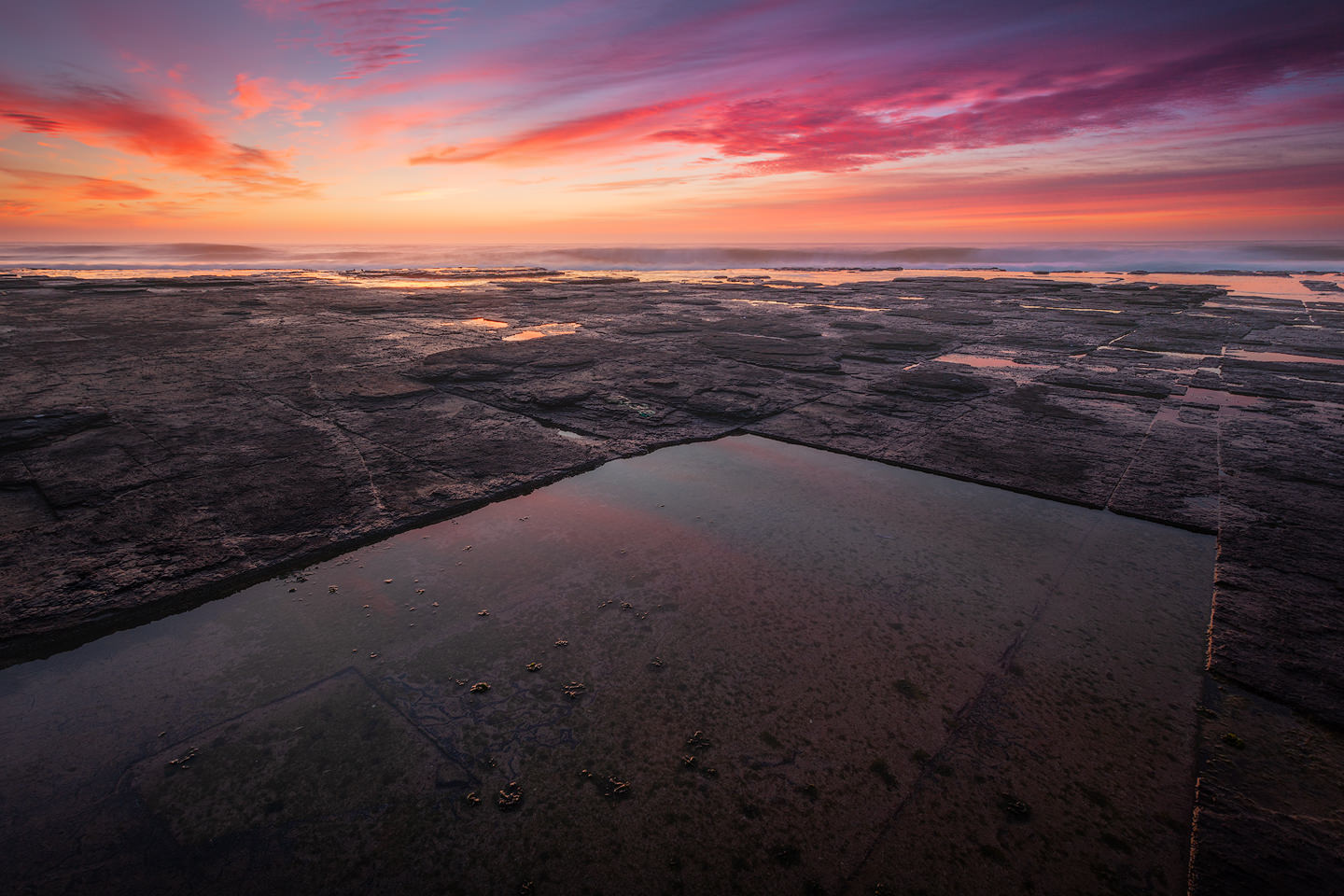
Before the trip I spent time looking for images of Dwesa Nature Reserve. There were almost none. A handful of photographs showing rock formations I’d never seen anywhere else — perfectly aligned tiles of black stone, parallel cracks and ninety-degree angles, some tiles missing as though pried from a floor. All of it close enough to the shore to flood at high tide.
That was enough.
I was travelling with friends on a six-week trip through South Africa. We had come from the Drakensberg and were heading south along the coast. Dwesa was my addition to the route — a planned detour nobody else had heard of or particularly wanted to make. The kind of photography-driven side trip that requires quiet insistence and a willingness to be the one navigating.
Dwesa Nature Reserve sits on the central Wild Coast in the Eastern Cape, between the Indian Ocean and the rugged farmlands of the former Transkei. Coastal forest, open grassland, winding rivers — and a coastline very few photographers have worked. Getting there is the first test. From the main road a small dirt road winds into the hills — seventy kilometres of gravel through countryside that has no reason to hurry. We passed through what felt like dozens of villages, small communities of rondavels and square houses, children running alongside the car, cattle settled in the road with the road as much theirs as ours. It took three hours. Way more than expected.
We arrived at the park gate with the sunset already underway — visible, just, through the window of the ranger’s office while we filled out paperwork. Dwesa works at its own pace. By the time we were through, the light was gone.
I knew we had to leave the next morning to continue south. If there’s one thing I dislike about photographing landscapes while travelling, it’s that too often the travel schedule takes control. Sometimes I’m forced to move on from a location I feel I’m not finished with. This time, I hadn’t even started.
The Rock Formations at Dwesa Nature Reserve
The next morning I was up before dawn. The sky was already building colour by the time I reached the shore.
The rock formations were more striking in person than in any photograph I’d found online. The shore platform at Dwesa is made of dark grey to black sedimentary rock, roughly 280 million years old, laid down on the floor of an ancient sea that once covered this part of Gondwana. Over geological time, two sets of stress fractures formed perpendicular to each other through the bedrock — orthogonal joints, running at precise right angles. The sea has been eroding along these joint lines ever since, cutting the platform into rectangular blocks. Some intact. Some broken. Some missing entirely, leaving pools where tiles once were. The geometry isn’t imposed by the water. It’s revealed by it — the rock’s internal structure, made visible by a few hundred million years of waves.
At low tide the platform stretches out like a vast, uneven floor — black tiles with sharp edges, water caught between them, reflecting what the sky offers. At high tide half of it disappears.
That morning, the sky offered everything. Colour flooded the horizon and the rock caught it — warm light pooling in the gaps, orange and pink reflected between the black edges of the tiles. I moved along the platform, finding new angles as the light shifted. The rock was wet — easy to slip. But wherever I looked the compositions kept appearing: straight lines, right angles, the hard edge of stone against standing water. Not a landscape you need to search for. The structure is there, insisting on itself.
I came away with a few keepers. But even as I was working I knew that I was seeing a fraction of what this coast could give under different conditions — different tides, different weather, different seasons. One morning is not enough for a place like this.
Why One Morning at Dwesa Isn’t Enough
That is the particular frustration of photographing a place on someone else’s schedule. You arrive, you see enough to understand what’s there, and then you leave knowing you barely started. The single morning I spent at Dwesa gave me one sunrise, one tide level, one set of conditions. The rock formations alone would need days — different light, different water levels, the geometry changing every few hours as the sea covers and uncovers the platform.
There is a pattern to places like this. The ones that are hardest to reach tend to be the ones that ask the most of you — but only give to those who return. The dirt road through the hills, the three hours of gravel and villages, the slow pace at the gate: all of it is a filter. It keeps the coast quiet. It keeps what’s there something you have to earn.
Dwesa is still on my list. Not because the images I came away with weren’t good enough — they were. But because I know I only touched the surface of what that coast holds. And a place with formations like these, shaped by forces older than anything I can properly imagine, deserves more than a single morning.
Have you ever pushed for a detour nobody else wanted to make — and found it was worth the argument? Share your story in the comments.
Landscape photographer
Vienna, Austria
Comments