
The Road to Piedras Rojas
Interaction with other human beings had been limited for the past eight days. We were going south on isolated roads alongside the Chilean-Bolivian border. We passed few trucks carrying their heavy loads, blowing huge clouds of black smoke, some of their drivers raising a hand to greet us. We bought coca leaves from an old woman selling goods on the plaza of an otherwise lifeless pueblo high in the Andes. And we handed worn bills to men selling fuel from big blue barrels in the backyards of their small houses. Only few words were exchanged. The Altiplano is a quiet place.
After more than a week of this — the thin air, the empty roads, the slow rhythm of days measured by light and distance — we arrived in San Pedro de Atacama. The small streets were alive with tourists, many of them wearing knitted hats with llamas. Most seemed busy, rushing in and out of souvenir shops or looking for restaurants. The atmosphere was posh and we were clearly sticking out. We wandered slowly, without destination. Our clothes were dirty and our bodies smelled of sulphur from a bath in muddy thermal waters two days earlier.
It was on the corner of one of the adobe buildings that I spotted a poster pinned to a wooden board belonging to a tour agency. The sun-faded paper was wrinkled around its borders. It showed a bright sky, turquoise and unreal, above what seemed to be a field of red rocks. The sign next to it read: Piedras Rojas — ½ Day. I took a mental note and looked it up later. The next morning we restocked supplies and left the town behind.
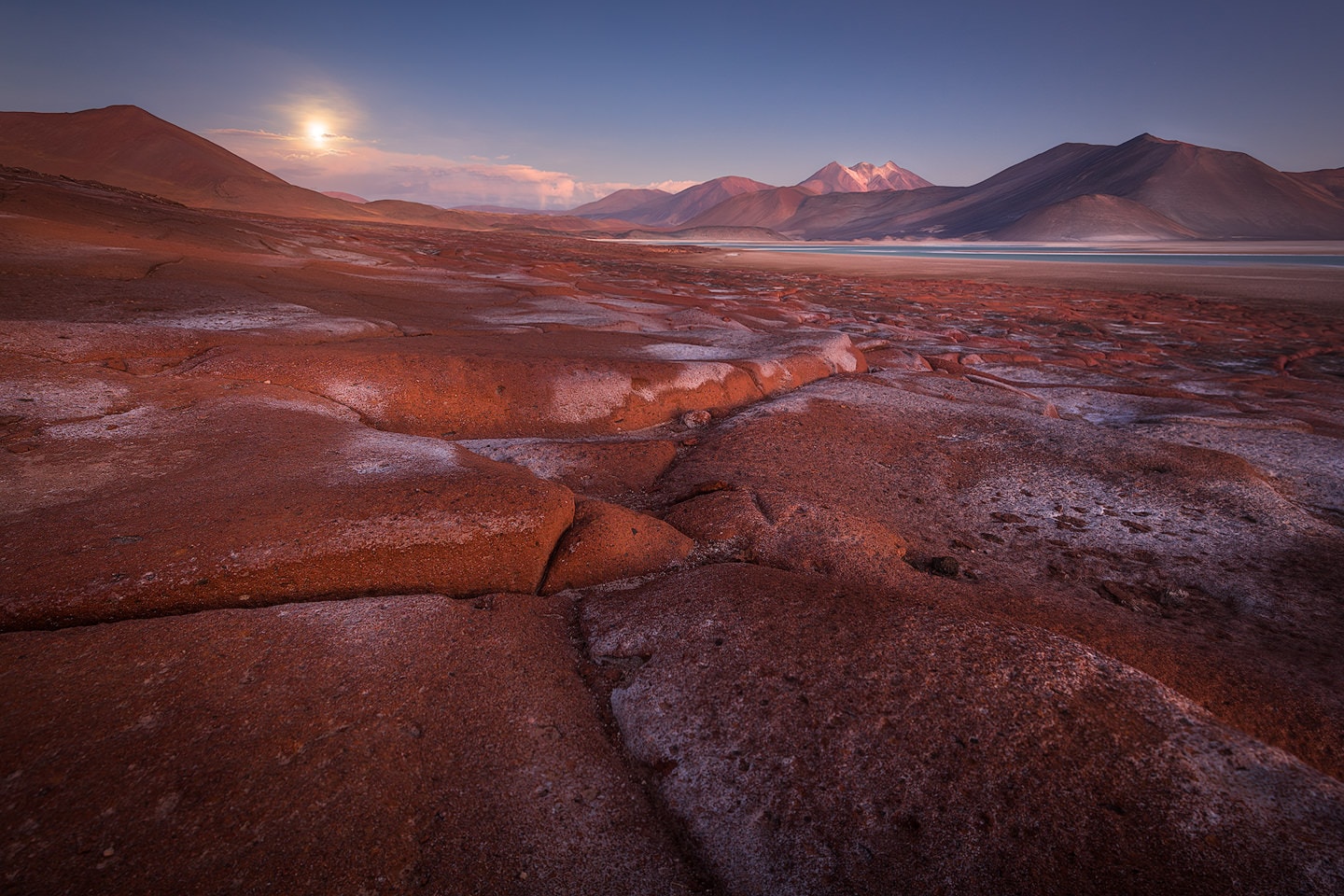
Piedras Rojas sits at roughly 4,200 metres, on the edge of a salt lagoon in the high Atacama. The rock is volcanic — iron-rich lava oxidised over millions of years in the driest air on earth, stained deep red by the process. Up close, the formations are softer than you’d expect. Rounded, porous, cracked in long curves that look more drawn than broken — as if the stone had been shaped by something patient rather than something violent. The surface gives the impression of something organic, almost breathing, though it is hard rock, cold to the touch.
Against the red, the lagoon is absurdly turquoise. The water holds its colour from concentrations of salt, gypsum, and halite — minerals that have no business looking this vivid at this altitude. The contrast between the two is the kind of thing that looks manipulated in a photograph but is quieter in person. More still. The silence at 4,200 metres has a particular weight to it. Sixty percent of the oxygen you’re used to. Every step deliberate.
Full Moon Over Red Stone
We had arrived with time to spare, and I’d been hoping for a sky that would match the foreground — something dramatic above the red rocks. The sunset came and went without much to show for it. A bland sky, fading light, and the slow realisation that the photograph I’d been composing in my head was not going to happen. The last tour vans had left a while ago, making sure their passengers would reach San Pedro de Atacama before dinner. The remaining footprints in the dry gravel were the only proof they had ever been here.
And then the land fell quiet in a way that changes something. The familiar hiss of our gas stoves was the last acoustic reminder of the civilised world. With a turn of a knob, it disappeared. We sat and ate, and while we did, the full moon rose above Piedras Rojas.
I hadn’t planned for it. The decision to stay was not really a decision — we were sleeping in the car up there, in the middle of nowhere, with nothing else to do. But that is exactly the point. On a half-day tour, you leave before sunset. You never see the moon come up over the red stone. You never hear what this place sounds like when everyone is gone.
The moonlight changed the rock. What had been deep red in daylight turned muted and cool, the shadows sharpening the curves and cracks I’d spent the afternoon studying. The turquoise lagoon went dark and still. I set up the camera and worked quietly, the only sound the shutter and the wind.
After the Last Van
There is something photography has taught me that I haven’t fully worked out yet. I feel good out there — in the wild, in the silence, in the places where the nearest person is a day’s drive away. Not the kind of good that comes from achievement or comfort, but something more basic. A settling. The noise of ordinary life drops away, and what’s left is clearer.
I don’t know if I sought out remote places because of photography, or if photography gave me a reason to seek them out. Probably both. What I do know is that the photographs I value most — the ones that feel honest — tend to come from the moments I wasn’t trying. The moments I was simply there, with nothing else to do, and the place offered something I hadn’t asked for.
Piedras Rojas gave me a moonrise on an evening I’d written off. That felt about right.
Have you ever stayed somewhere long after the plan ran out — and found that was when the place finally showed itself? I’d love to hear your story in the comments.
Landscape photographer
Vienna, Austria
Comments