
Monte San Lorenzo and Laguna de los Témpanos
Before the trip I spent time trying to find information about Monte San Lorenzo. There was almost none. A few expedition reports from climbers. A handful of photographs that told me nothing about what the approach looked like or what I might find at the base. The mountain had a reputation among serious alpinists for its east face — nearly 2,500 metres of granite and glacier, largely unclimbed — and almost nothing else. No photography guides. No trail reports. No sense of what the landscape around it looked like from the ground.
That gap, I’ve learned, is its own kind of signal. A place with no information is a place almost nobody goes. Which is a different thing from a place that isn’t worth going to.
I was travelling with a friend — the same one who has a reliable habit of making fun of my photography ambitions, which keeps them proportionate — and in late March 2012 we drove west through Parque Nacional Perito Moreno, one of the least visited national parks in Patagonia. The plan was to reach Monte San Lorenzo. Specifically, a glacial lake at its base called Laguna de los Témpanos — the Lake of the Icebergs.
Into the Valley
We started from the ranger station at El Rincón, spending a night there among a herd of guanacos that had no particular opinion of us. The next morning we headed north into the valley of the Río Lácteo. The path disappeared quickly. We pushed through swampy grassland, boots sinking into reddish-brown mud, following the valley rather than any trail, until we reached a small wooden hut known as Puesto San Lorenzo.
The hut had served for years as an isolated border post and still did the work of a base camp for climbing expeditions heading toward the mountain. It had the atmosphere of a place that accumulates time. The smell of wood and old fires. Makeshift shelves holding food and utensils that could have been left two weeks or two centuries ago. A visitors book stuffed with notes from climbers and trekkers who had come this way and felt compelled to leave something behind. We crossed the Río Lácteo just a few steps from the hut — knee-deep in glacial meltwater, in late March, with full packs — and continued up the valley without a trail to follow.
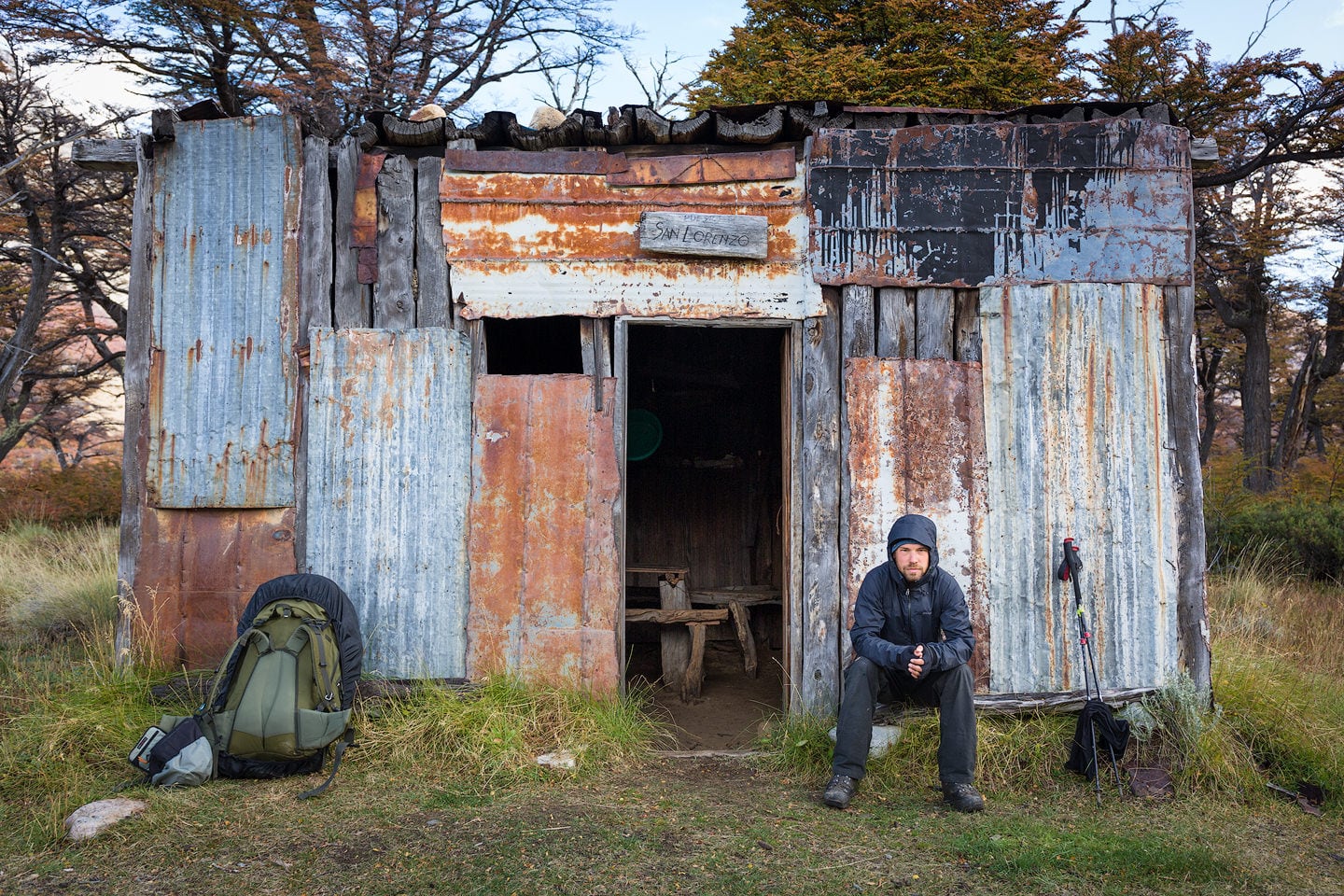
Since publication, the land previously managed by Conservación Patagónica has been incorporated into Parque Nacional Perito Moreno. Infrastructure has been carefully developed — new huts now stand along the route. The spirit of the place is unchanged.
There were no footprints. No markers. The valley was wide and flat and shaped entirely by ice — scattered boulders, open sky, the east face of San Lorenzo growing ahead of us. By the time we made camp at the edge of Laguna de los Témpanos, a gale had built behind the mountain. We weighted the tent down with what felt like half the valley in rocks and waited.
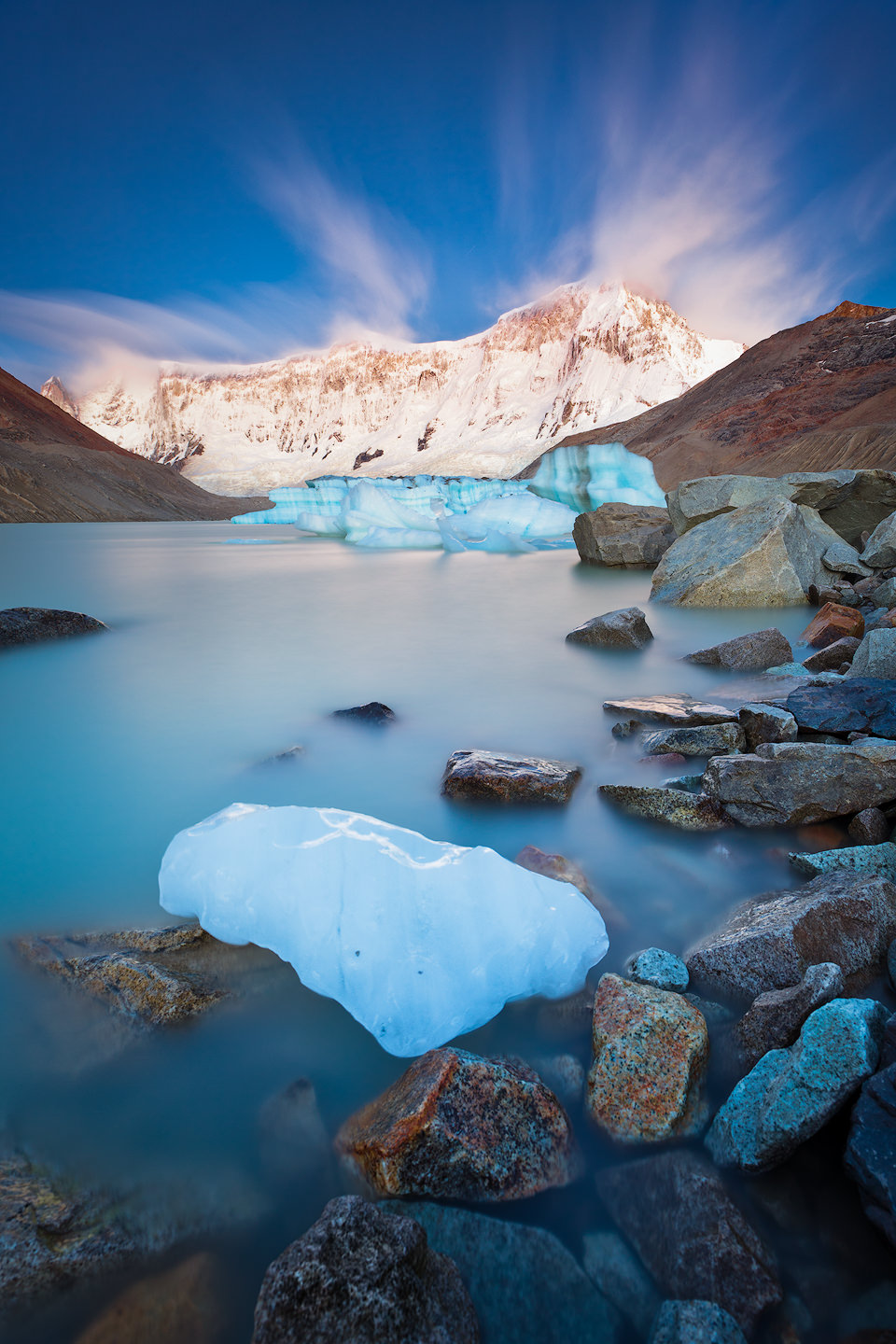
When the wind dropped, I walked the shore of the lake. The icebergs were enormous — some the size of small houses, drifting slowly in the grey water, others broken into smaller pieces that had been pushed onto the rocks along the beach by the night’s wind. I found one I wanted. Shiny, compact, its glassy surface catching light from every direction. I made a note of where it sat and went back to the tent.
Four Minutes
I was up before dawn. The gale had cleared the sky completely. The ice block was where I had left it.
I set up at low angle, placing the ice prominently in the foreground and Monte San Lorenzo’s east face — still in shadow — filling the frame behind it. As the light built on the upper mountain, the granite and glacier began to warm: pale gold at first, then briefly something richer, before the sun climbed above the cloud layer that was forming again and the moment ended. The exposure ran for four minutes. The wind was still strong enough to pull the clouds into long smears above the summit. The surface of the lake smoothed in the long shutter. The ice block held still.
The image is about contrast — the cold blue of the lake and sky against the warming rock, the clean white of the ice against the dark foreshore — but what I remember most about making it is the quiet. After the night’s gale, the valley was completely still. Just the sound of the shutter opening and some small ripples splashing.
Where Nobody Goes
There is a version of landscape photography that runs on reputation — the places everyone photographs, the known viewpoints, the images you have already seen before you take them. That version has its own logic and its own rewards. But there is something that it cannot give you, which is the specific feeling of standing somewhere that very few people have stood. Not because it is difficult or dangerous, but simply because it is far from any map that matters to most people.
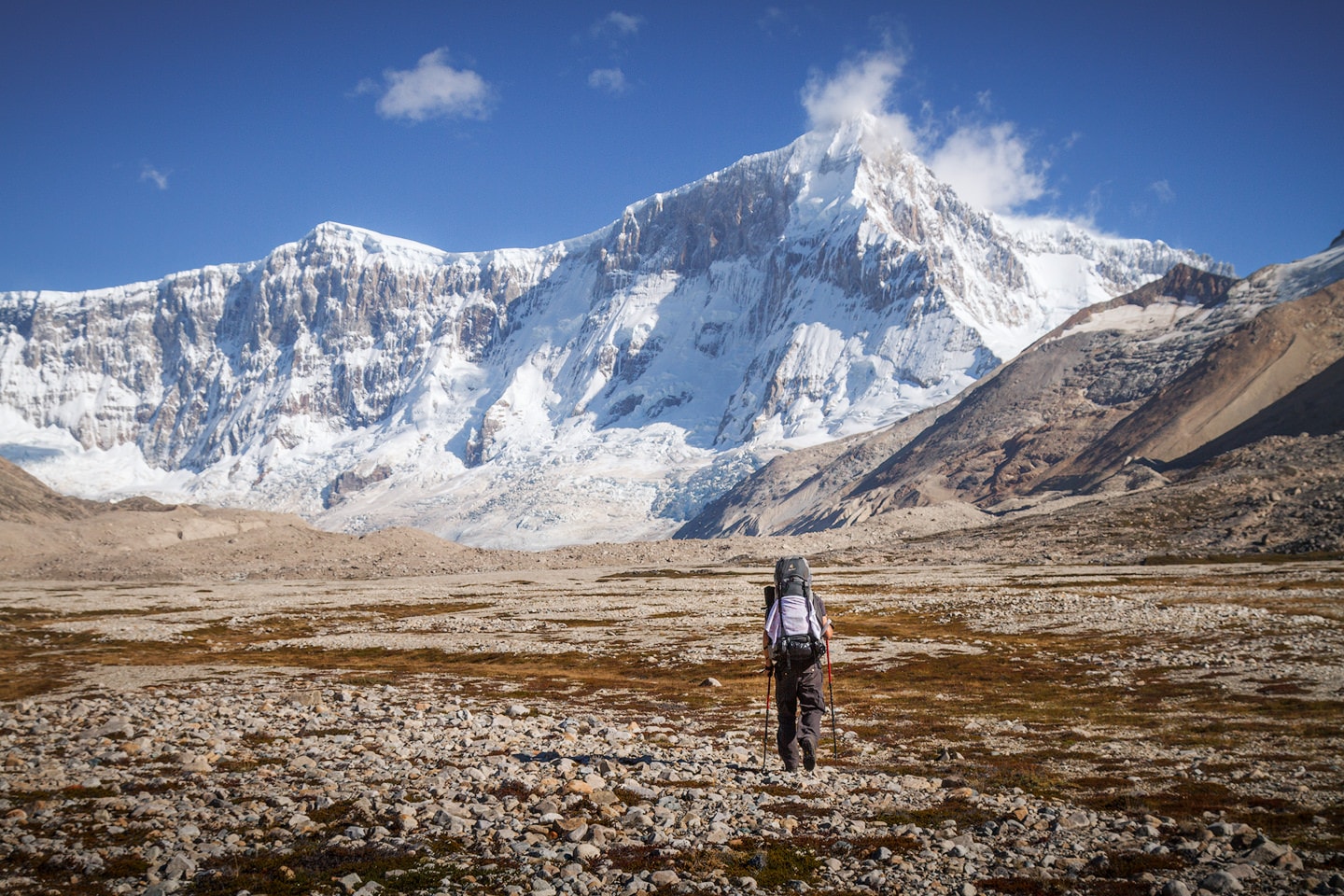
The information gap I found when researching Monte San Lorenzo was not a warning. It was the point. Places where the absence of information is itself the signal tend to be places where the landscape is still doing what it does without an audience. The ice on the shore at Laguna de los Témpanos had been moved there by forces that had nothing to do with us. The icebergs were there for the same reason. We were simply present — which, in a place like that, is the whole of the work.
Have you ever gone somewhere specifically because you couldn’t find much information about it — and found that was exactly the right reason? I’d like to hear about it.
Landscape photographer
Vienna, Austria
Comments