
Red Light on Granite
Getting to El Chaltén took longer than we thought. The bus from El Calafate arrived late at night — hours after I’d had my first glimpse of Fitz Roy through the window, sharp against the horizon, closer than anything I’d expected. We still had to find a room. We ended up in a small hospedaje — I don’t remember the name — sharing with another couple.
The next morning we got up early to organise. A tent. Food. A better place to stay. El Chaltén turned out to have more than we’d anticipated: a few places with genuinely good food, and even a shop with exquisite wines and homebrewed beer. It was the first visit for both of us, and we had three days of trekking around El Chaltén ahead through Parque Nacional Los Glaciares — but first I wanted a sunrise.
We spent the afternoon scouting the village’s surroundings. Mirador de los Condores sits above El Chaltén, maybe forty-five minutes on foot, with an unobstructed view north toward the entire Fitz Roy massif. The granite spires at the end of everything — behind them, the Southern Patagonian Icefield. From the mirador they feel close. We checked the angle, noted the path, and went back down.
The next morning I got up two hours before sunrise. It was cold — the kind of cold that has you putting on every layer you brought — and the village was dark when I left. The trail takes about an hour. In the dark, on an unfamiliar path, it felt longer. I could hear my own breathing and my boots on the gravel. El Chaltén sat below me, quiet, a scattering of lights in windows. No one else heading up.
I reached the mirador well before the light and waited. Fitz Roy was a dark shape against a slowly brightening sky — familiar from photographs, unfamiliar in person. The cold had settled in. There was nothing to do but stand there.
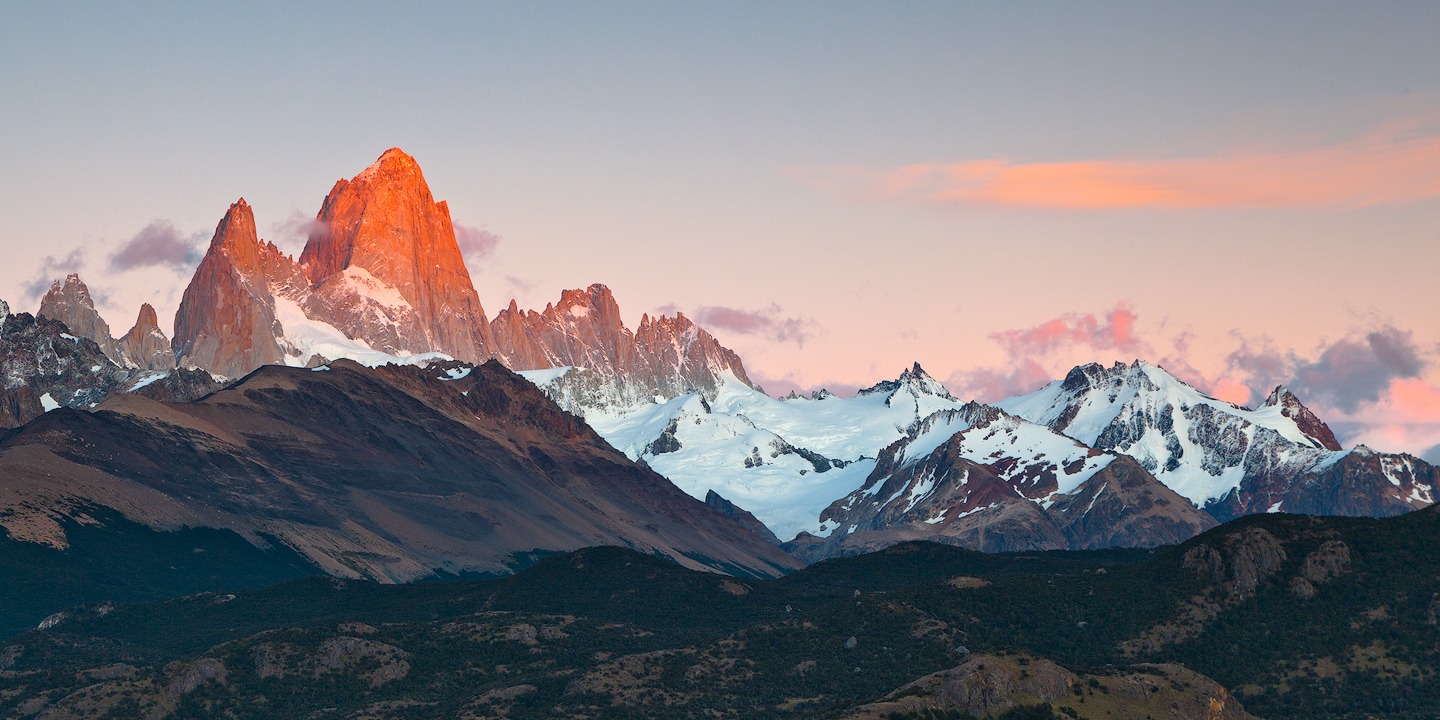
When the first light came, a few clouds were still hovering above the massif. For a few seconds the peak was bathed in red — intense, absolute, then fading. The sun hadn’t cleared the horizon yet, but its light was already arriving, refracted through the atmosphere, the shortest wavelengths stripped away until only the reds remained. A few seconds of colour on granite. Then the mountain slipped back into shadow and the ordinary light of morning took over.
A Few Seconds of Light
I had come to Patagonia expecting the skies I’d studied in other photographers’ work — cloud formations sculpted by the westerlies, storm light breaking through at impossible angles, wind reshaping everything above the ridgeline. The kind of conditions that make this part of the world legendary for landscape photography. That morning offered none of it. Clear sky. No cloud structure. No drama. Just a mountain catching a few seconds of colour before the day settled in.
Alpenglow doesn’t need any of that. It happens when the sun is still below the horizon — light travelling through such a long slice of atmosphere that only the longest wavelengths survive. The mountain catches what the sky won’t carry. It is a quiet phenomenon, independent of the weather a photographer usually hopes for, and it is over before most people have finished setting up a tripod. The window is seconds, not minutes. You’re either in position or you’re not.
Everything that morning — the two hours of cold, the unfamiliar trail in the dark, the waiting — came down to a few heartbeats of red on stone. There is something honest about that ratio. The preparation against the brevity. The commitment measured against a result you cannot control. It says something about what light actually asks of a photographer — not skill, not planning, but the willingness to be there for something that may last only seconds.
I walked back down to El Chaltén with that particular feeling photographers know well: of having been present for something, and of wanting more.
First Steps
I returned the next year. And the year after that.
Over fifteen years El Chaltén became something I hadn’t planned for. I spent months there — close to half a year across visits that grew longer each time. I learned the trails in every season, found viewpoints far from the standard routes, understood slowly how the light on these mountains changes with the angle of winter sun. I got to know the village — the places that serve food late, the bars where climbers and photographers end up after long days on the trail. I photographed Fitz Roy in winter light from places most visitors will never see. I got married there.
What started as a stop on an eight-week trip through South America became the place I return to more than any other.
That first morning at Mirador de los Condores was the beginning of all of it — cold hands, an unfamiliar trail, a few seconds of red light on a mountain I was only beginning to know. I would stand at that mirador many more times over the years, in better light and in worse. But I didn’t understand any of that yet. I didn’t know that some mornings the alpenglow would arrive, and some it wouldn’t, and that both were part of the same relationship with a place.
I just knew I wanted more.
Have you ever arrived somewhere for the first time and only understood later what that place would become? I’d love to hear your story.
Landscape photographer
Vienna, Austria
Comments