
The Bolivian Winter: Light After the Storm
The term Bolivian Winter — invierno boliviano in Spanish — refers to the wet season that affects the high Andes between roughly December and March each year. Despite the name, it reaches well into northern Chile and Argentina. High up on the plateau of the Andes, this season brings afternoon and evening thunderstorms, heavy cloud cover, and occasional snow on the higher peaks. Mornings can be deceptively clear — the storms tend to build through the day and peak by late afternoon.
For landscape photographers, this creates a genuinely complicated situation. The dramatic skies that make the Altiplano so compelling are also the ones that make camping uncertain and close roads without warning. But these same conditions are what make the Bolivian Winter unique. The light that follows a storm — brief, unstable, and often highly colourful — is unlike anything the dry season produces.
Photographing the Bolivian Winter teaches patience in its most stripped-down form: you can’t plan your way out of it. You wait, watch, and stay ready.
Timing matters more than almost anything else during the wet season. Mornings tend to offer the clearest conditions — cloud cover builds steadily through the day, and by mid-afternoon the storms often arrive without much warning. For night photography, the season is largely unforgiving: even a promising evening can close over within an hour, and clear skies become the exception rather than the rule. Adjusting expectations accordingly is not defeat — it’s strategy.
What the Bolivian Winter offers in return is mood, drama, and the volatile light that follows bad weather. The key is mobility and patience. A 4×4 is less a convenience than a necessity: the most rewarding locations are far from any settlement. Being able to stay on location, rather than returning to a base each evening, is what makes the difference between witnessing that light and missing it.
One of the most rewarding spots to put this into practice is Salar de Surire, a remote salt flat in northern Chile’s Altiplano, where the volatile light and dramatic skies of the Bolivian Winter come alive.
Salar de Surire: The Salt Flat at 4,200 Metres
Salar de Surire sits at around 4,200 metres above sea level, in the southern part of Reserva Natural las Vicuñas. Reached only via unpaved roads and far from any settlements, it is one of those locations that takes real effort to access — and rewards that effort accordingly.
For landscape photography, Salar de Surire offers a setting that is both sparse and highly specific. Volcanic plains stretch out toward the horizon, flamingos move through the brine, and on the southern edge of the salt flat, the turquoise hot springs of Termas de Polloquere cut through the muted tones of the surrounding terrain.
The two volcanoes that dominate the horizon — Pukintica and Arintica — are not the famous peaks of the region. They don’t attract the crowds that Licancabur or Parinacota do. But they are present enough to appear, with the salt flat below them, on the back of the Chilean 20,000 peso banknote. In the right light, you understand why.
Forty Litres of Fuel
The Bolivian Winter in the Altiplano was something I had already encountered during my first visit to northern Chile — and learned to respect quickly. At over 4,000 metres, where weather defines everything from movement to photography, February and March bring moisture, instability, and skies that rarely settle. Back then, my hopes of nighttime photography around San Pedro de Atacama were crushed by clouds and rain — and on one occasion, by a hailstorm that caught us somewhere on the Bolivian side of the border. Up here in the high plains, during the rainy season, anything can happen.
The second time I returned to the Altiplano, I came prepared. I had lowered my expectations for clear nights and shifted my focus toward what the Bolivian Winter actually offers — not predictable skies, but the kind of volatile, post-storm light that defines remote places like this. Instead of relying on tours and shared transport, we rented a 4×4 pickup. Tour schedules and a landscape photographer’s plans rarely coincide — and watching the most beautiful light disappear through the rear window of a tour van was a lesson I only needed once.
Being able to drive wherever we wanted, and stop wherever the light demanded, changed everything — including where we slept. We spent our nights mostly at the end of dirt roads, the car parked slightly uphill so that sleeping in the front seat became almost comfortable. This was not glamorous travel. But it was exactly right.
That night, we camped next to the hot springs at Termas de Polloquere on the south-eastern tip of Salar de Surire. I had been here before — a quick stop on an earlier tour visit, long enough to know I wanted to come back and stay. This time we brought a tent, food and no schedule. The plan was simple: sunset, the night sky, and whatever the morning might bring.
Thunder & Lightning in the Altiplano
What the evening had in store was something else entirely. But what it brought first was thunder and lightning.
It’s common knowledge that a car is a relatively safe place during a thunderstorm. It’s less common to be sitting in one at 4,200 metres above sea level with forty litres of fuel on the cargo bed. We were nervous. We sat there for hours — watching heavy curtains of rain sweep across the plain, counting the seconds between lightning and the next clap of thunder. Puquintica and Arintica had disappeared entirely behind the storm. And then — all of a sudden. It ceased to rain.
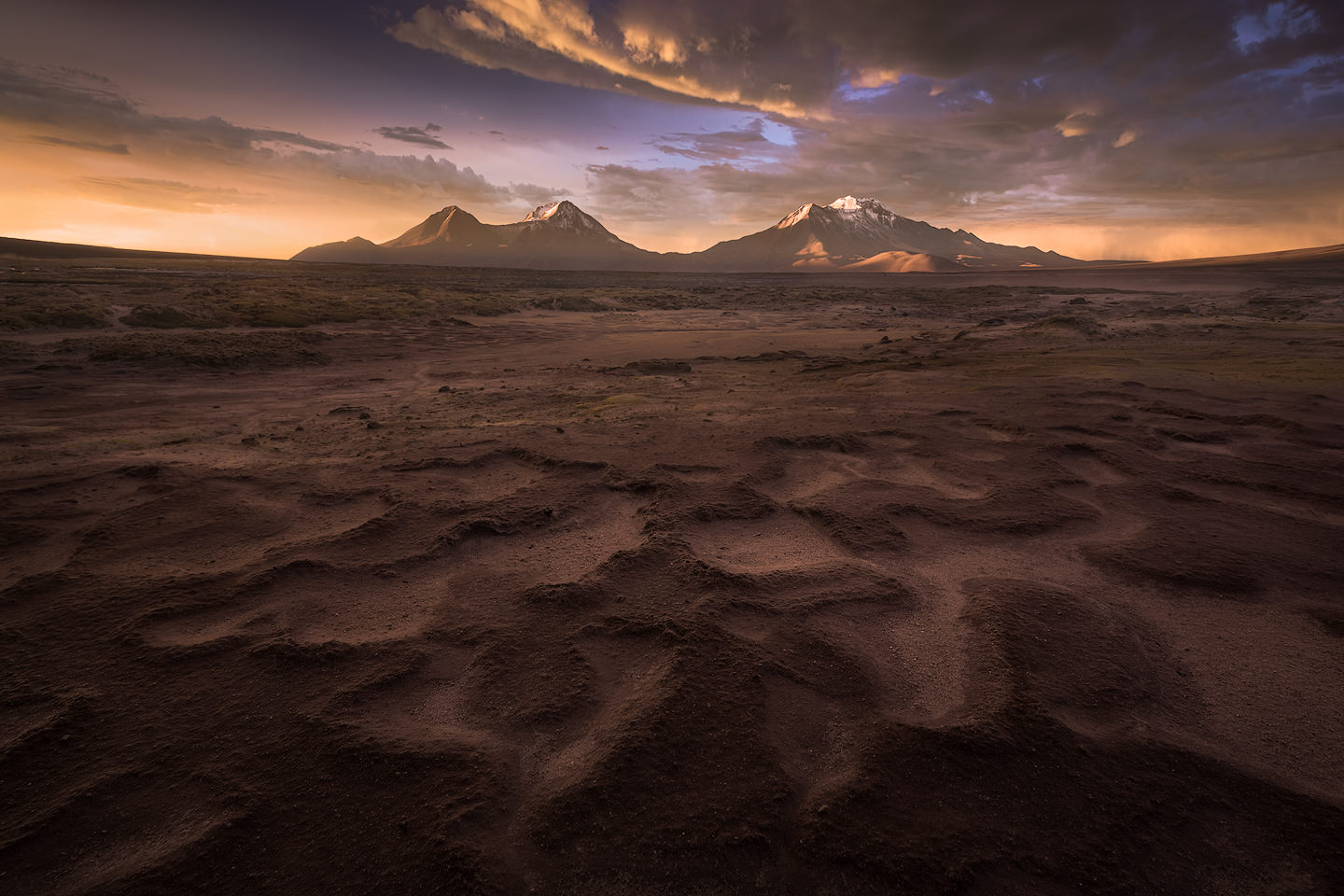
The storm clouds slowly dissolved, moving east, and as the sun broke through, the sky seemed to glow from within. The volcanic plain caught the last warmth of the day. The two volcanoes emerged again, their snow-capped summits glowing against a sky that was still purple and unsettled behind them.
The foreground mattered as much as the sky: the dark, textured volcanic terrain — churned and patterned, almost lunar — absorbed the warm light differently from the sky above. The scene organised itself into layers: the close ground, the salt flat, the peaks rising from it, the sky still carrying the memory of the storm. The light held for close to an hour — not static, but moving through its own progression: gold first, then a deep orange, and as the last of the sun caught the clouds behind the volcanoes, pink and then a quiet purple. I moved around, finding new frames as each shift arrived.
That evening we retreated to the hot springs. The water was warm, the air cold, and somewhere there were beers. We sat there in silence, eventually watching the stars come out above the Altiplano.
To Wait or not to Wait for the Light
Not every storm ends this way. Most don’t. The Bolivian Winter extracts its toll in cancelled plans and evenings that simply go dark without producing anything worth the effort. The light that followed this particular storm was not something I could have earned through preparation or technique — it was something I was allowed to witness because I had stayed.
I’ve written about what I think of as disruptional light — the volatile, fleeting quality that appears when dramatic weather suddenly breaks — in a longer piece about how light shapes landscapes in photography. It is the most unpredictable form light can take, and in many ways the hardest to photograph. There is no planning for it, no positioning in advance. You can only be present when it arrives.
That distinction matters to me. There’s a version of landscape photography built around optimising for the best conditions, choosing the safest windows, eliminating uncertainty wherever possible. And then there’s the version that involves forty litres of fuel and a thunderstorm at altitude, waiting out the weather in the front seat of a pickup truck, not quite sure what the evening will produce.
The image I came away with, The End of All Light, was not planned — but it was not an accident either.
Have you ever waited out a storm for the light? I’d love to hear about it in the comments.
Landscape photographer
Vienna, Austria
Comments