
Arrival in El Chaltén
Getting to El Chaltén took us longer than we thought. Our bus arrived late at night and we still had to find a room. We ended up in a small hospedaje — I don’t remember the name — sharing with another couple. The next morning we got up early to find a better place to stay and organise our trip into the park. El Chaltén provided everything we needed. apart from a tent, we managed to find a few places that offered delicious food and even a shop with exquisite wines and homebrewed beer.
Often referred to as the trekking capital of Argentina, El Chaltén sits at the northern edge of Parque Nacional Los Glaciares. Unlike many mountain destinations, access here is immediate — trails begin right at the edge of the village and lead deep into a landscape dominated by Fitz Roy and Cerro Torre.
What makes trekking in El Chaltén stand out isn’t just the scenery — it’s the unpredictability. Wind, clouds, and light are constantly in motion. Conditions change within minutes, and every hike feels different depending on when you step onto the trail. For photographers and trekkers alike, this creates a rare combination: accessibility and raw wilderness.
A 3-Day Journey Through Los Glaciares
We had planned to walk the classic 3-day itinerary of Parque Nacional Los Glaciares, so we spent the next day organizing food and equipment. Once everything was in place, we started scouting the surroundings of the village for a sunrise location. The easiest viewpoint to reach was Mirador de los Cóndores.
The next morning I got up two hours before sunrise to make it there in time. It was cold and the village was quiet when I left — too early for anyone else to be up. The trail was still unfamiliar, and the dark didn’t help. A skunk crossing my path seemed to be the only other living creature awake, moving through the grass with complete indifference to my presence.
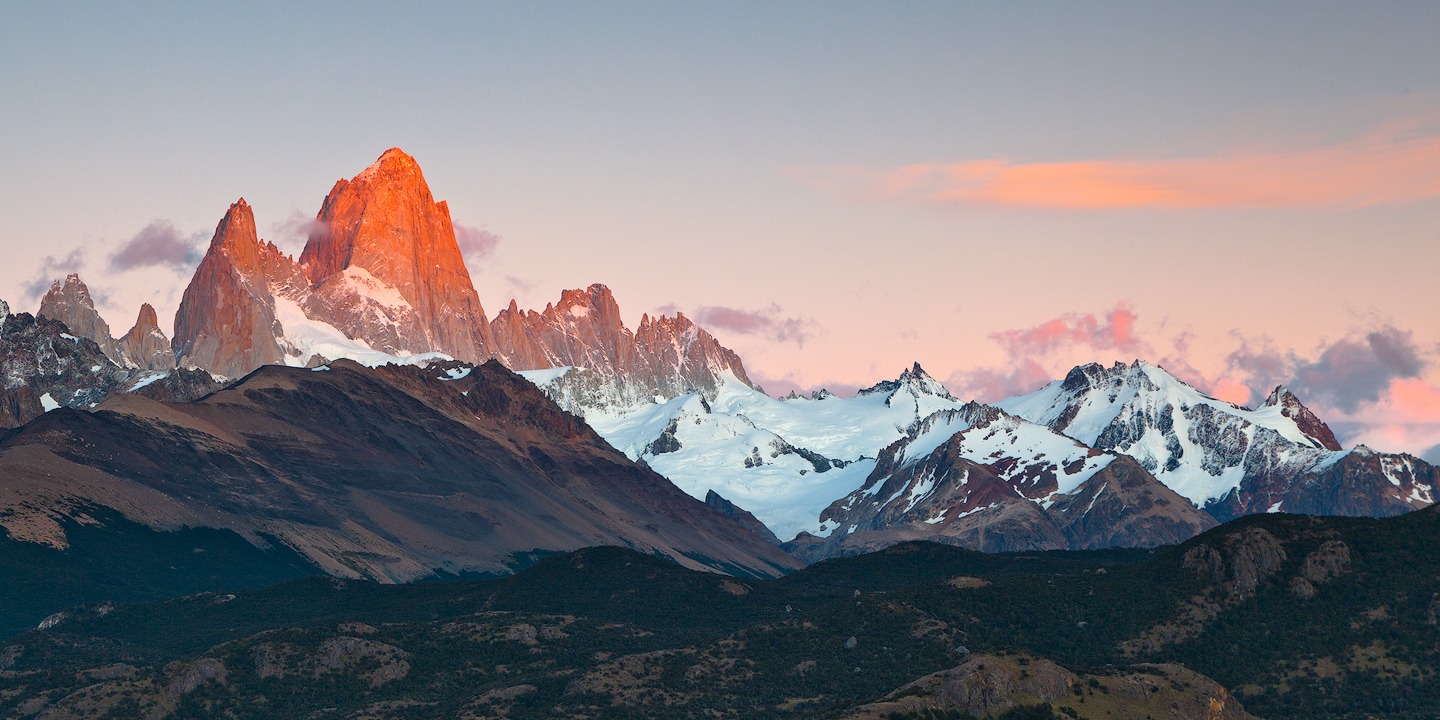
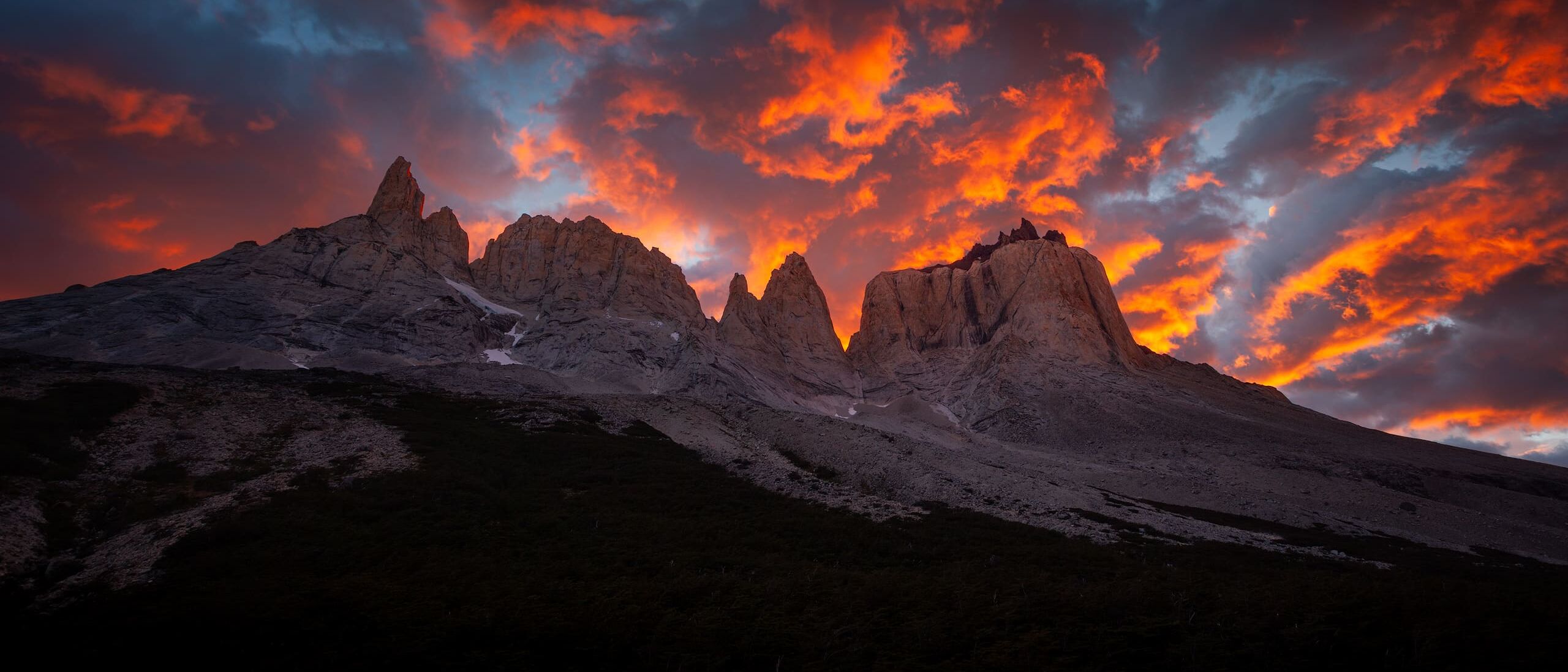
I reached the mirador well before sunrise and set up my camera. The alpenglow on Fitz Roy came and went in seconds — a brief, intense red before the mountain slipped back into shadow. Beautiful, but not quite what I had been imagining.
I walked back down with that particular feeling photographers know well: of having been present for something — and of having wanted more. But I didn’t have much time to dwell on it, and I knew I had 3 days of trekking through Parque Nacional los Glaciares in front of me.
Day 1 — Laguna de los Tres
After breakfast we left El Chaltén for Campamento Poincenot — Fitz Roy basecamp — a three to four hour walk from the village. The first section of trail is steep — genuinely steep, the kind that turns a crowd of enthusiastic trekkers quiet within the first twenty minutes. There’s nothing technically difficult about it, but it asks something of your legs before you’ve had time to warm up. We walked mostly in silence.
When Mirador Fitz Roy finally opened up ahead of us, it was worth every step — the walls and ridges sharp against a clear blue sky, ice catching the light on every face. A stiff wind was blowing and despite the powerful sun it was rather cold, so we hurried on toward the campground. We continued the path until we reached a little stream, Chorillo del Salto, where we stopped again to snap a few pictures. The light was harsh — it was early afternoon — so I decided to go for a black and white conversion, making use of the full tonal range.
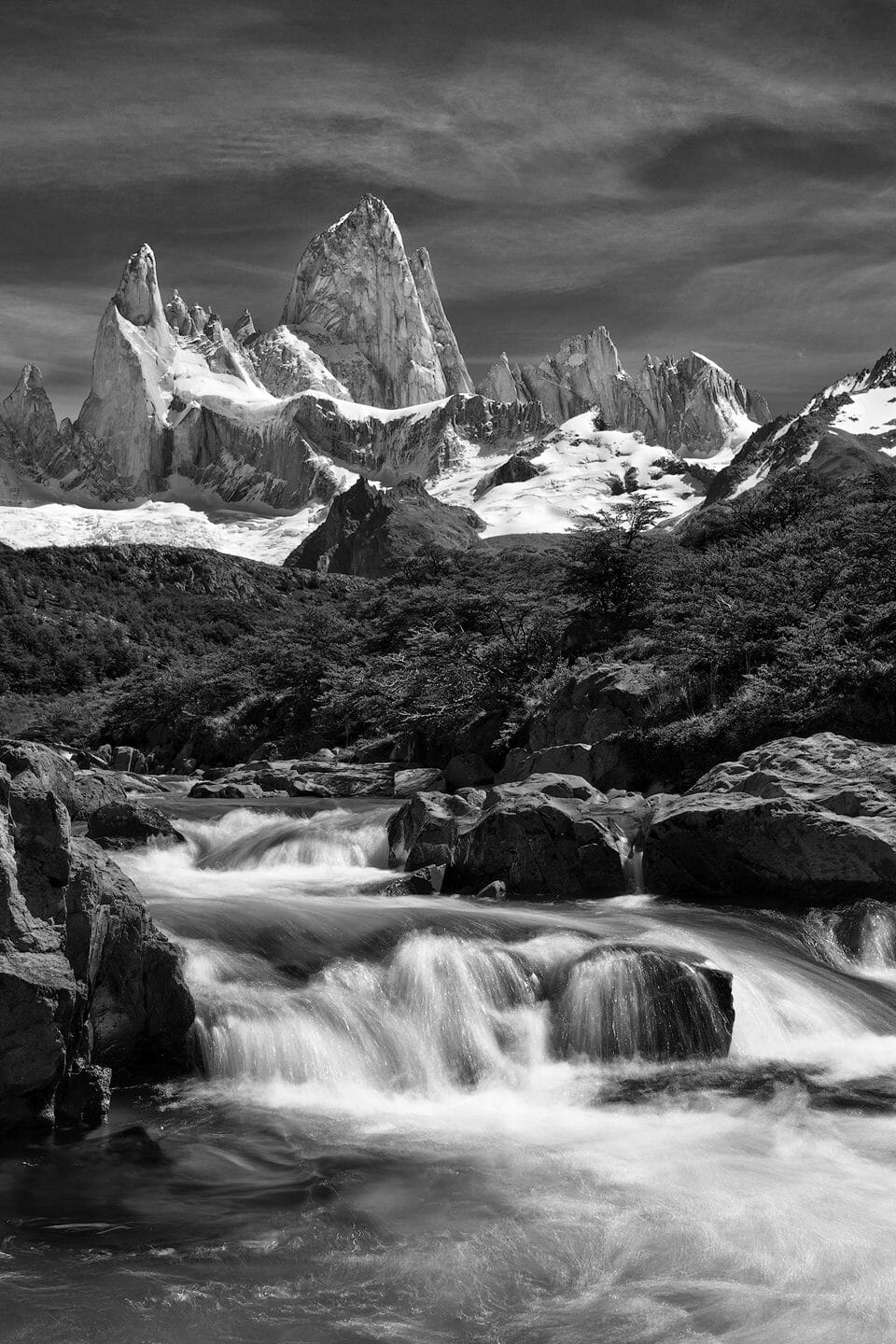
By the time we reached Campamento Poincenot, the initial energy had settled into that steady, slightly tired rhythm that comes with a day on the trail. The forest offered some shelter from the wind, and for the first time since leaving the village, it felt like a place to stop. Campamento Poincenot held more tents than I’d expected — fifty or sixty at least, trekkers from every corner of the world at every level of preparation. I pitched my tent, nodded at my neighbours, and headed up.
The break was brief — more of a pause than a stop — before I continued toward Laguna de los Tres. I crossed the bridge over Río Blanco and continued uphill along the trail. On the way up I passed dozens of people heading down. That feeling — of moving against the current, toward a place everyone else is already leaving — is something I’ve gotten quite used to over the years. It comes with the work. The higher I climbed, the quieter it became again, the hustle and bustle from camp fading quickly behind me.
The trail was demanding — steep, another 400 metres of ascent. With only my photo equipment and something warm to wear, I was dripping with sweat by the time I reached the small lake below Fitz Roy. From there I had a great view of Cerro Fitz Roy and the surrounding peaks. I’d studied photographs of this exact view hundreds of times. Standing there finally, it felt less like discovery than recognition. After a short chat with two Canadians who had decided to spend their night up there, I descended to the shore to set up my tripod.
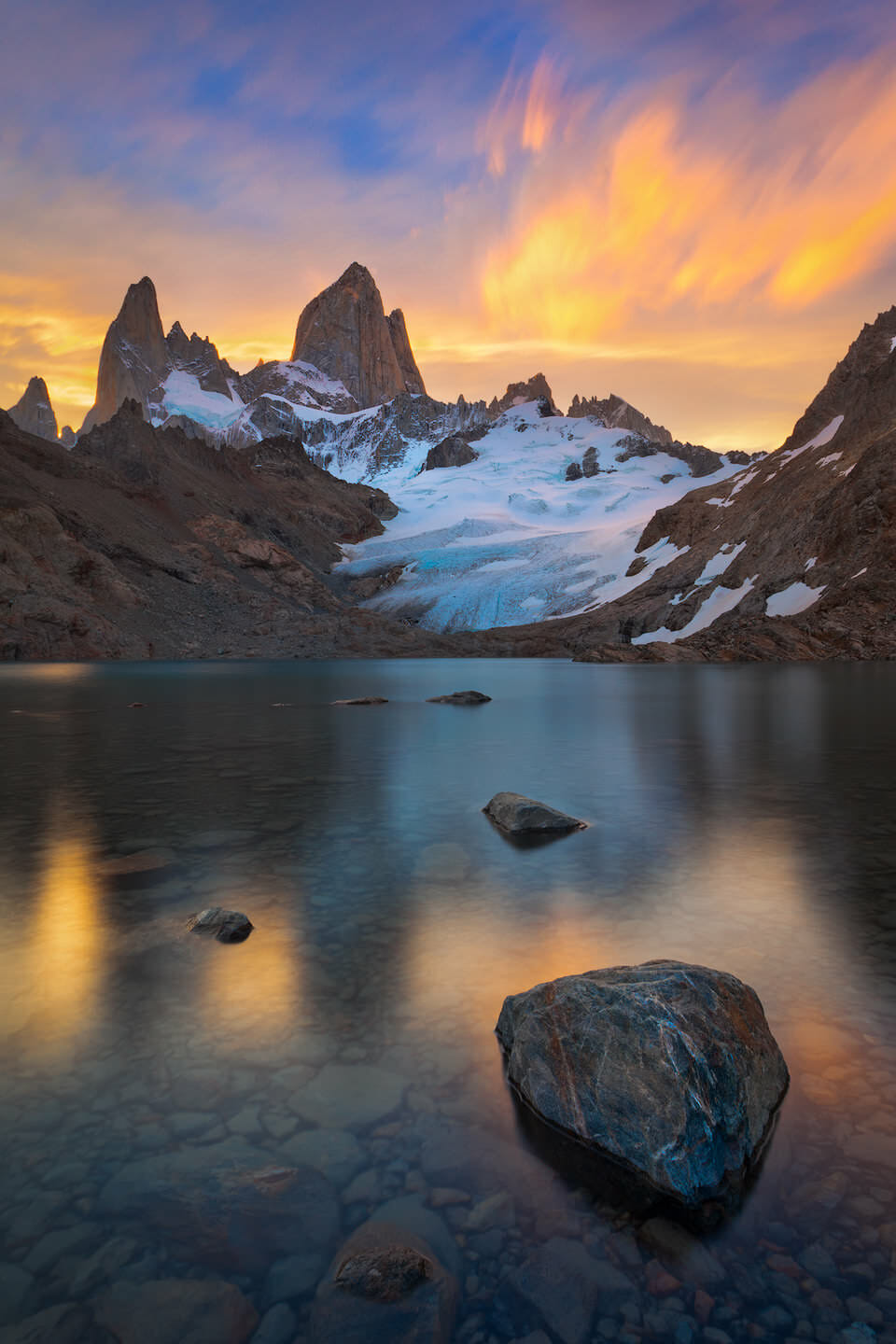
Chaltén, as Fitz Roy was called by the indigenous Tehuelche people, is a peak of 3,406 m and well known amongst climbers all around the world. Not only is it a great mountain to climb — it is also one of the great mountains to photograph. Patagonia’s climate and strong winds are two important ingredients for spectacular cloud formations and sunrise and sunset colours. I was lucky that evening and experienced a great light show. The wind that had blown all day was almost gone and it was unexpectedly warm. I was glad to be alone up there and stayed way past sunset before I returned to camp.
The descent was in the dark. My headlamp lit the path well enough, but what I couldn’t shake was the thought of a puma. It follows me in Patagonia whenever I’m alone on a trail at night — not exactly fear, more a quiet presence at the back of awareness.
By the time I returned to camp later that evening, the quiet of the mountains had been replaced by a more lively atmosphere. Voices carried through the trees, groups gathering around tents, the occasional burst of laughter breaking the silent sound of the trees being shaken by the wind. Nothing excessive, but enough to remind me that this wasn’t quite the solitude I tend to look for. I crawled into my sleeping bag, aware of the sounds around me, knowing that the night might be shorter than planned.
Day 2 — Laguna Torre
The second morning started with tiredness and a low-grade disappointment — I hadn’t made it to Laguna de los Tres for sunrise, and that sat with me through breakfast. But there’s a particular energy in moving toward something new. By the time we left camp, it had taken over. The route toward Cerro Torre is quieter than the Fitz Roy side — fewer people, no real ascending or descending, the trail winding past the twin lakes of Laguna Madre e Hija in a way that feels almost contemplative after all the spectacular views of the day before.
It was windy and rather cold. The sun didn’t come out too many times and the peaks were hidden in clouds. When we finally reached Laguna Torre the weather began to improve, and after we had set up our tent it was sunny. We sat at the shore cooling our sore feet in the freezing water and watching the clouds spin around Cerro Torre. After dinner almost all the clouds had disappeared and I started developing hopes for a nice sunset shoot. I had scouted a rock that would work as an anchor in the foreground and returned there to await sunset.
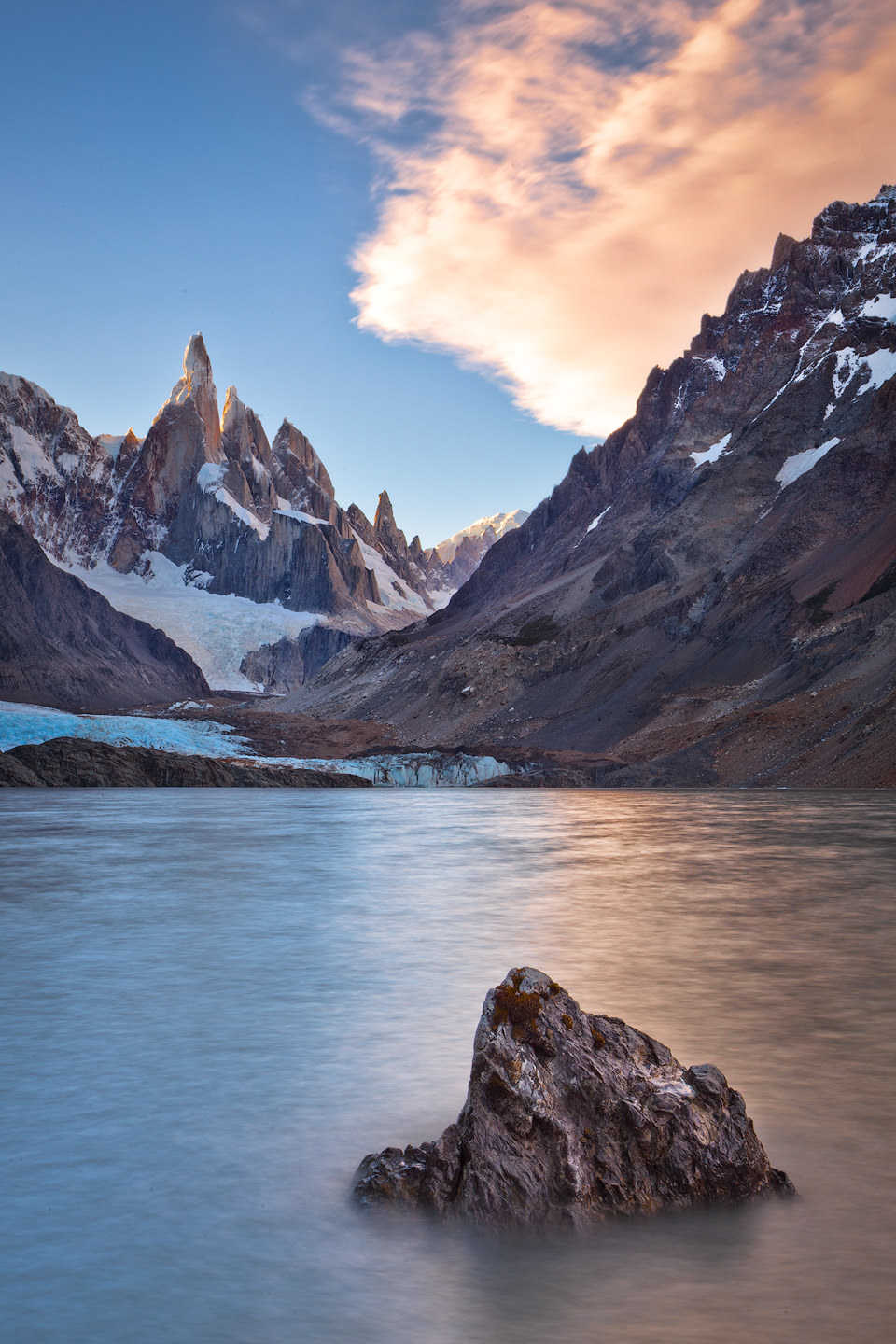
Unfortunately, the cloud framing Cerro Torre wasn’t there to stay. It disappeared within minutes. By the time the sun dropped lower, the sky had cleared completely — unexpectedly so. After everything I had read about Patagonian weather, and after our time on the W-Trek, this wasn’t what I had imagined. We had come prepared for wind, rain, even snow. Instead, there was nothing. No clouds, no movement, no surface for the light to hold onto. It wasn’t what I had hoped for—but it was what was there.
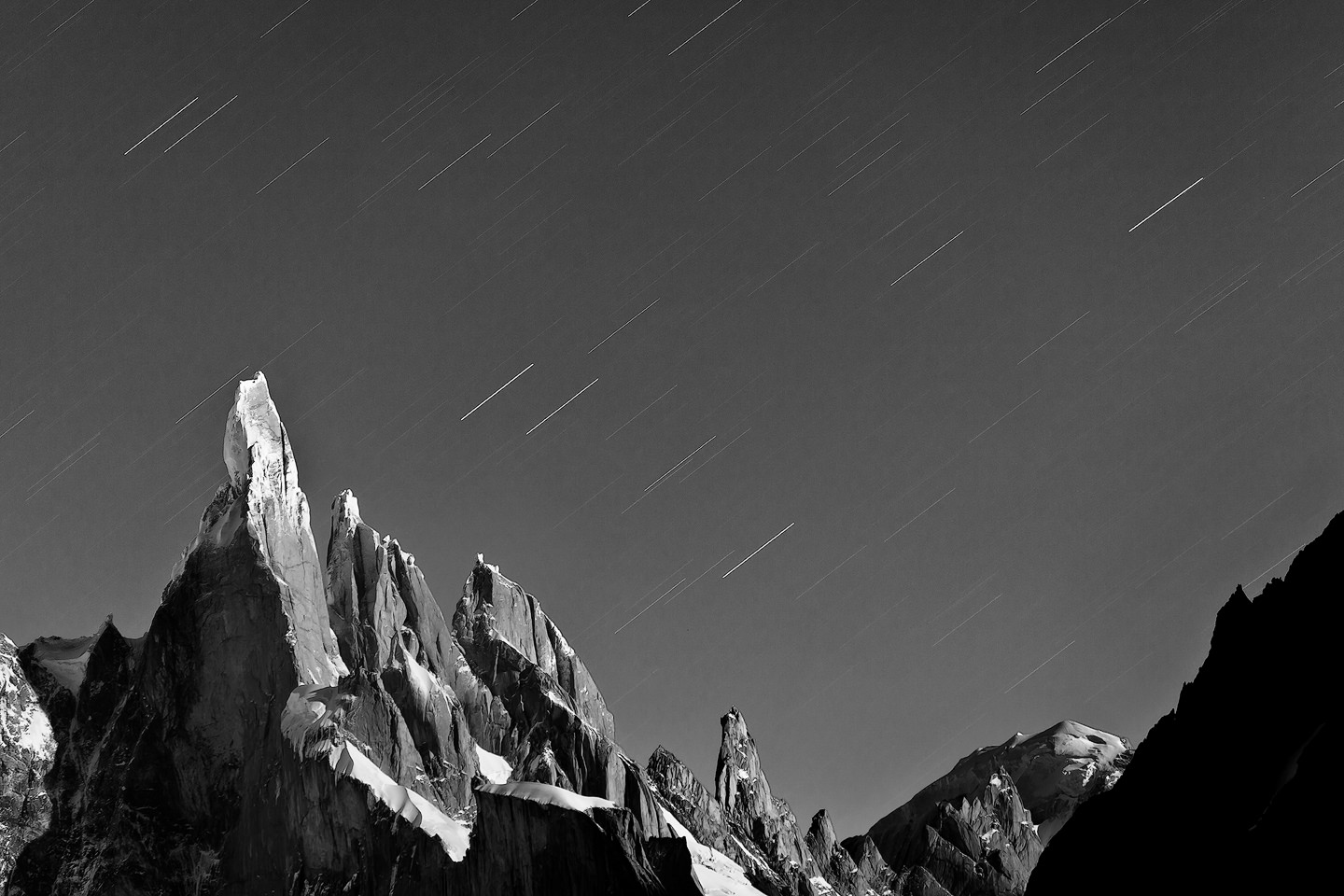
Two hours after sunset I was back outside. That particular photographer’s logic had taken over — you came all this way, you try everything. The camp was silent, everyone else long since asleep. I set up facing Cerro Torre and stayed there while the stars moved. I had something in mind — a quiet nightscape of Cerro Torre under the stars — but the conditions never quite came together. The image I came away with wasn’t what I’d hoped for. But being out there alone in that silence, with the spire above me — that part wasn’t wasted.
Day 3 — Return to El Chaltén
We had set an early alarm for the next morning. Again we woke to cloudless skies. Again, nothing to work with — nowhere for the light to go. Three days in Patagonia without a single cloud had begun to feel almost unlikely.
But that morning, something shifted. The moon was setting behind Cerro Torre just as the first light arrived, and for once the clear sky worked in its favour. The moon hovered just above the summit, moments from disappearing. I went back to the rock where I had been the night before and arrived just in time.
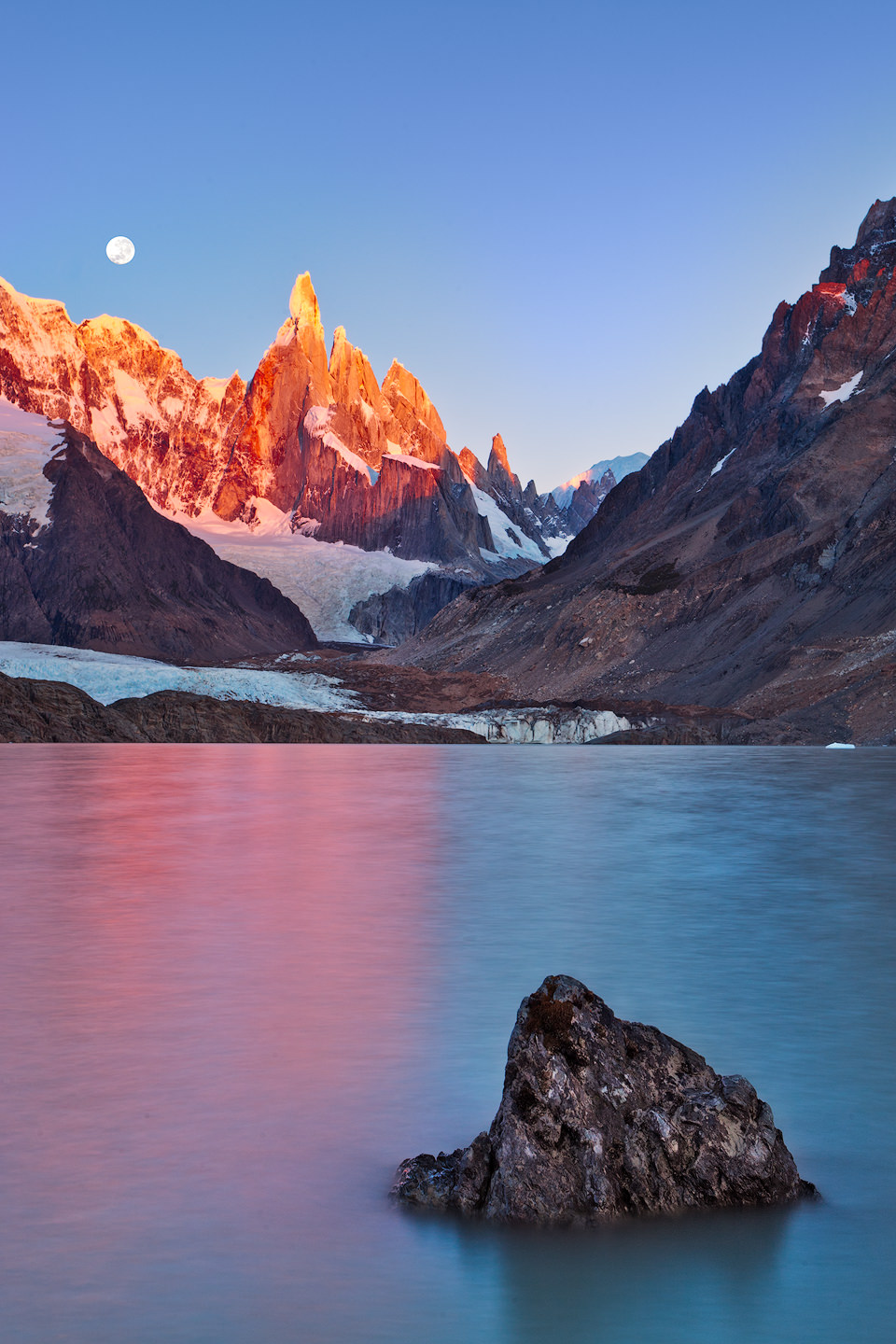
Standing at Laguna Torre isn’t really about the photograph. It’s the shape of Cerro Torre — the sheer verticality, the ice mushroom balanced at the summit, the impossible narrowing of all that rock into a single point. I found myself thinking about the people who actually climb it, who look at that wall and decide to go up. There’s something in that thought I can’t quite resolve, and I’m not sure I want to. It leaves you speechless — and with a very strong urge to keep staring.
This was our last morning in the park. Soon after, we packed our things and began the hike back to El Chaltén.
The return felt different. Not just the end of the trek, but the quiet unravelling of it. Leaving the valley also meant leaving the mountains, the silence, the weather, and the particular sense of being out there that had settled over the past days. It was a strange kind of disappointment — not sharp, but slow. A familiarity I only really knew from other journeys, the feeling of heading home after something that had been fully lived. Too short to be tired of it, but enough to feel its absence already.
El Chaltén arrived inevitably. One moment you are still surrounded by ridges and wind-shaped valleys, the next you are stepping into a small town where everything feels temporarily suspended around the same reason for being there. We found food and a glass of Malbec — warmth, tables, conversations. A place where people return from the same landscapes, each carrying their own version of it — whether they came to climb, to photograph, or simply to stand beneath it for a while.
Turning Back
I settled back into El Chaltén easily enough. The town sits inside the park, and even here the mountains don’t really disappear — they just shift into the background, partly hidden, their peaks present. Life moved into a different rhythm again: food, conversations, the small comfort of being indoors. But later that evening I went back out once more to Mirador de los Cóndores.
Fitz Roy was mostly hidden behind cloud, the peaks reduced to shifting outlines in the distance. The real light was happening behind me — a soft glow moving across a far less dramatic range of mountains, catching the last minutes of the day. I turned away from what I had come for.
Sometimes it’s not the subject that holds the frame, but the light itself.
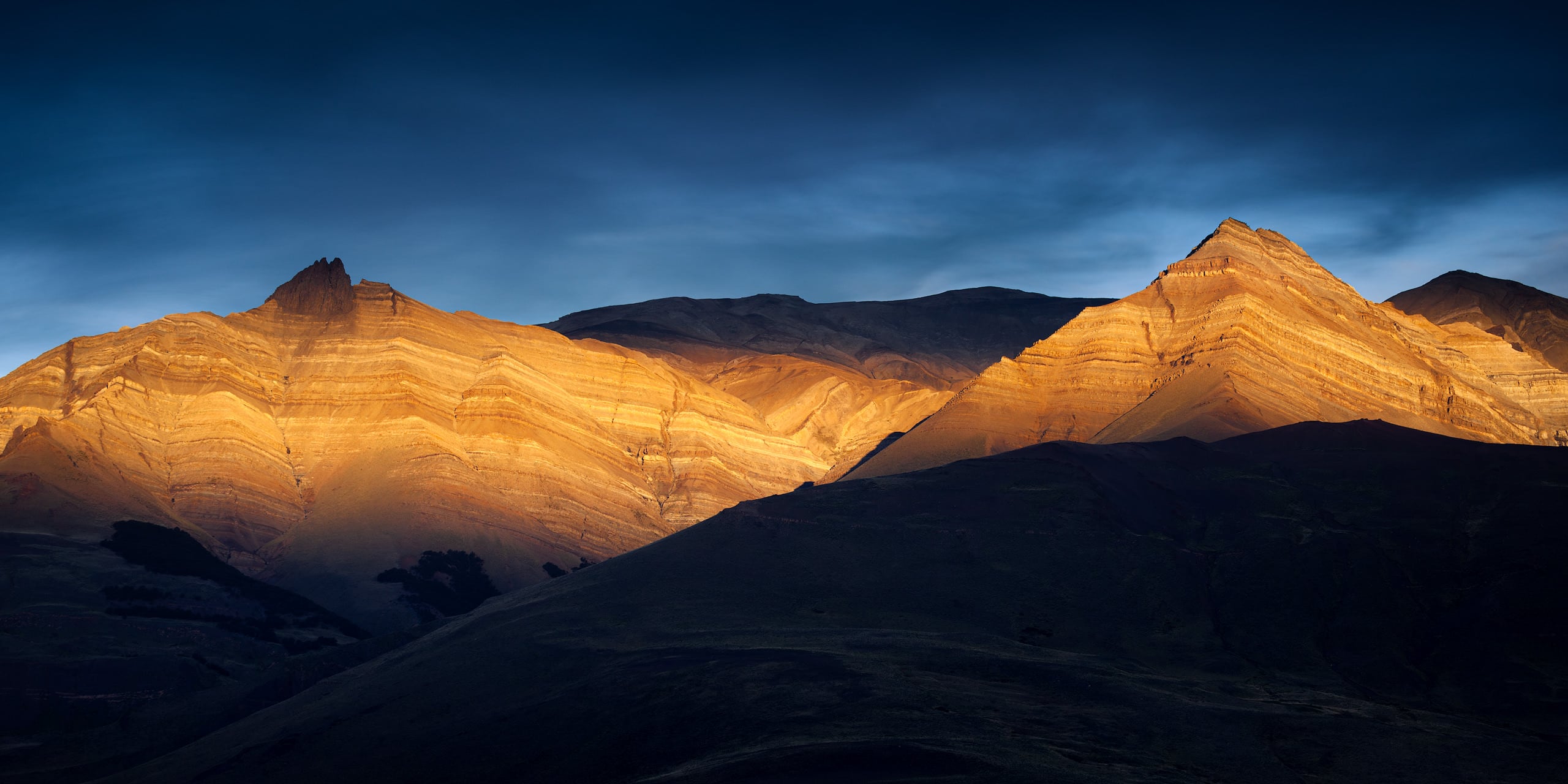
Despite the less-than-stellar conditions, trekking in El Chaltén did not disappoint at all. The mountains, the light, the constant unpredictability — it draws you back in. Not just for better conditions, but for a different experience altogether.
By the time we left, one thing was certain: I would return.
FAQ — Trekking in El Chaltén (Updated 2026)
How difficult is trekking in El Chaltén for first-time hikers?
Trekking around El Chaltén is technically accessible, but the combination of steep ascents, wind exposure, and rapidly changing weather can make even moderate distances feel demanding — especially on sections like the ascent to Laguna de Los Tres.
Do you need a guide for the Laguna de los Tres or Laguna Torre trek?
No guide is required for the classic trails, and most hikers complete the 3-day route independently. However, in more remote conditions — like on the trails to Paso del Viento — local knowledge becomes increasingly valuable.
Can you camp at Laguna Torre or Campamento Poincenot?
Yes. Both Campamento Poincenot and Campamento De Agostini are free backcountry campsites within Parque Nacional Los Glaciares. They operate on a first-come, first-served basis and must be registered at the ranger station in El Chaltén.
Do you need to pay entry fees for Parque Nacional Los Glaciares?
Yes. Foreign visitors are required to pay an entrance fee to access the national park. Registration is typically done in El Chaltén or at park access points before starting the trek.
How hard is the hike to Laguna de los Tres?
The final ascent is steep and physically demanding, especially after a full day of hiking. It’s not technically difficult, but it requires endurance — particularly when carrying photography gear or dealing with strong Patagonian wind.
What is the weather like in El Chaltén?
Weather in El Chaltén is highly unpredictable. Wind, cloud cover, and visibility can change within minutes. Be prepared for snow even in summer.
When is the best time to trek in El Chaltén?
The best trekking season is from November to March, when trails are most accessible and daylight hours are long. Shoulder seasons can offer fewer crowds but more unstable weather conditions.
Have you been trekking in El Chaltén, or are you planning a trip to Los Glaciares? I’d love to hear your experience — share it in the comments below.
Landscape photographer
Vienna, Austria
Comments