
Reflections of Fitz Roy and Cerro Torre
The end of a year — or the beginning of a new one — is usually a time for looking back. Last year, unfortunately, didn’t quite turn out to be the year to look back on. So I’ll take the liberty of going back a little further, to a time when things still ran a different course. Five years ago today, I found myself high above El Chaltén, looking at Cerro Torre and Fitz Roy from a perspective I had discovered only a few weeks before.
By late afternoon I had laid out my bivi bag on a meadow, in the lee of a bush. The air was still, but I wanted to be ready for the notorious winds of Patagonia. Sunset was still hours away — in early January it came at around ten at night. Overhead, the clouds had settled into a shape I knew well: a long band stretching from north to south, with clear blue sky to the west. If the sun sank into that clear strip, it would light the cloud from below — the surest sign of a good sunset I knew. As usual, the sight set off a familiar excitement, but it was far too early to get carried away. For the moment, I would just have to wait.
For Once, No Hurry
Waiting was something I had only recently learned. For a long time I hadn’t been interested in it at all. Most of my trips had been about covering ground, and wherever I went, I arrived just in time to shoot whatever I could point my camera at — or a little too late. I was in a constant hurry. That was mostly down to the way I travelled, but the photographs paid for it. It took me years to understand how much depended on coming prepared, and then stepping back and letting things happen.
I had arrived in El Chaltén in December 2015, with a return flight booked for July. For the first time, time was not a constraint. I had come to scout new photography locations in Parque Nacional Los Glaciares, and to photograph Fitz Roy and Cerro Torre from every angle I could find, in every light the months would bring. It was also the first time I had come to Patagonia entirely on my own. I knew I would spend a lot of time with no one to talk to, so I had packed for that as well: books, and music.
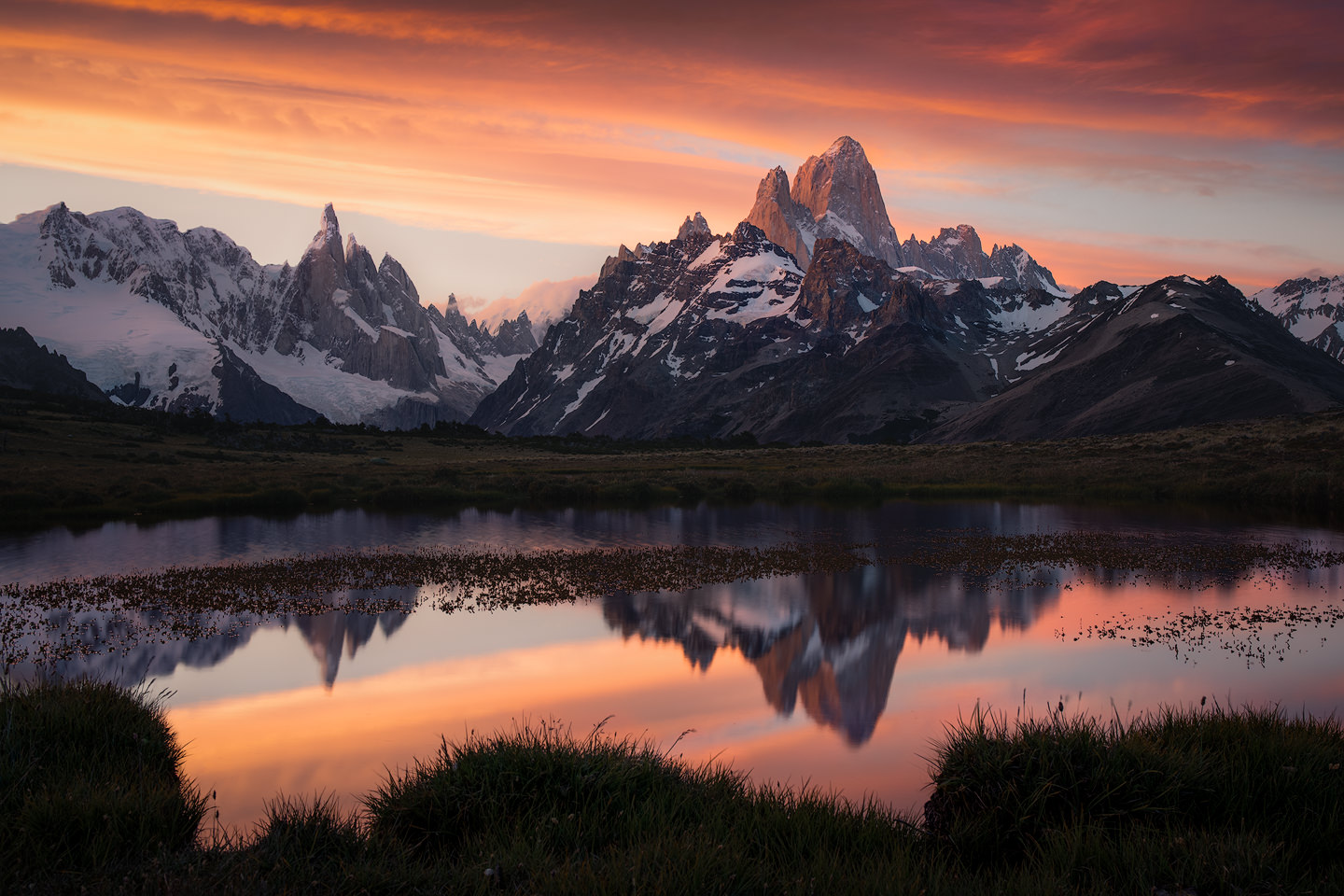
The ponds below Loma del Pliegue Tumbado lie in open meadow a couple of hours’ walk south-west of El Chaltén, off the marked trail. They are small, and after a dry spell some of them disappear altogether — but from their edge, both mountains stand across the water: the east face of Cerro Torre to the left, the south-east face of Fitz Roy to the right. It had been the first place I went after arriving, a location new to me, and at the time simply something to tick off the list.
That first time, the light came — only on the wrong side. The sky lit up in the east, over Lago Viedma, and I stood with my back to Fitz Roy and Cerro Torre, watching colour I could do very little with. Over the lake there was no mountain to work with. But I had seen the view the other way, across the water to both mountains, and I knew what it would take: the right sky on that side, and me already in place when it came.
This time I came prepared. I had been here before. I knew exactly where to put my camera. And so I made myself comfortable in the grass, next to the pond I had chosen as my foreground, grabbed a book and started reading…
A Clear Plan, a Clear Mind
For a long time, nothing happened. The clouds held their shape. The pond stayed still. The sun worked its way down towards the clear strip in the west, and I read, looking up every now and then. Whether the light would come was out of my hands. Everything else, I had taken care of.
Once the light was low enough, I put the book away and started shooting. A clear plan, a clear mind. The underside of the cloud band soon turned yellow and eventually orange and pink. The upper granite of Fitz Roy caught the last of the sun, while Cerro Torre, further to the left, stayed a silhouette against the sky. And below them, in the pond, both mountains appeared a second time. Two mountains in a single frame — and each of them twice. I knew conditions like these were unique, and that every hour of the wait had been worth it.
I kept working as long as the light lasted. When it was gone, I crawled into the bivi bag and went through the images on the back of the camera. I was happy. I knew I wouldn’t get anything better the next day, and that in the morning I would walk back down to town.
Letting Things Happen
When you arrive just in time, the light makes the decisions for you. You shoot whatever is in front of you, settle on a composition in a rush, and the best of the evening is over before you have really seen it. When you arrive early, the big decisions are made before the light comes. All that is left is to watch what it does.
That, for me, is what comes down to: not sitting out the weather for its own sake, but doing the work early enough that you can afford to step back. Waiting doesn’t make the light happen. It only means that when it does, you are there for all of it.
It had taken me years to understand that, and that season still had more to teach me — by April, autumn photography in Patagonia would turn from something I hoped for into something I planned around. But the habit of arriving early has stayed with me ever since. Some evenings the light comes. On the others, I finish the book.
Are you someone who arrives hours before the light — or, like me for many years, the one hurrying up the hill as the sun goes down? Tell me in the comments.
Landscape photographer
Vienna, Austria

Comments