
Photographs of landscapes are often described by what they show: mountains, coastlines, deserts, skies. For a long time that held true for my own landscape photography, but when I look back now, I realise that what actually drew me to press the shutter button was rarely the subject on its own. The scene itself was always shaped by some form of light. Not necessarily dramatic light in the obvious sense – not just sunsets for the sake of color, or storms for the sake of spectacle – but light as a shaping force. Light, that simplifies, compresses, reveals. Light, that turns terrain into something worth looking at, and landscapes into something to remember.
Light is never static. It moves constantly, shifts – sometimes almost imperceptibly – and reshapes the terrain in ways that only reveal themselves if you pay enough attention and bring patience. A star-filled night, the muted calm of blue hour, the brief clarity of sunset, the final fade of twilight — each moment leaves behind a different pattern, a different way the land organises itself. Of course the landscape stays the same, but the light emphasises different aspects and features of it.
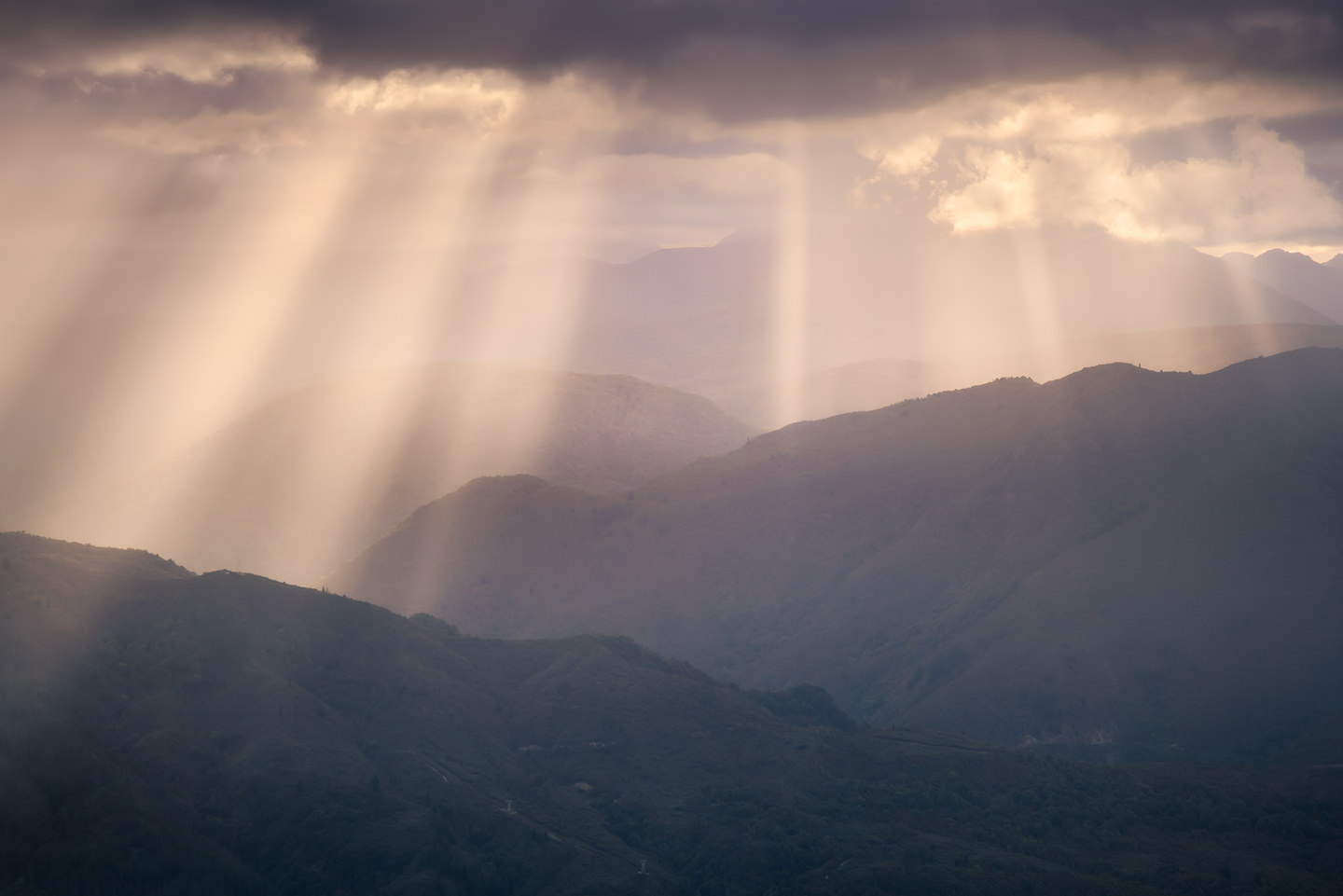
Over time, I’ve come to think of light not only as illumination, but rather as a catalyst. As something that defines visual flow, rhythm, and balance and thus makes subjects become interesting. But this way of seeing didn’t come early in my venture into photography. It came from spending long hours in remote landscapes waiting for something to “happen“, or from even longer hours looking at photographs of spectacular landscapes, asking myself whether something had „happened“. This article explores those „happenings“ — and how they shape the way we practice landscape photography. We’ll try to make the shift from photographing mere places to photographing the shapes that light creates within them – as chasing these shapes of light is less about collecting images and more about paying attention: about being present long enough to notice how the world quietly rearranges itself.
Transitional Light: Blue & Pink Hours
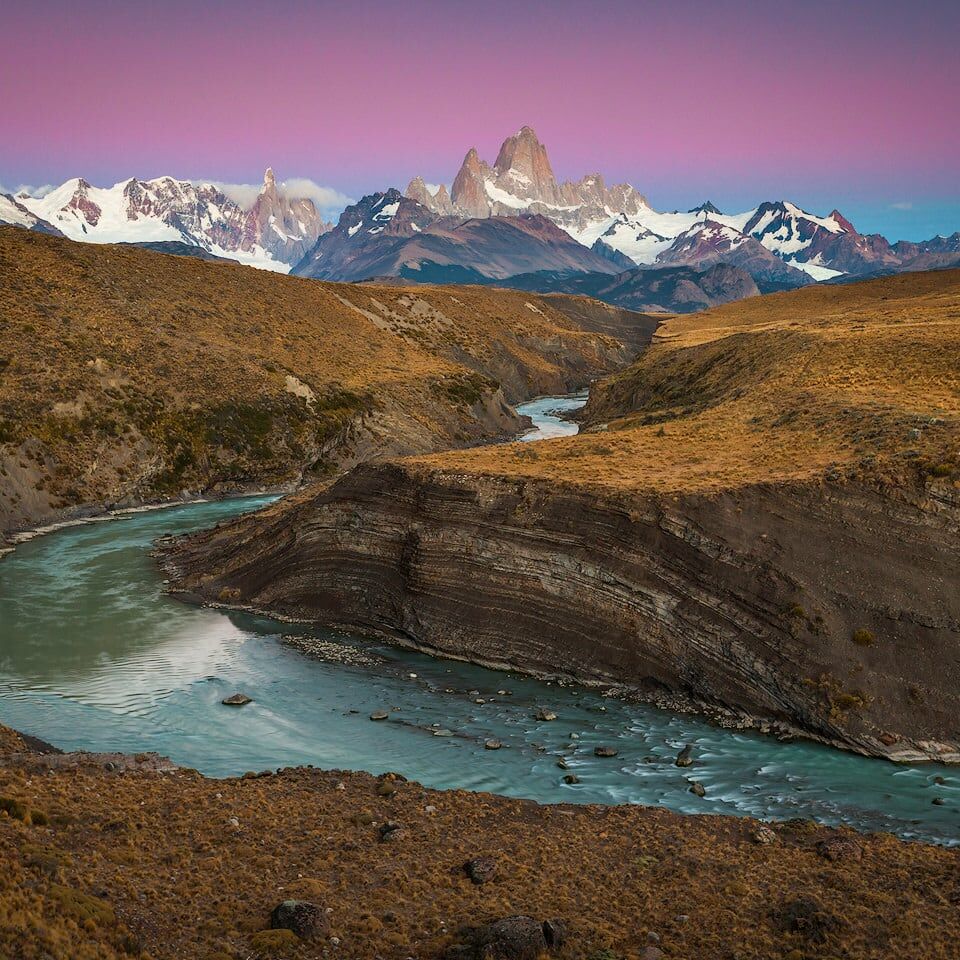
When the sun sits well below the horizon, a blue and – depending on the atmospheric conditions – sometimes pink dome reflects light evenly onto the landscape, diffuse and indirect, without a clear source. It feels quiet and subdued. The land is either about to wake up or about to go to sleep, and the world is holding its breath. Between day and night, the light of the blue hour is transitional, and it’s one of the softest shapes light can take.
This light treats all things equal and terrain becomes approachable. Every nuance is visible, yet nothing is emphasised. The absence of sharp shadows allows soft contours to surface — forms that usually disappear once contrast takes over. What later becomes shadow and highlight is, for now, a slow conversation of cool and slightly less cool tones. At the same time prominent features of the terrain tend to stand out more clearly — not because they demand attention, but because they are what they are. Depth is present, but gentle. Less a question of distance, more one of subtle, almost infinite layering. During deep blue hour, color is reduced to all but a single note. Other hues fall quiet, textures soften. But the light slowly begins to shift as the sun nudges the clouds from below, and a faint directional warmth starts to seep into the scene. All change happens slowly, almost imperceptibly, yet longer exposures register the passing of time through movement: drifting clouds, flowing water, the subtle shift of light itself.
The light of the blue hours rewards patience. Photographs made here are less about all time favourite moments and more about quiet relationships — between form and surface, tone and shape, stillness and motion. This may not be the loudest shape of light. But it often leaves a deep mark.
Directional Light: Alpenglow & Golden Hour
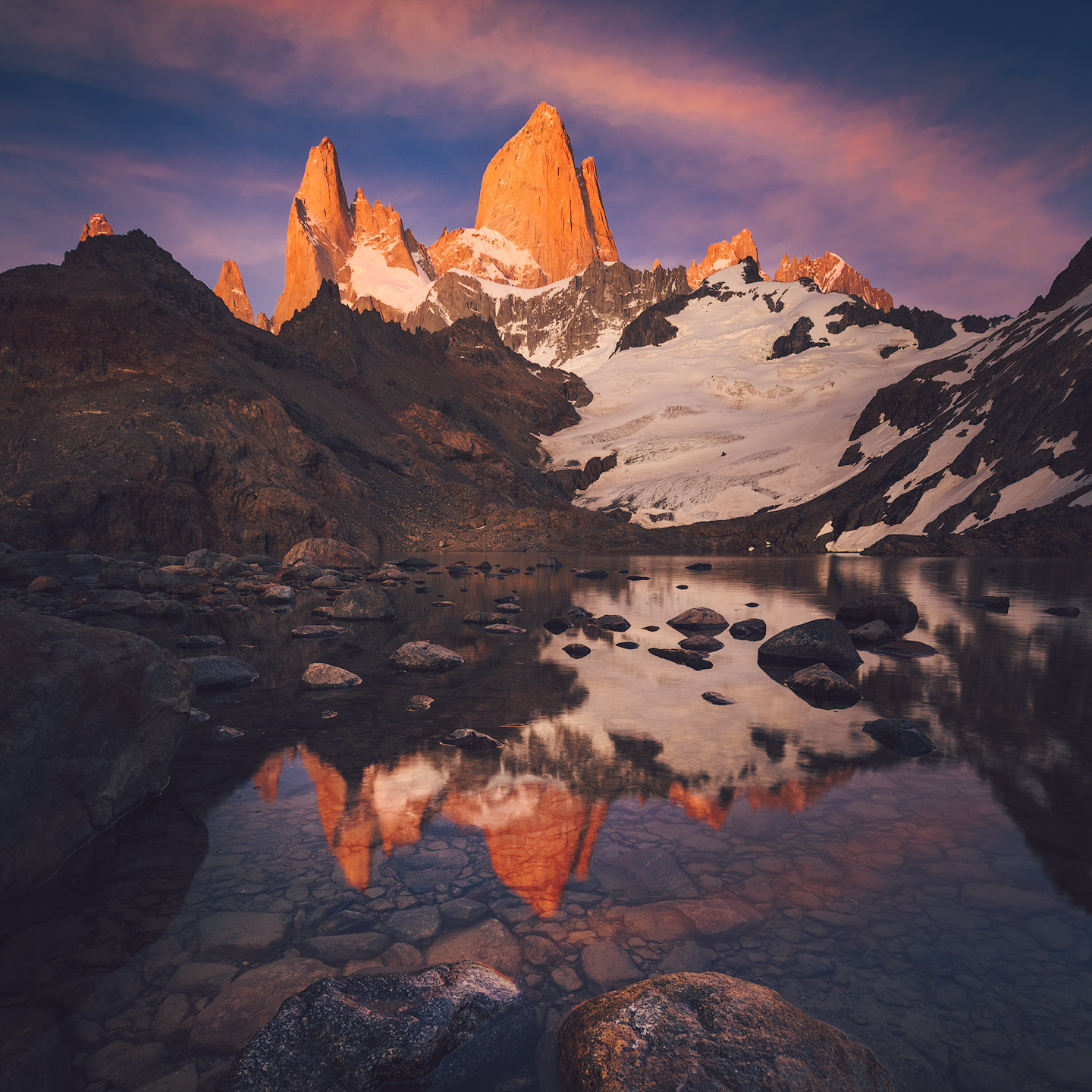
Few moments in landscape photography are chased more eagerly than sunrise and sunset. Terms like Alpenglow and golden hour need little introduction. Low rays of warm light – red and golden – bring immediate structure and drama to the land. With the sun low above the horizon, only the highest features of a landscape are touched. Peaks glow, ridges ignite, and the land suddenly gains hierarchy.
With the sun just above the horizon, shadows appear and deepen, carving structure into the land. For photography angle is critical. Frontal light flattens detail. Side light builds depth. Backlight – when handled carefully – can introduce atmosphere and complexity. Depth becomes more pronounced, and so does contrast — both requiring balance to separate the good, from the bad and ugly.
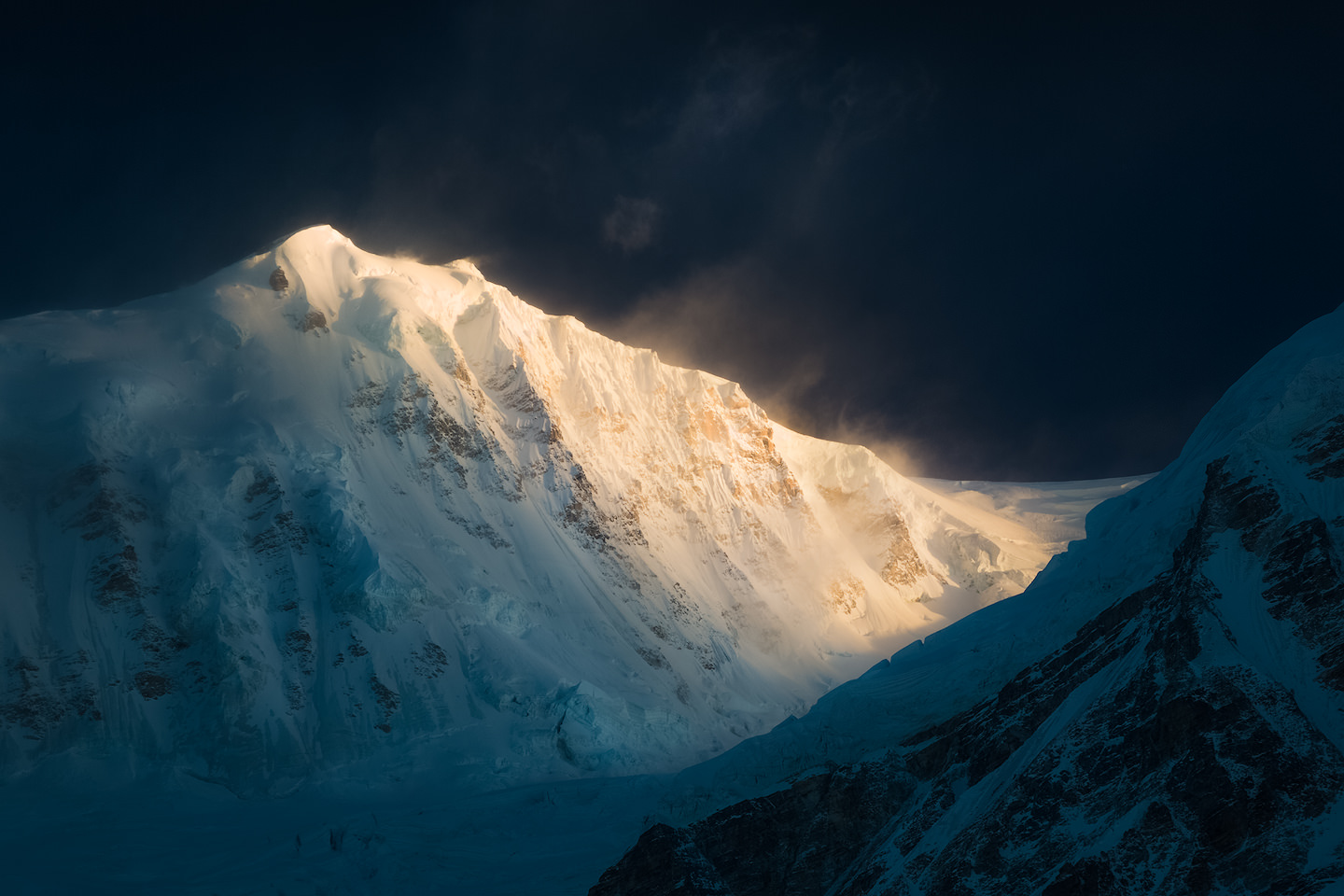
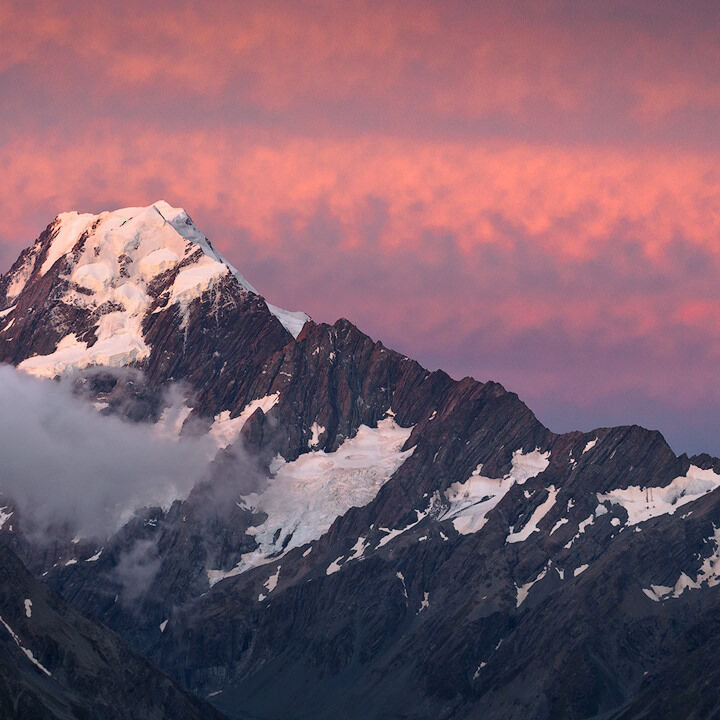
I took Kabru’s Awakening on the Goecha La Trek high up in the Himalayas. A corridor of alpenglow reached above the fog, striking the southeast face of Kabru South. What struck me wasn’t just the warmth of the colour, but also the geometry: ridge crests blazing, everything below in cold shadow, every serac suddenly readable. The dark sky behind the peak made the effect complete. Directional light at this hour doesn’t flatter — it exposes.
Like a spotlight, this light demands a subject. Prominent features thrive in it; less defined terrain often doesn’t. The light may feel intense, sometimes even overwhelming. And without careful composition, the result can easily tip into excess.
Yes, golden hour light is seductive: intense color, deep shadows, and crisp contrast create impact almost automatically. But this is also where the danger lies. The more spectacular the light, the easier it becomes to overlook what isn’t working. The light is generous, almost indulgent, gifting drama and contrast with little effort. But as with too much sugar or too much fat in food, this generosity can hide the imperfections beneath the surface. A weak foreground, an unclear subject — all kinds of flaws can comfortably hide behind colour and glow.
The light of the rising or setting sun doesn’t just reveal the landscape; it also reveals how disciplined the photographer really is. Golden hour doesn’t guarantee a strong photograph — it only guarantees that the land appears seductive for a fleeting moment. This light isn’t inherently good or bad, but it must be shaped and restrained through composition. In the end, the image still has to stand on its own — it must earn its impact, not simply borrow it from the sun.
Diffuse Light: Clouds, Fog & other soft Conditions
Diffuse light shares some qualities with blue hour light, but without the emotional pull of a prevailing color. Under overcast skies or in fog, light loses direction entirely. It arrives from everywhere at once, flattening contrast and dissolving the visual hierarchy the landscape usually relies on. Shadows become infinitely soft and nearly disappear. What remains is texture, tone, and repetition. Rock, snow, sand, and vegetation reveal themselves evenly, without emphasis or distraction. The terrain can feel subdued, even restrained — but also honest. Nothing is hidden behind drama. Nothing is elevated above the rest.
This is a light that removes easy decisions. Without highlights to chase or shadows to anchor the frame, composition becomes more deliberate. You start to notice rhythm instead of contrast, relationships instead of focal points. Subtle changes in tone and texture begin to matter more than dramatic shapes alone.
Diffuse light doesn’t reward quick reactions. It asks for patience of a different kind: the willingness to stay with a quiet scene and trust that restraint can be enough. Landscape photographs made in these conditions rarely shout—but when the right care is taken, often endure.
Disruptional Light: Dramatic Weather Conditions
Storms gather over the land, hiding peaks and valleys beneath clouds, rain, or snow. Contrast collapses, visibility is low, and the terrain seems to disappear. And then suddenly, as the storm breaks, light cuts through: sharp volumetric shafts cut across the terrain, isolating ridges, plains or rock faces with an urgency that feels almost unreal.
If diffuse light removes tension, the disruptional light of dramatic weather brings it back all at once. Visual importance is often turned upside down, as in this dramatic mood it‘s about where the light points. What moments before felt chaotic suddenly becomes precise. Shadows conceal distractions, light reveals what matters. Rainbows, lightning, and sculpted cloud formations add to the sense of volatility. Sometimes this light overlaps with sunrise or sunset, stacking one condition onto another and adding additional drama through colour.
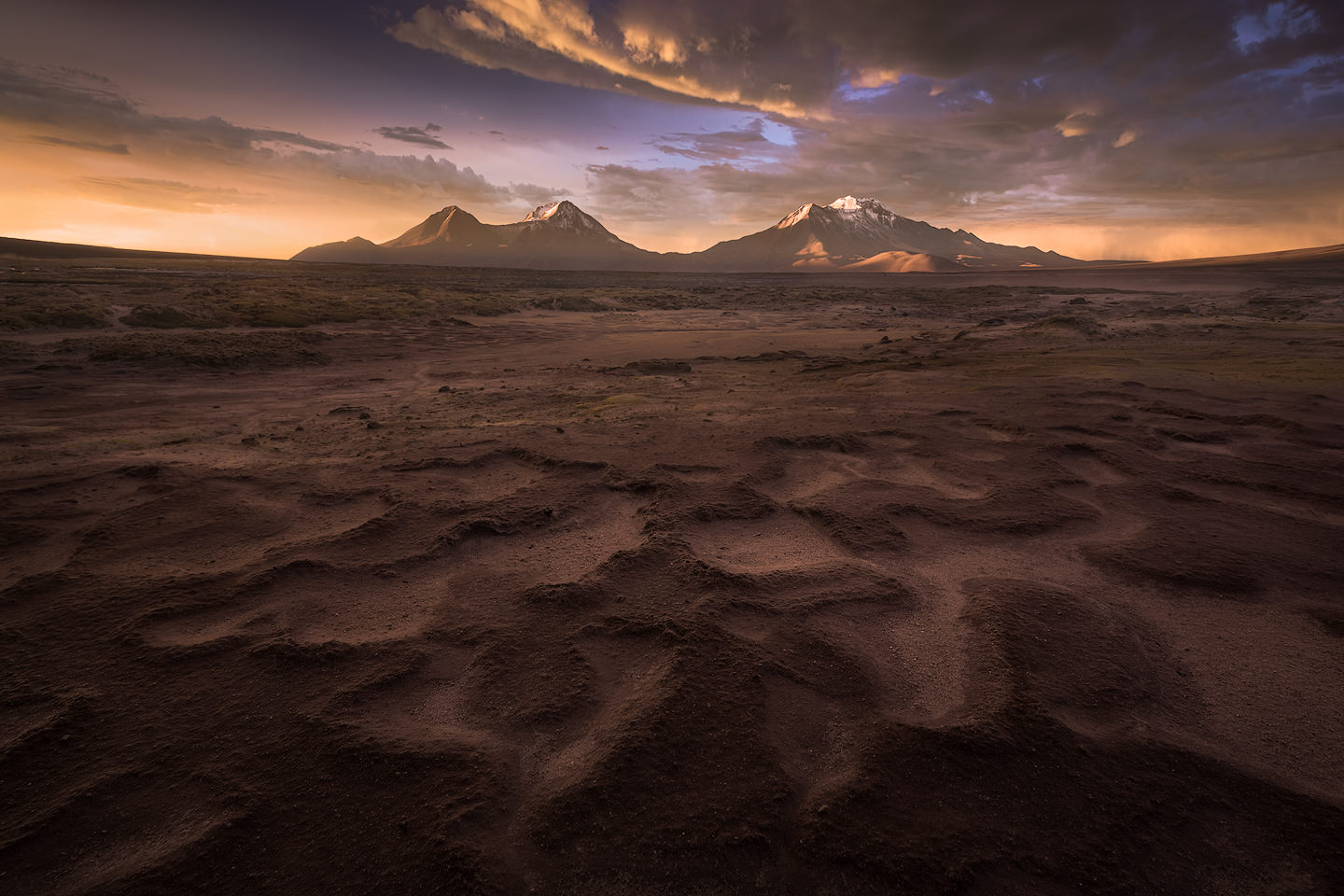
High up in the Andes, on the edge of Salar de Surire in Chile, we had spent the afternoon sitting in the our 4×4 watching a thunderstorm erase the Altiplano. The landscape disappeared entirely behind the rain. Nothing about the sky suggested it would produce anything worth photographing — until the clouds moved east and the sun broke through from below without warning. The volcanic terrain caught the light. The clouds put on a show. The End of All Light: a sudden glimpse of light, earned by sitting still.
Dramatic weather presents the most unstable shapes of light — fragmented, fleeting, and impossible to rely on. Seconds – or fractions of seconds – matter. You can’t plan for it, and you can’t demand it. Spotlit scenes appear and vanish within the blink of an eye, leaving only your awareness as evidence of their fleeting presence. You better make sure to compose and expose quickly.
These moments feel earned, but not so much because they are rare, more likely because they demand commitment. And while it may sound counterintuitive: You don’t stumble into disruptional light. You either wait long enough to witness it — or you don’t.
Reduced Light: Moonlight & Stars
Night brings a final shift—not louder or quieter, but more distant. The unfamiliar appearance of the remaining light strips the scene down to form and scale. Moonlight, though subtle, can cast surprisingly harsh shadows, but with an entirely different tonal language. Color drains away, replaced by muted tones and a limited palette. The sky deepens, sometimes turning almost black, punctuated by sparkling stars.
Moonlight grazes ridges and slopes, emphasising curves and angles without relying on the colours we are used to. Long exposures soften water and reveal lines that can help guide the eye through darkness. Fast-moving clouds introduce motion above a largely still terrain, reinforcing the contrast between sky and land.
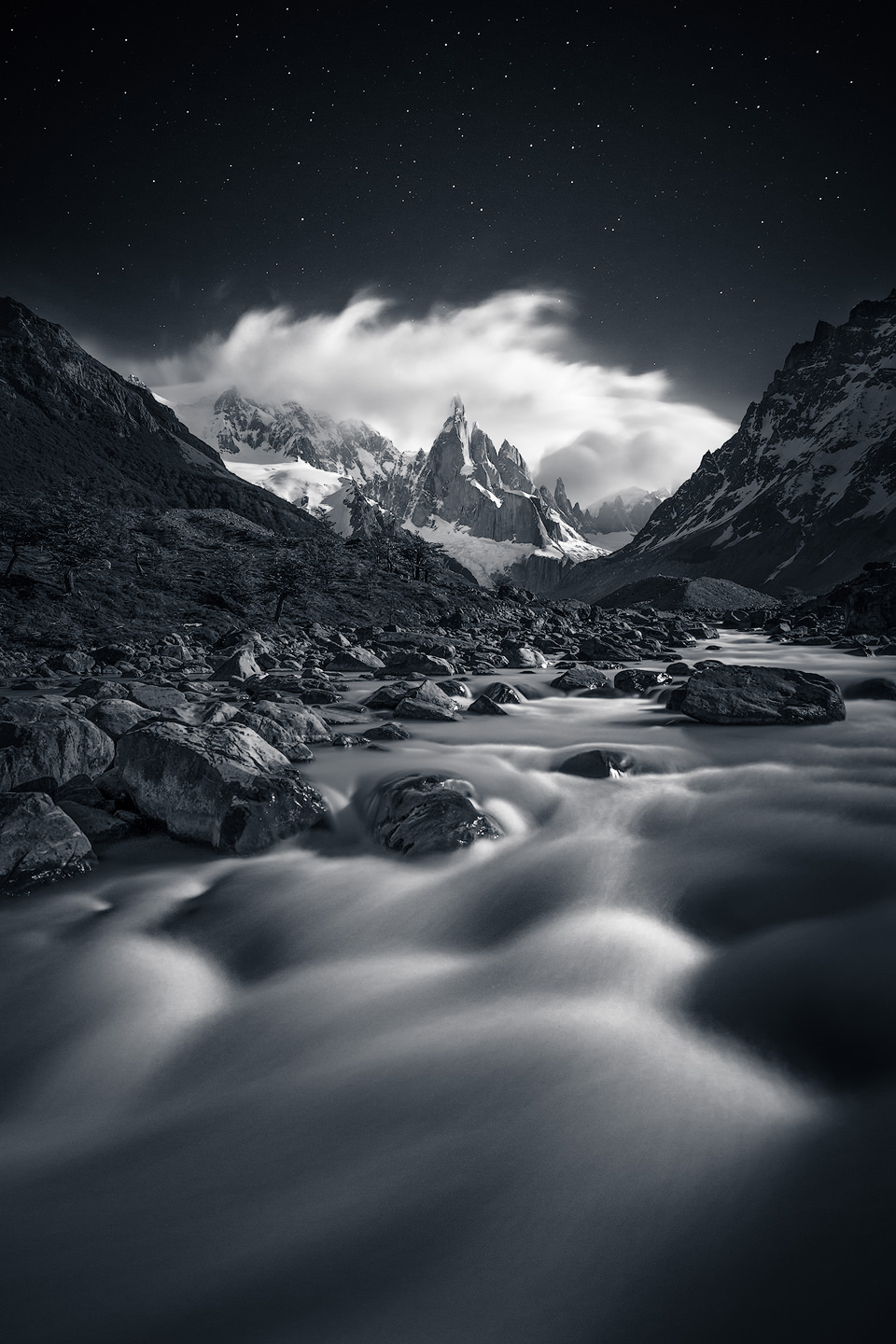
The image I called The Light of the Night was made below Cerro Torre, at the edge of the lenga forest right next to the camp at Laguna Torre. The moon was up — almost full. The river in the foreground ran long enough to become something other than itself: smoothed and almost glassy, the individual stones beneath it visible only as suggestion. Above, the clouds were moving around the Torre — driven by the wind that defines Patagonia. There is a particular tension in that compression: river and clouds both in motion, but held still by the exposure, framing the motionless granite spire in between.
This nightly and stripped-down version of the landscape can feel instructive. Not because it teaches technique, but because it reminds you what remains when spectacle is removed. Often, the naked eye barely discerns what the camera reveals through its processing. Night doesn’t add information — it removes and delays it. And in doing so, it profoundly changes what can hold a scene together.
Unlike other shapes of light, night can feel less transient. This may be an illusion, but standing in a fully transformed landscape, watching it hold this form for hours, creates the sense of witnessing something rare — and being allowed to stay with it.
Learning to Notice the Shapes of Light
Most shapes of light appear on a daily basis. They don’t require remote places or spectacular views. What matters is not so much the landscape, but what we choose to notice and appreciate, and what we choose to make out of it. And thus, over time, landscape photography becomes less about finding new terrain and more about recognising familiar places under unfamiliar light. The same ridge, the same valley, reorganised to appear in a different shape.
Light doesn’t just illuminate the land; it gives it structure, rhythm, and meaning — and our task is learning to wait for it, to recognise it, and to let it shape both the photograph and the way we move through the world.
How Light Shapes the Landscape
A Question for the Reader
We all respond to light differently. Which shapes of light keep drawing you back in your own photography — and why? I’d love to hear how light has shaped not only your images but the way you look at the world. Feel free to share your experience or photos in the comments.
Comments