
Location & Geography
The Cordillera Patagónica is the wild southern spine of the Andes, running roughly 1,600 kilometres from the Río Negro in northern Patagonia to the Strait of Magellan. Here the range narrows and fractures into fjords, ice fields, and vertical granite towers — one of the most dramatic and photogenic landscapes on Earth. Relentless westerly winds sweep in from the Pacific, dumping extraordinary precipitation on the Chilean side while the Argentine steppe lies dry in the rain shadow. Glaciers still shape the terrain, calving into lakes and fjords that existed for millennia before any road reached them.
The two Patagonian ice fields define the range’s interior. The Southern Patagonian Ice Field — at roughly 13,000 square kilometres the largest temperate ice mass in the southern hemisphere outside Antarctica — sits between the Argentine and Chilean flanks, feeding glaciers that calve into both Lago Argentino to the east and the Pacific fjords to the west. The Northern Patagonian Ice Field, smaller but no less imposing at around 4,200 square kilometres, dominates the upper section of the range and is the source of Monte San Valentín’s near-total isolation. Together they make up a landscape that is still actively being shaped by ice — a rarity on this scale anywhere on earth.
The Chilean side of the range is a different world from the Argentine. West of the divide, the mountains dissolve into a labyrinth of channels, fjords, and archipelagos that stretches south through Aysén and Magallanes all the way to the Strait of Magellan. This coastal fringe is almost entirely roadless — the Carretera Austral, Chile’s southern “highway”, reaches only partway before giving out at Villa O’Higgins — and the inner fjords remain accessible only by boat or small aircraft. The national parks on this side, including Bernardo O’Higgins, Parque Nacional Pumalín Douglas Tompkins and Kawésqar, are among the least-visited protected areas in South America.
The Argentine flank is comparatively accessible, and this asymmetry shapes how most visitors experience the range. Ruta Nacional 40 runs along the eastern edge of the Andes from Bariloche south through Santa Cruz province, connecting the gateway towns of El Calafate — the hub for Parque Nacional los Glaciares and the Perito Moreno Glacier — and El Chaltén, the small climbing and trekking village at the base of Fitz Roy. From El Chaltén, the core of the southern Cordillera Patagónica is within walking distance; from the Chilean side, most of it is weeks away.
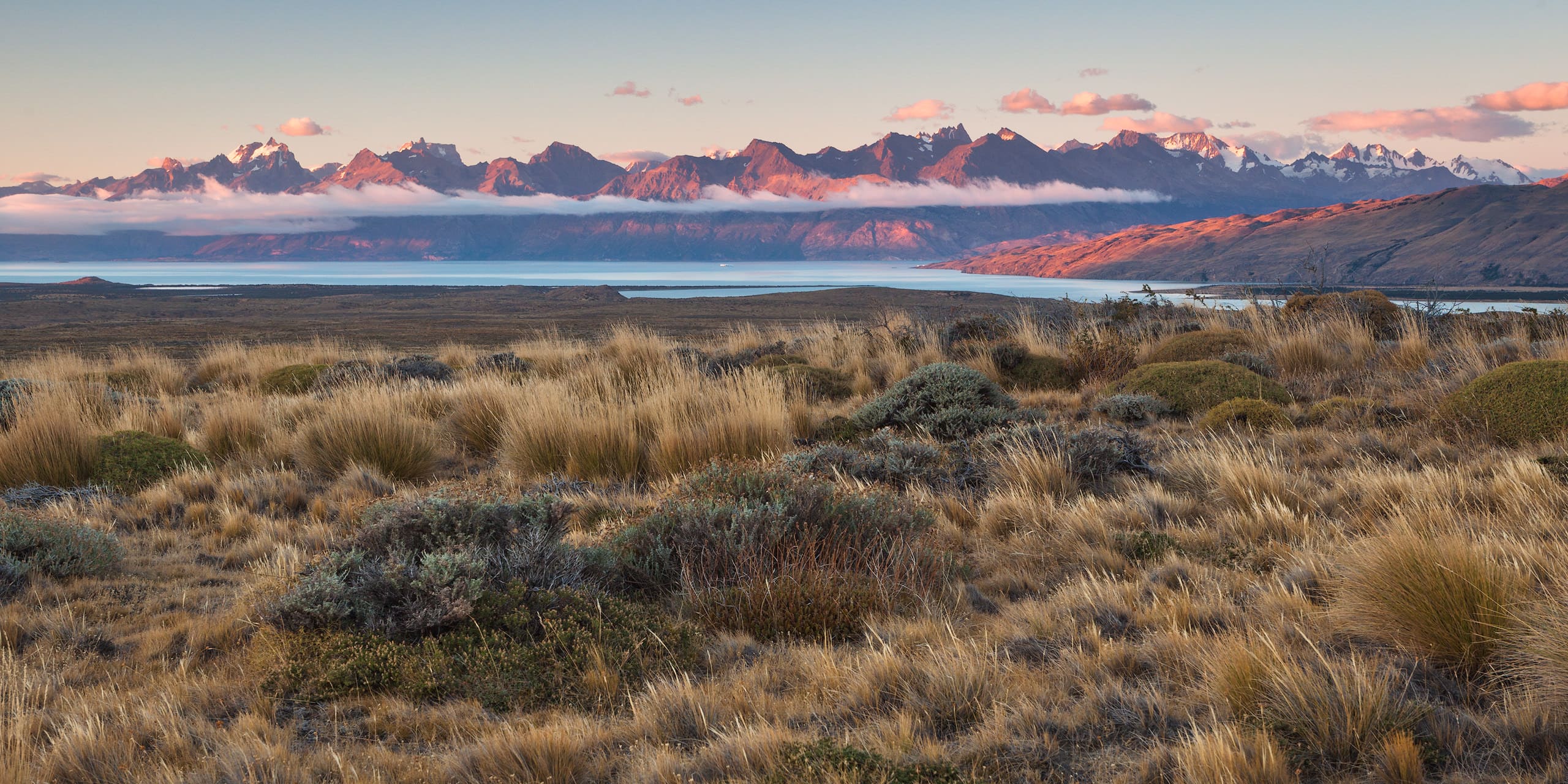
Cordillera Patagónica
Quick Info
The southern anchor of the Andes, the Cordillera Patagónica stretches from the Río Negro basin to the Strait of Magellan across Chile and Argentina. The temperate rainforests of the Chilean slopes receive among the highest precipitation on the planet, feeding the Northern and Southern Patagonian Ice Fields. The Argentine side sits in a cold, semi-arid rain shadow, while the southernmost tip of the range dissolves into the sub-Antarctic archipelago, where conditions approach those of the polar regions.
Facts
- Length: ~1.600km
- Highest Peak: Monte San Valentín
- max. Elevation: 4,058 m
Location
- Continent: South America
- Countries: Argentina, Chile
Sub-Ranges & Zones
The Cordillera Patagónica divides naturally into two main sectors. The northern sector is anchored by the Northern Patagonian Ice Field and Monte San Valentín, a realm of glaciers, fjords, and largely roadless wilderness accessible mainly by boat or the occasional dirt road. The southern sector is defined by the Southern Patagonian Ice Field, Parque Nacional los Glaciares, and the granite towers around El Chaltén — the most visited and best-documented part of the range.
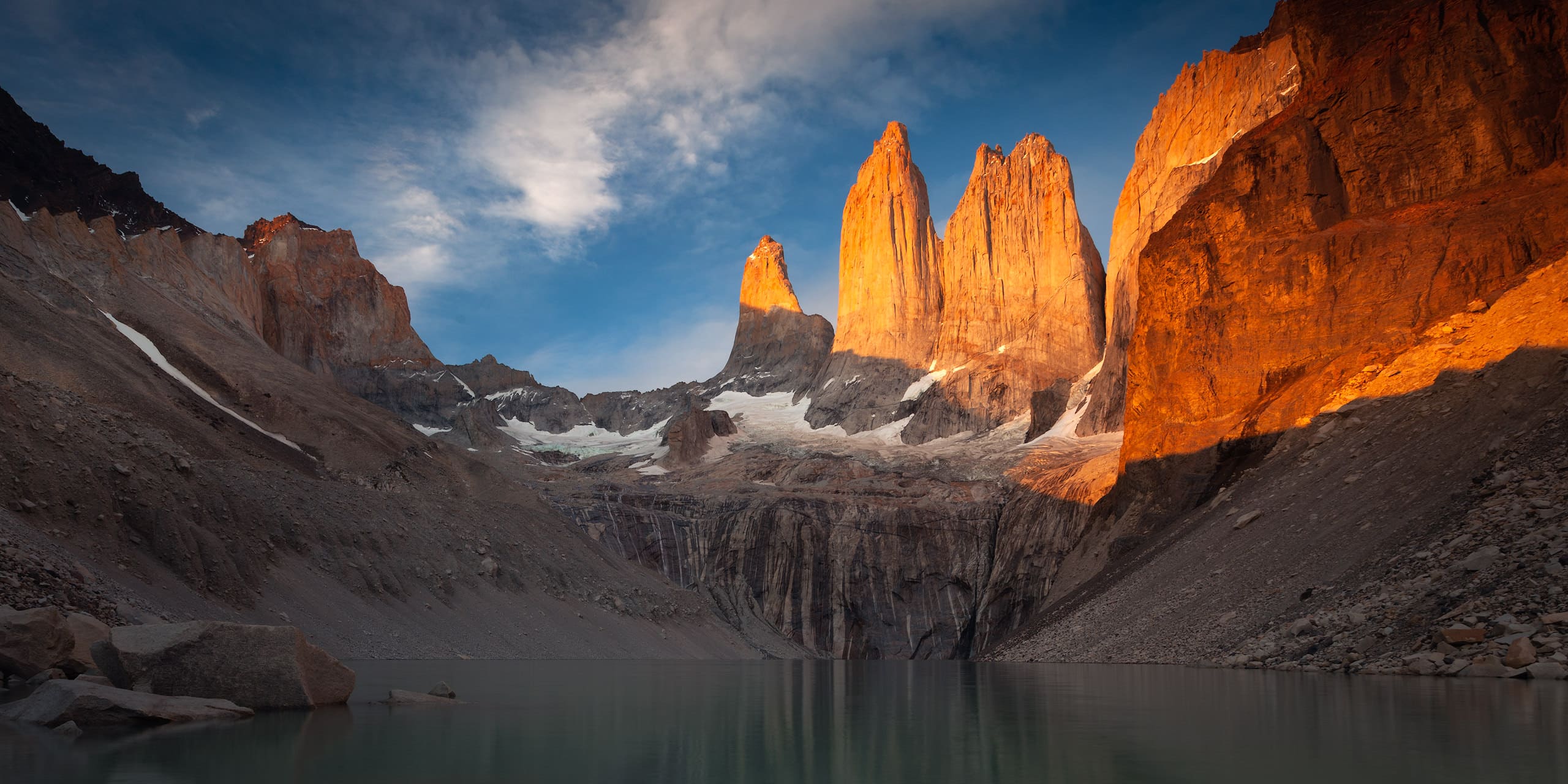
The Cordillera Paine, with its famous Torres del Paine massif, sits at the southern edge of the broader Patagonian range. Its granite peaks were formed by a laccolith intrusion rather than tectonic folding, making it geographically and visually distinct.
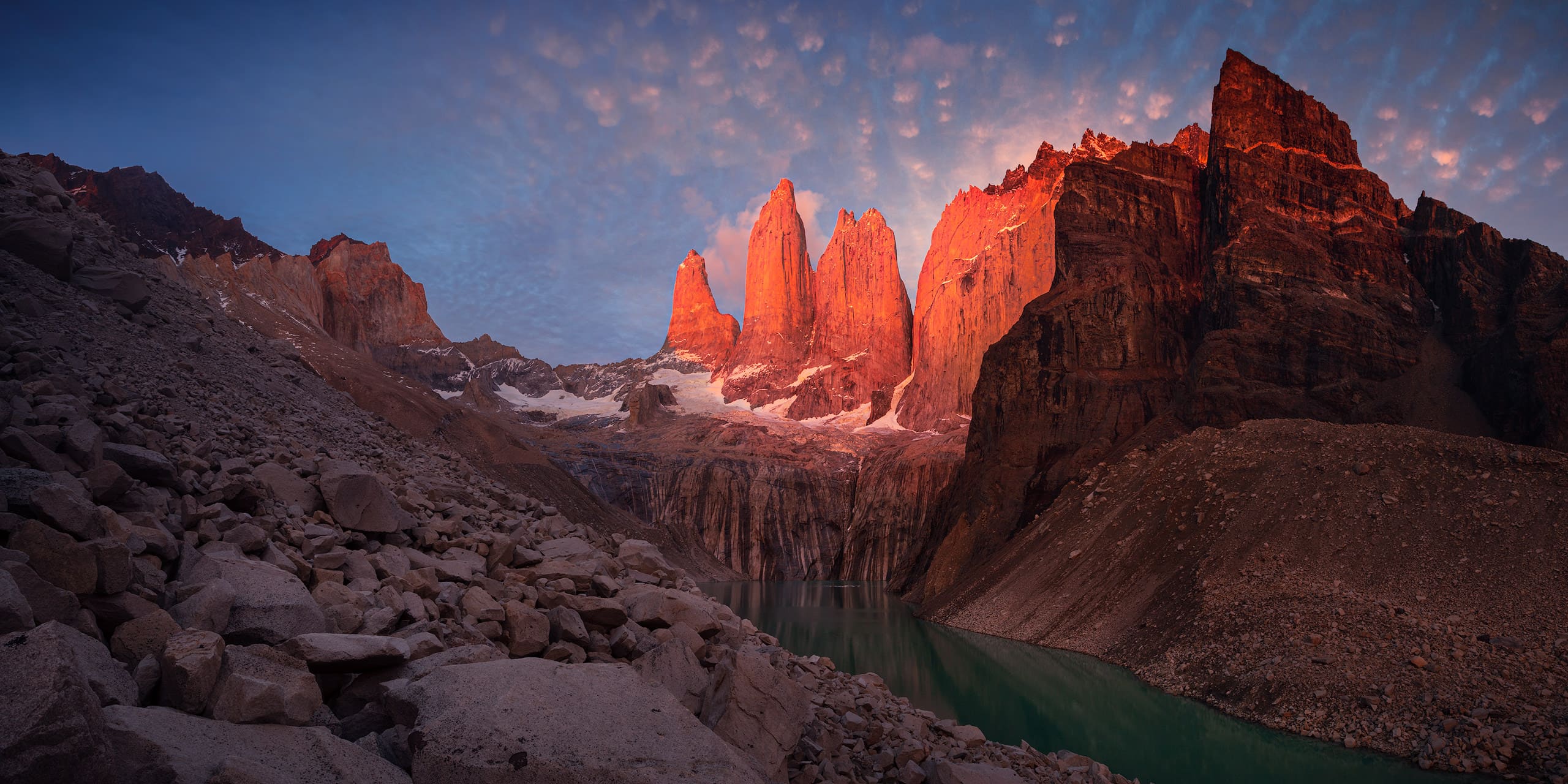
Highest Peak
The Cordillera Patagónica is home to some of the most technically demanding peaks in the world. What the range lacks in absolute altitude it more than compensates for in exposure, weather, and sheer vertical relief.
Monte San Valentín — 4,058m
Monte San Valentín (4,058 m) is the highest summit in all of Patagonia, rising from the Northern Patagonian Ice Field in Chile’s Aysén Region. Despite its prominence, it sees far fewer ascents than the granite towers to the south — the approach requires crossing the ice field, and the summit weather window is notoriously narrow. For the handful of expeditions that reach the top, the panorama across the ice field and the Pacific fjords is unmatched anywhere in the range.
Other Notable Peaks
Fitz Roy (3,405 m) and Cerro Torre (3,128 m) are the emblematic peaks of the southern Cordillera Patagónica, rising above El Chaltén on the Argentine side. Neither is the tallest summit in Patagonia, but both are among the most recognisable mountains on Earth — their near-vertical granite walls have defined big-wall climbing since the first ascents of the 1950s and 1970s. Fitz Roy draws the most attention, but Cerro Torre has its own cult following among alpinists drawn to the near-impossible conditions of its headwall.
Monte San Lorenzo (3,706 m) sits further north along the range, in Parque Nacional Perito Moreno. It is the second-highest peak in Patagonia and rewards those willing to make a remote approach with genuine wilderness solitude — far fewer trekkers reach its base than the El Chaltén circuit. Cerro Hermoso, a neighbouring summit in the same massif, is occasionally noted alongside San Lorenzo but remains a footnote for most expeditions.
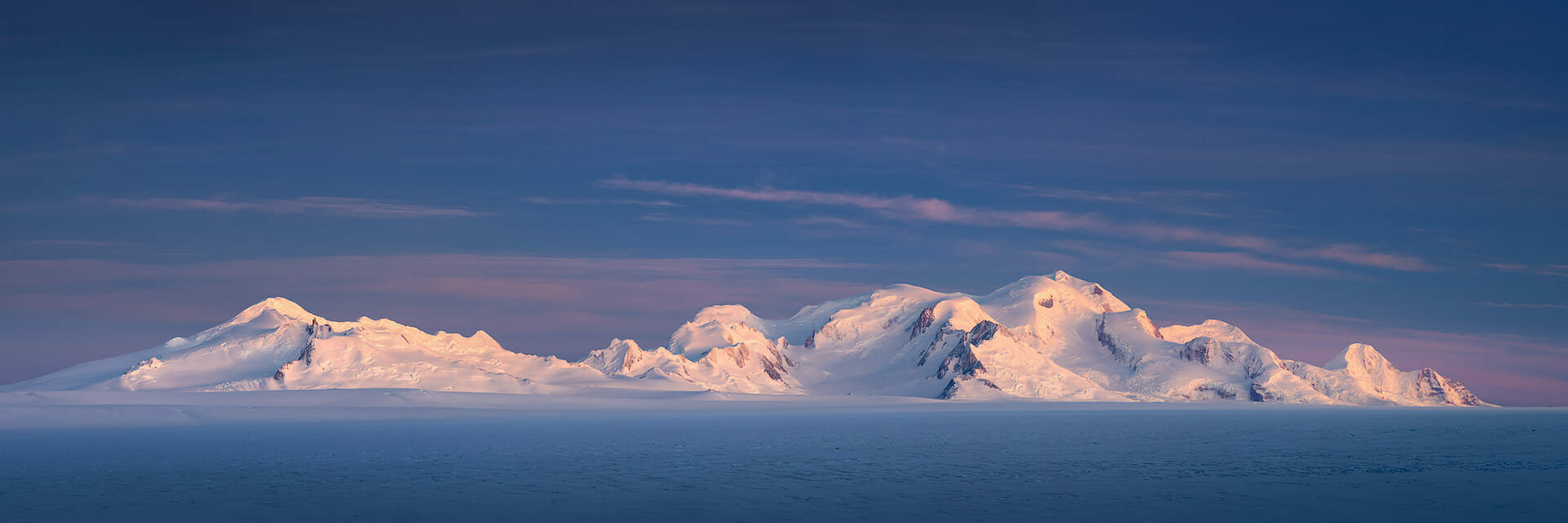
Cerro Murallón, Cerro Norte, and Cerro Solo complete the cluster of impressive peaks around the El Calafate and El Chaltén area. Further west, summits of the Southern Patagonian Ice Field — the highest being Volcán Lautaro (3,623 m) and Monte Mariano Moreno — represent some of the most isolated terrain on the continent.
Hiking & Expeditions
The Cordillera Patagónica offers some of the most celebrated long-distance trekking in the world, most of it concentrated in the Argentine sector. The hiking around El Chaltén is the obvious starting point: the circuit around Fitz Roy and Cerro Torre covers all views of the towers across multiple days, with well-marked trails and sheltered campsites making it accessible to strong walkers without technical skills. Further south, the Torres del Paine W Trek connects the glacier and fjord scenery of the Chilean side — it belongs to the Cordillera Paine, but for many visitors it is the natural companion to an El Chaltén trip.
Further north, options become rapidly more remote – Northern Patagonian Ice Field being largely the domain of ski-mountaineering expeditions. One of the few accessible option are the remote trails of Parque Nacional Perito Moreno, taking you to the foot of Monte San Lorenzo. Compared to its neighbors further south this park sees little to no visitors, and offers a pure Patagonia experience.
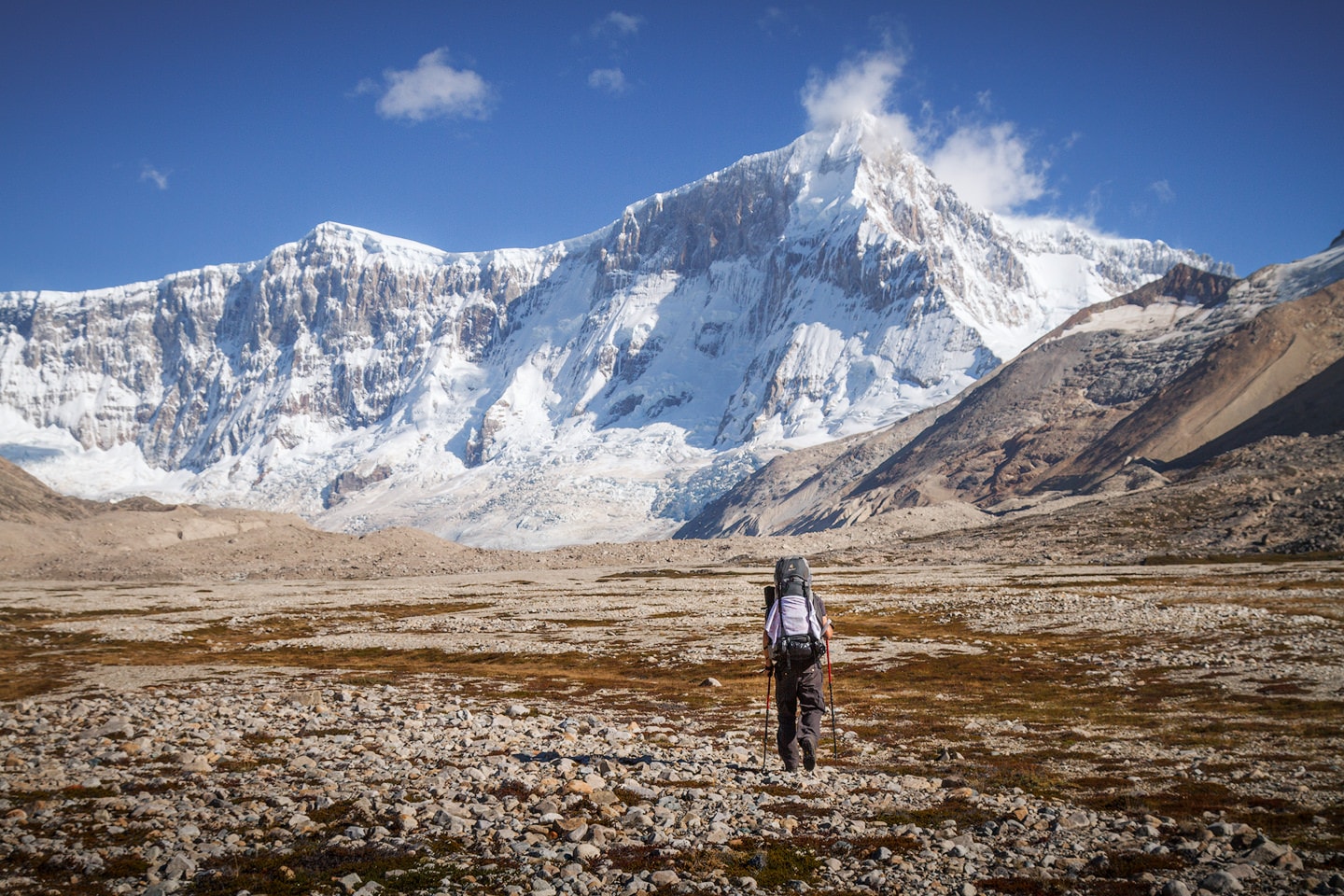
Seasonality matters more here than almost anywhere else in the Andes. The main window runs from November to March, with January and February offering the best odds — though “best” in Patagonia still means planning for days of wind and rain between the clear spells.
Landscape Photography
The Cordillera Patagónica is among the most photographed mountain ranges in the world, and for good reason: the combination of extreme weather, granite geometry, and a quality of light unique to the southern latitudes makes for images that work on a purely graphic level even without knowing the location. The challenge is entirely logistical — getting to the right place at the right time, then waiting through wind and cloud for the moments when everything opens up.
Fitz Roy & Cerro Torre
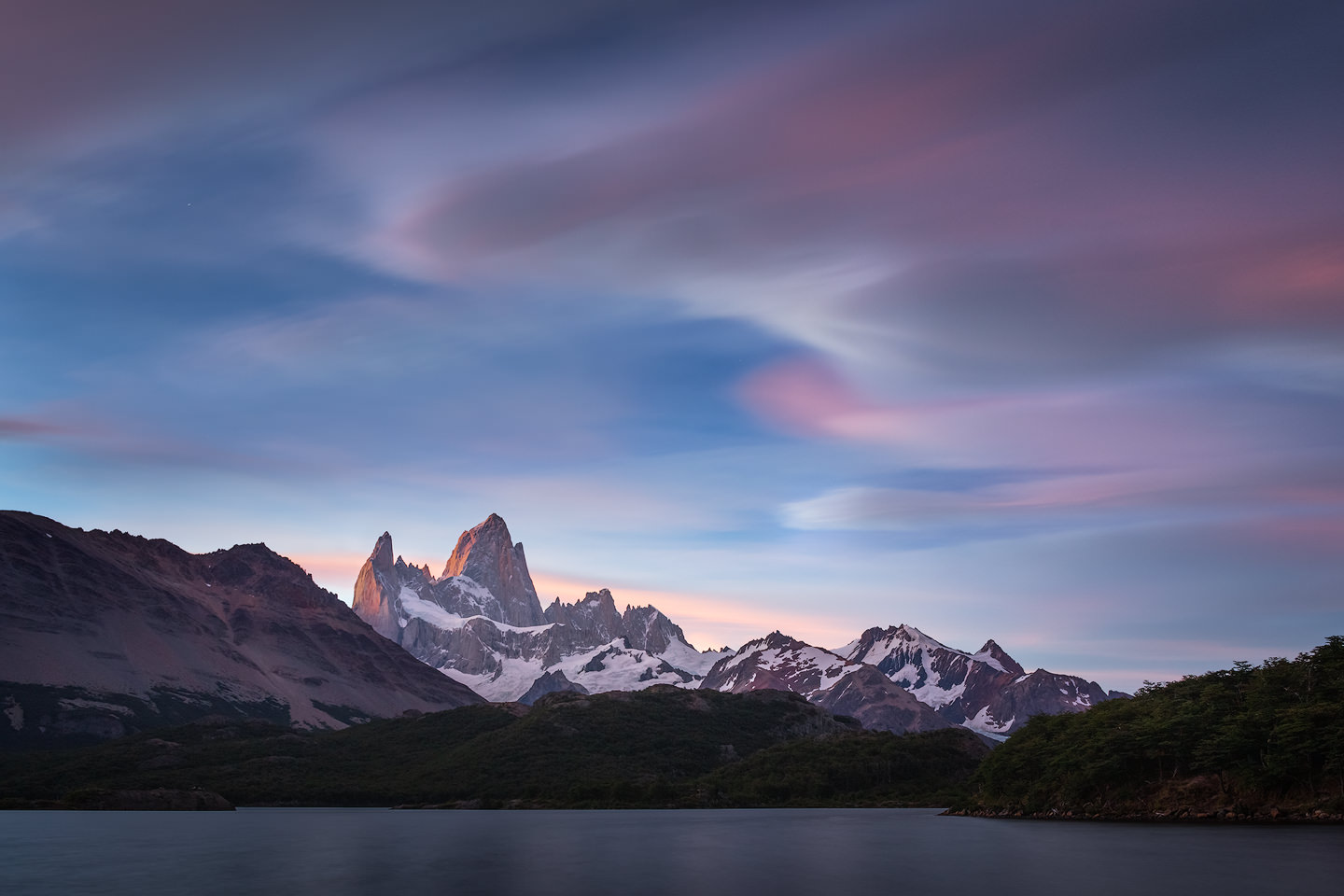
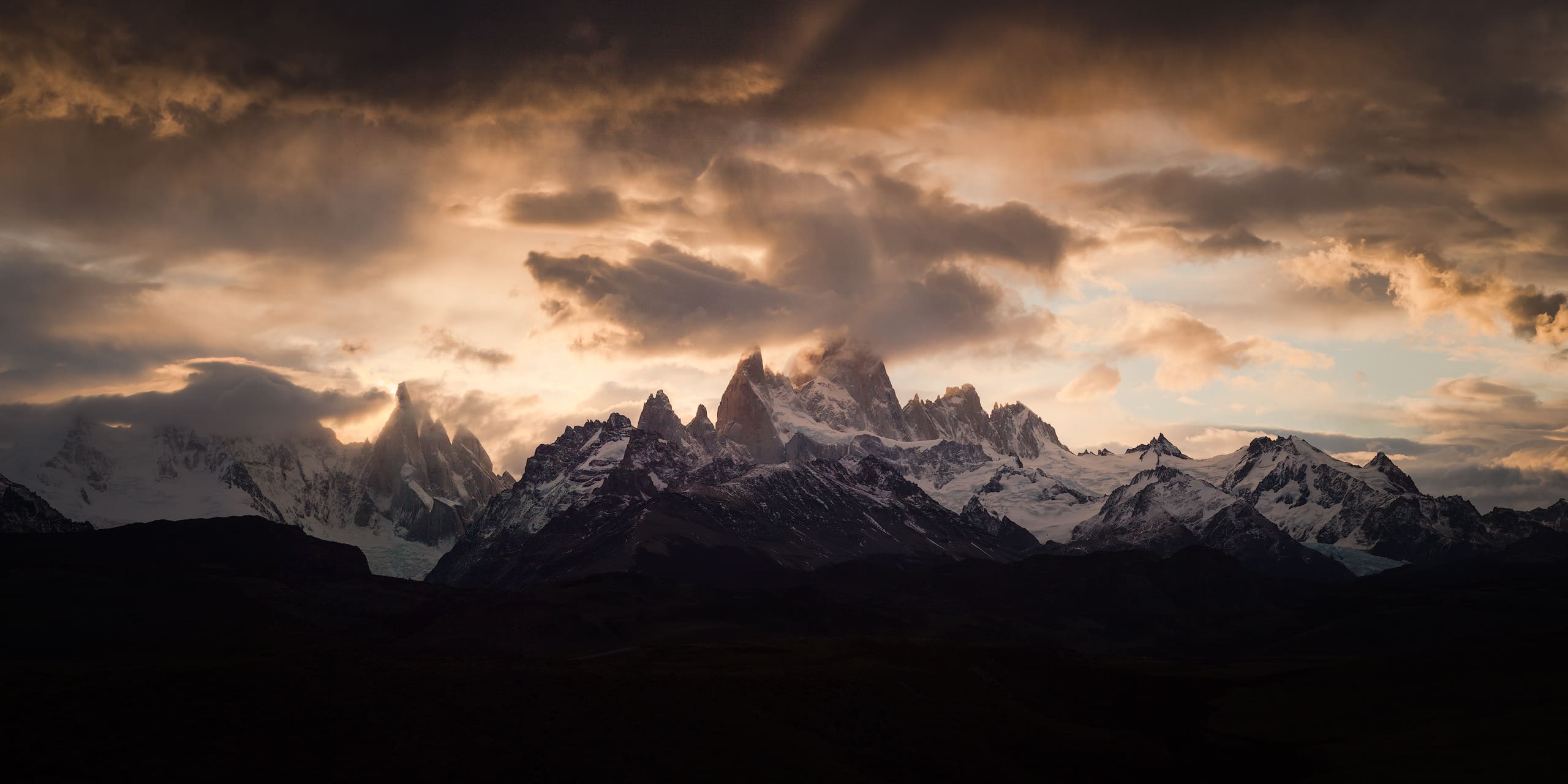
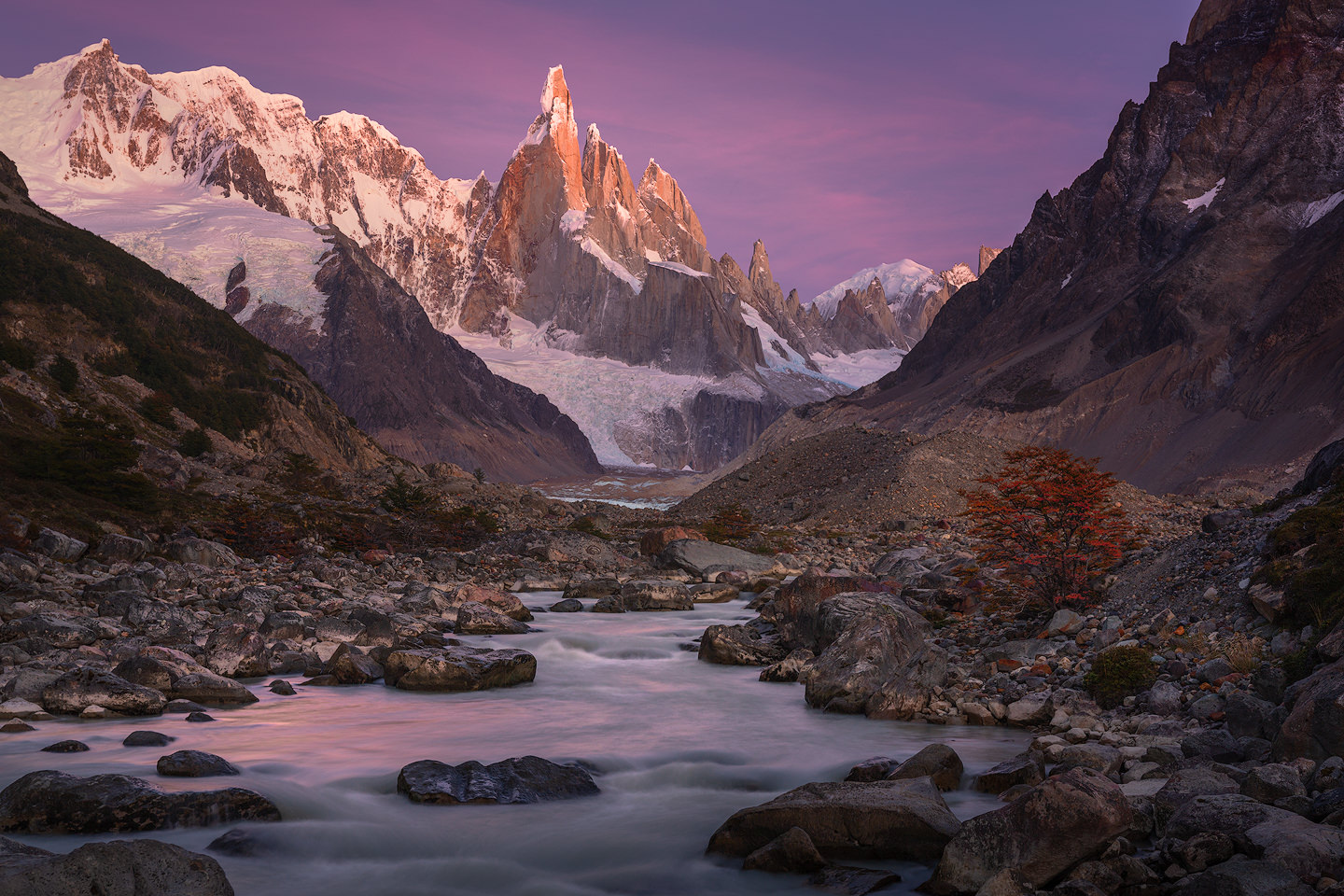
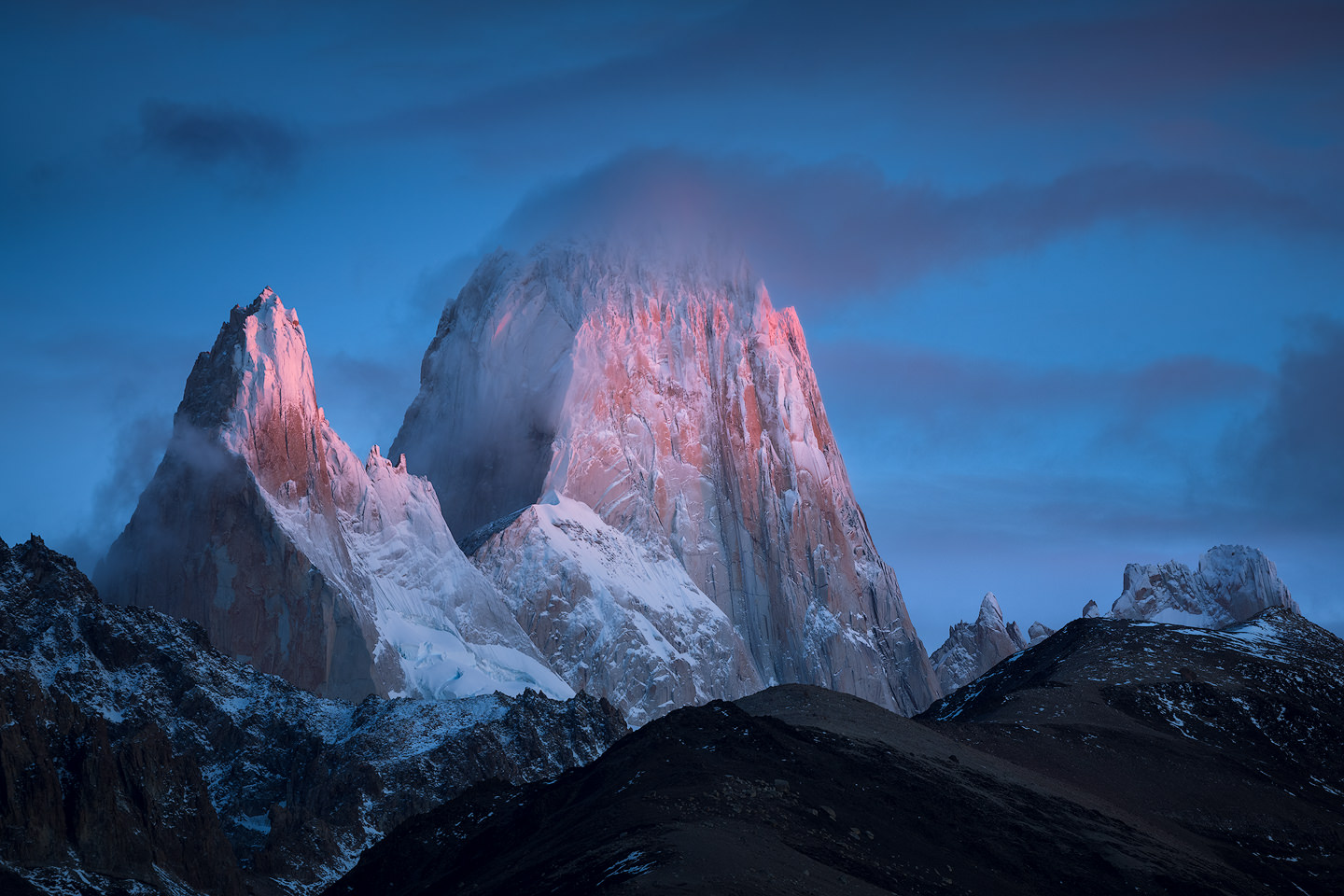
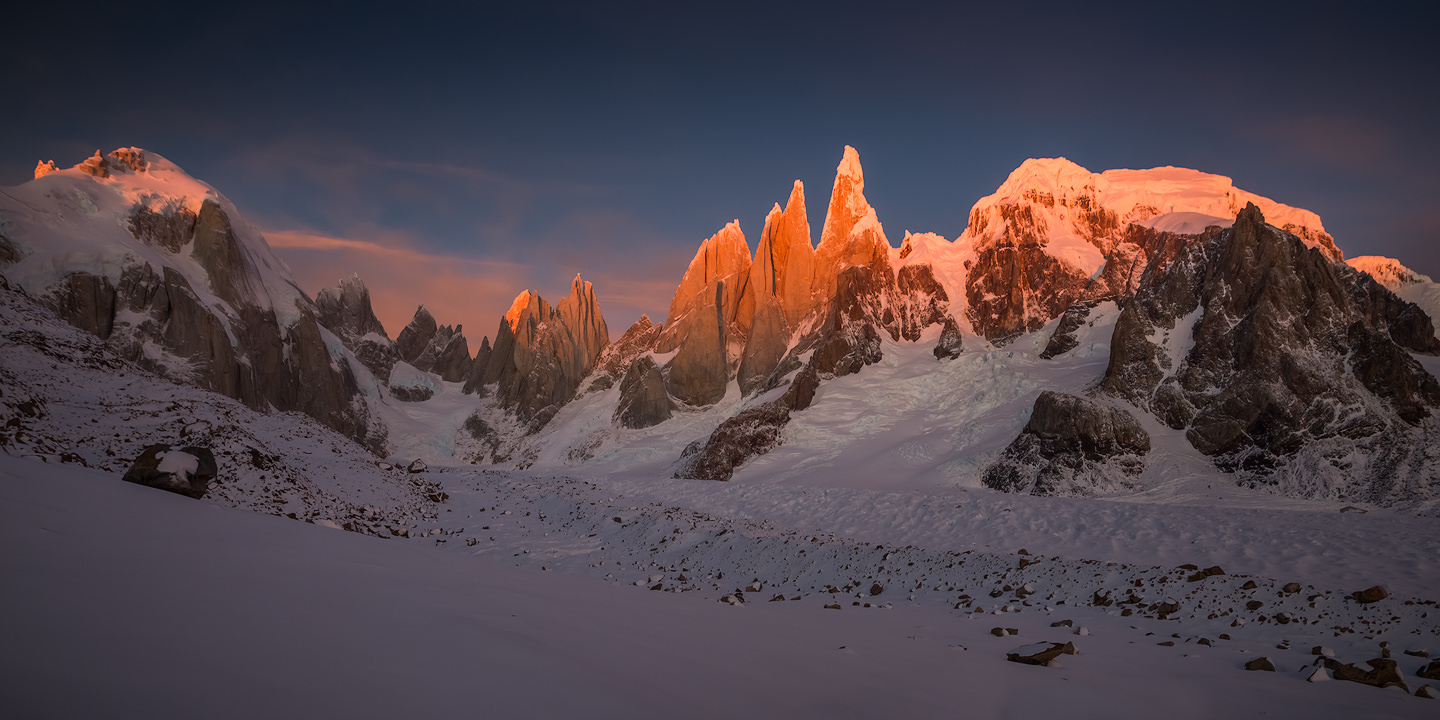
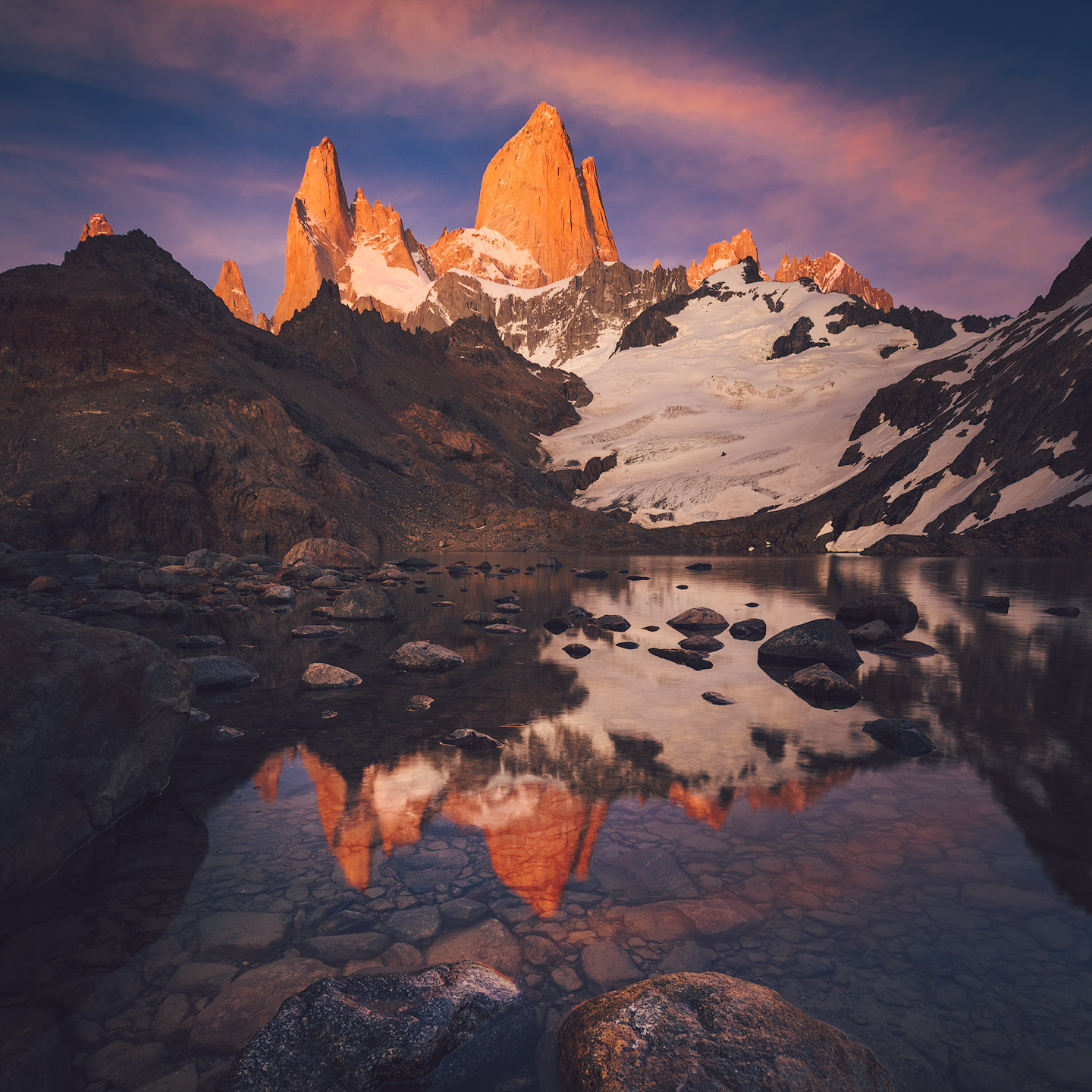
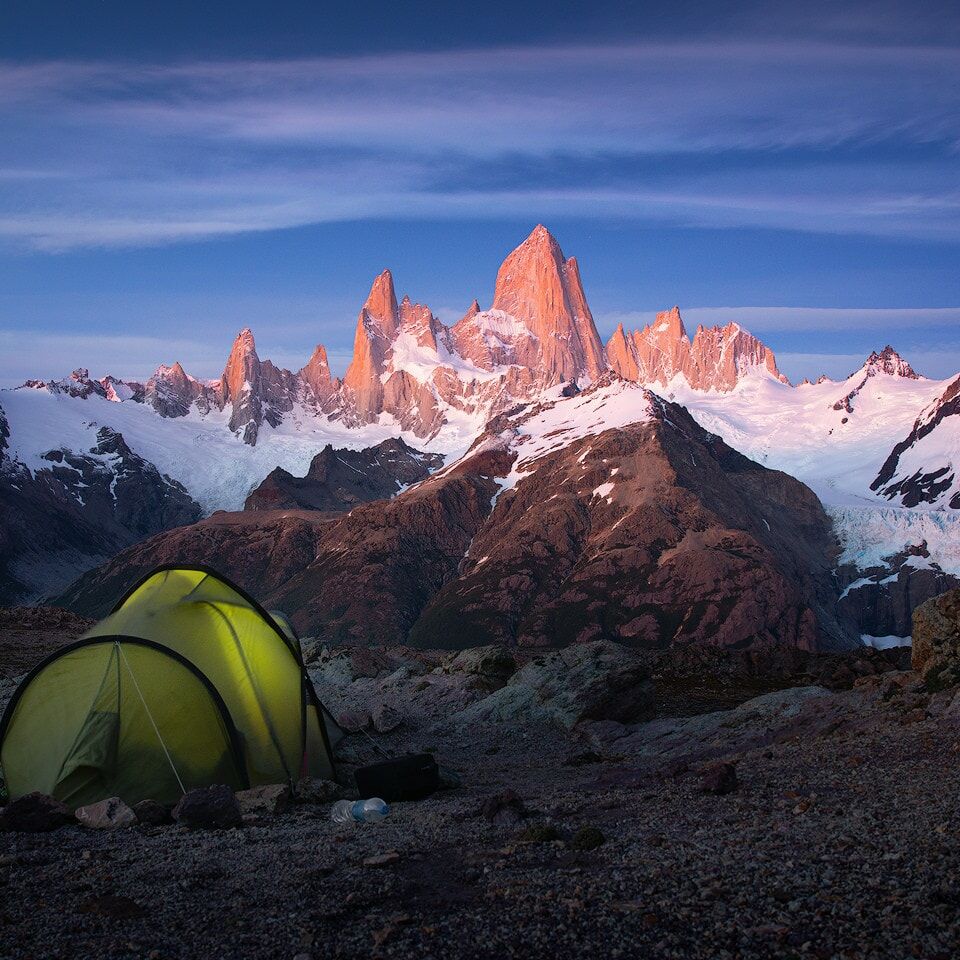
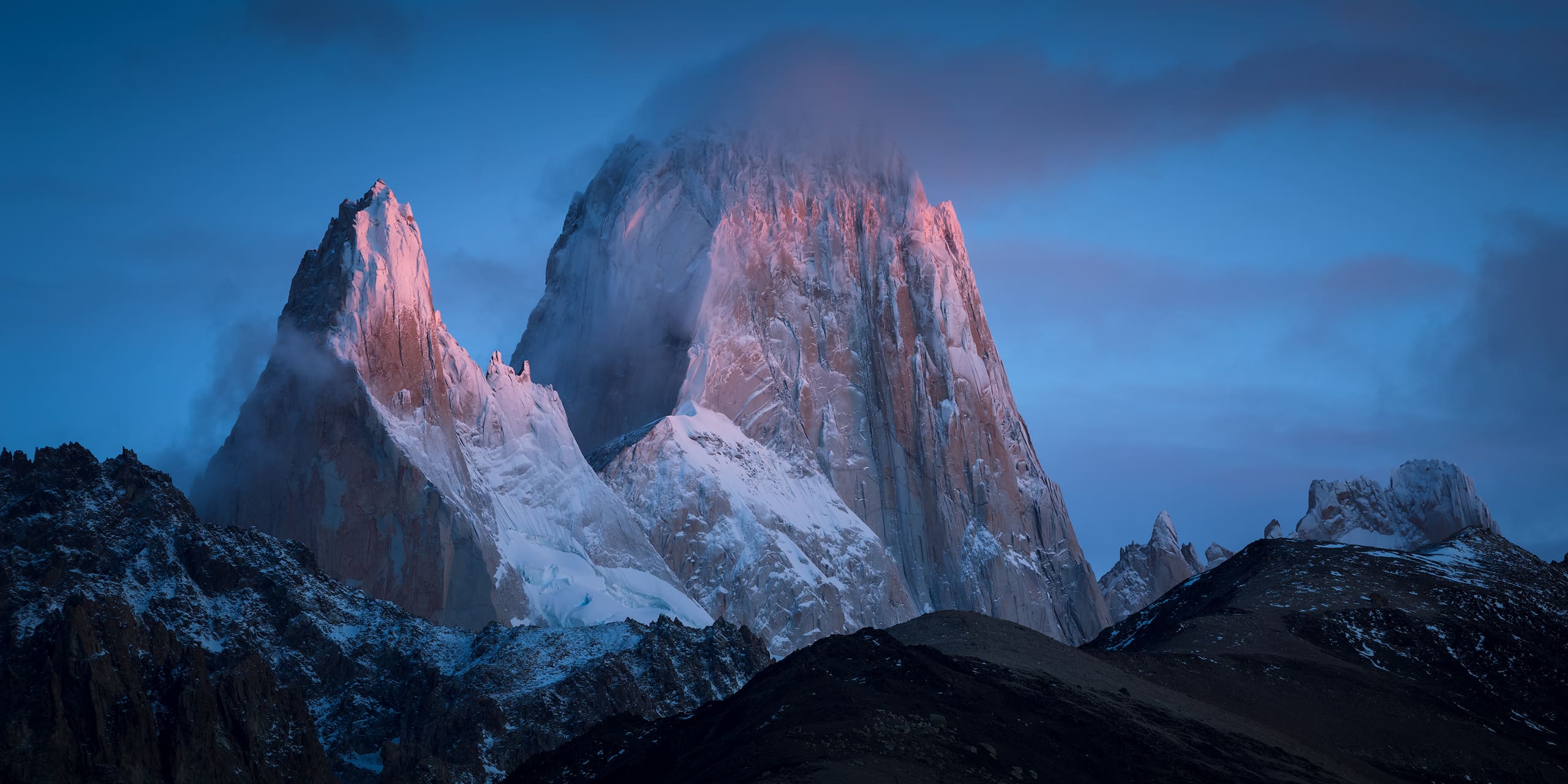
The Fitz Roy massif and surrounding Parque Nacional los Glaciares offer the most concentrated photographic opportunities in the range. Most photographers are chasing the same thing: the east faces of Fitz Roy or Cerro Torre towers catching the first light of the sun in the pre-dawn stillness — capturing Fitz Roy and Cerro Torre reflected above El Chaltén requires a two-hour pre-dawn hike and a short break from the notorious Patagonian wind. On one of the most popular hiking routes, Patagonia offers something less serene but no less worth staying for: a sunset at Laguna de los Tres might present Fitz Roy’s silhouette against a darkening, storm-charged sky, which is as impressive as what mornings sometimes deliver.

Monte San Lorenzo
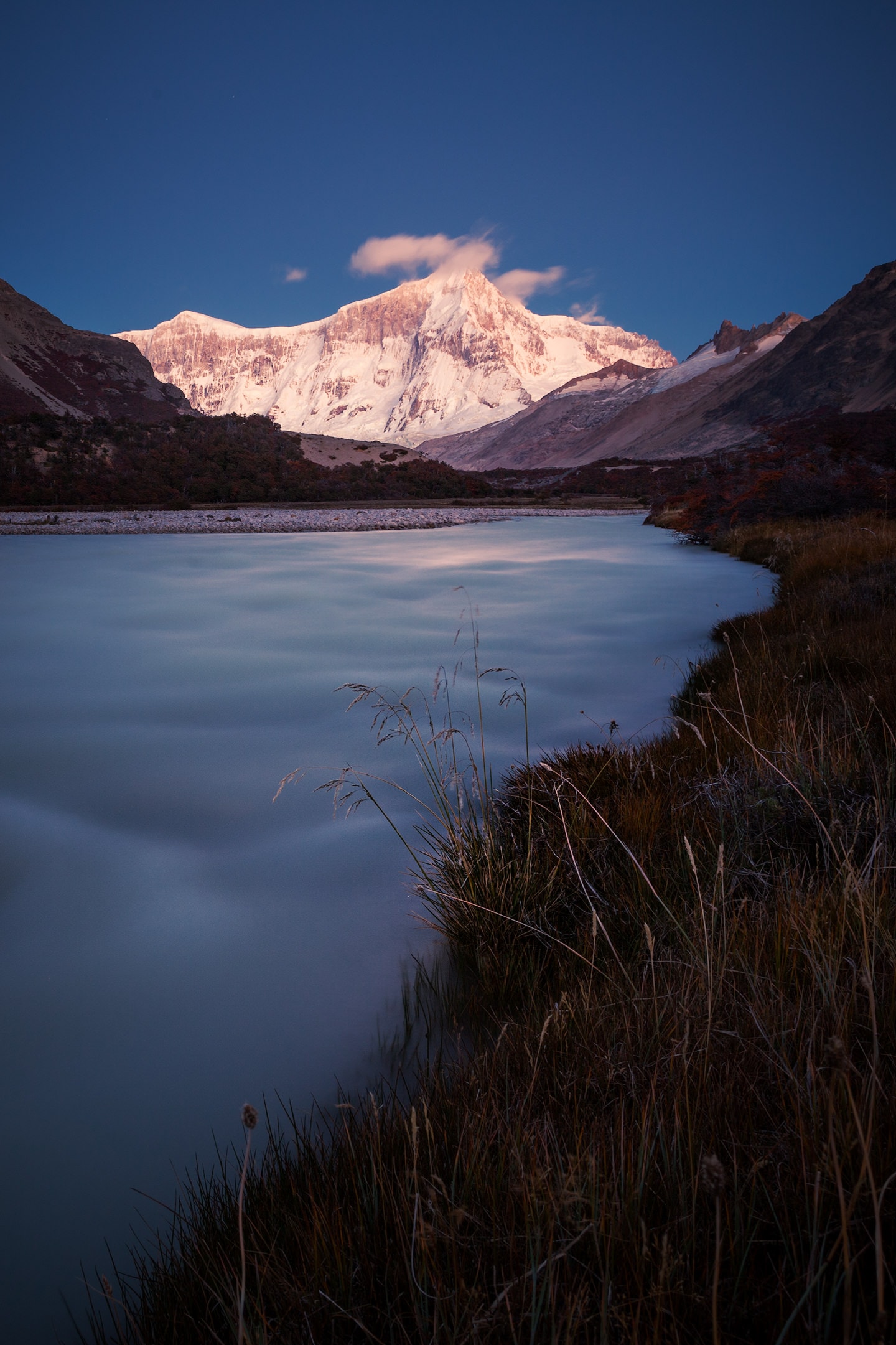
The San Lorenzo sector rewards photographers willing to leave the circuit trails entirely. The approach ends at a glacial lake deep in Parque Nacional Perito Moreno — icebergs on still water, Monte San Lorenzo’s east face catching the first light above — and a sunrise in Parque Nacional Perito Moreno shows exactly what that cold southern palette looks like when the conditions align. This is Patagonia before the trail signs went up.
Image Gallery
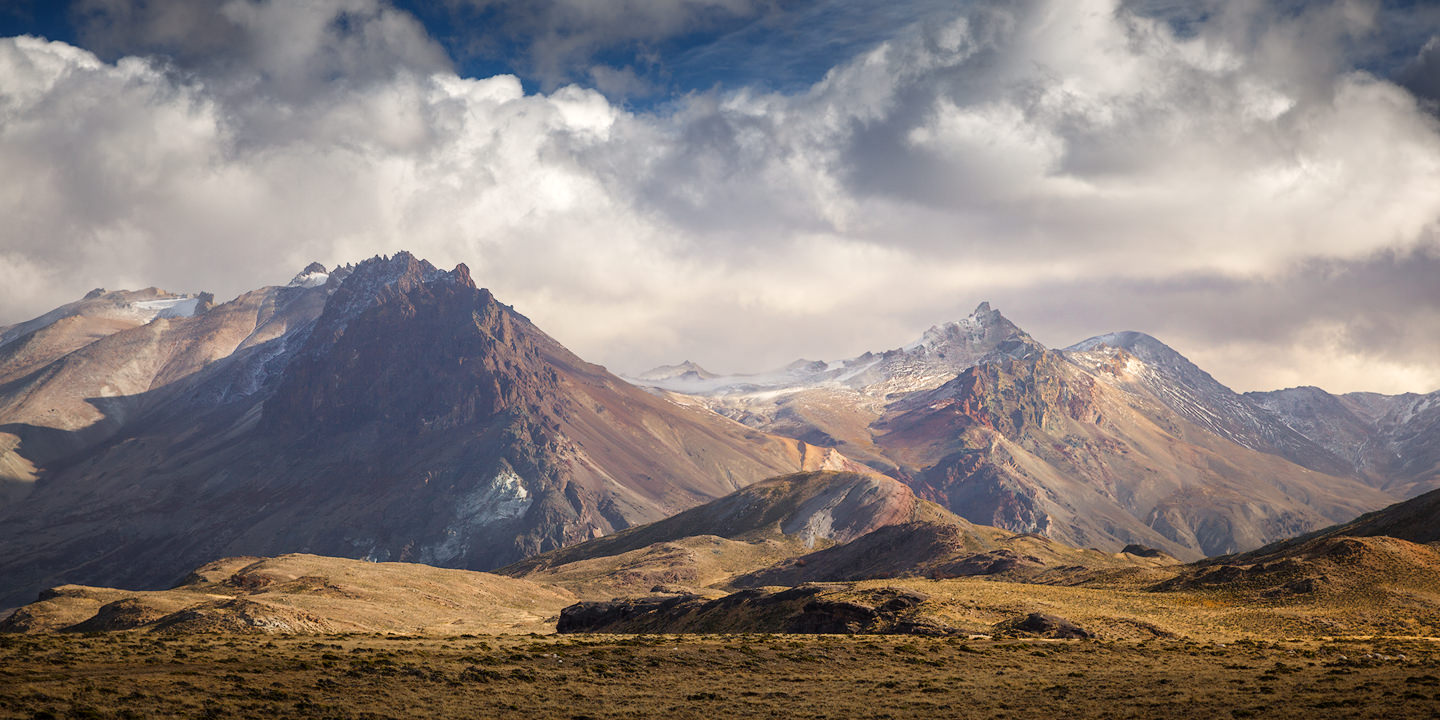
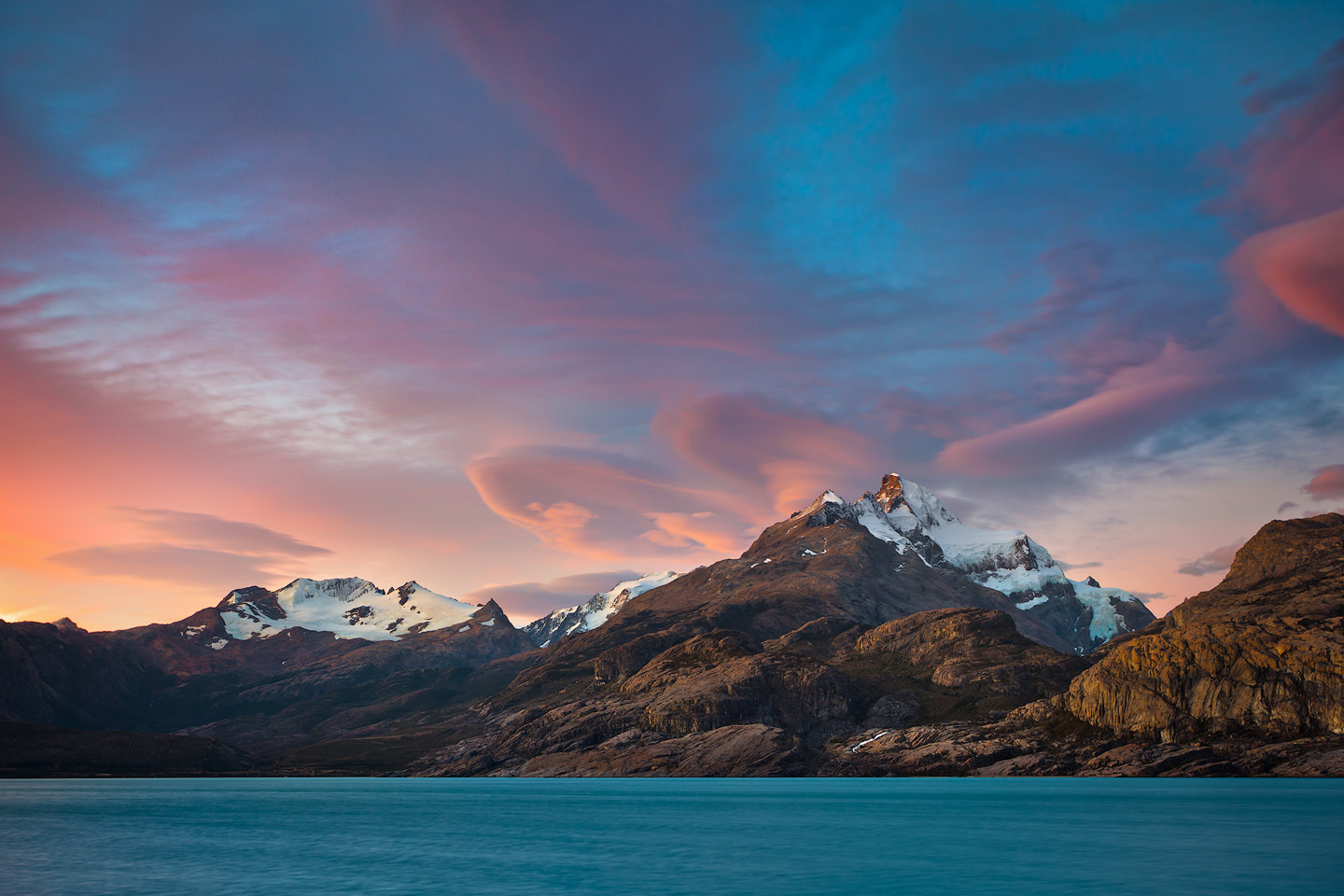
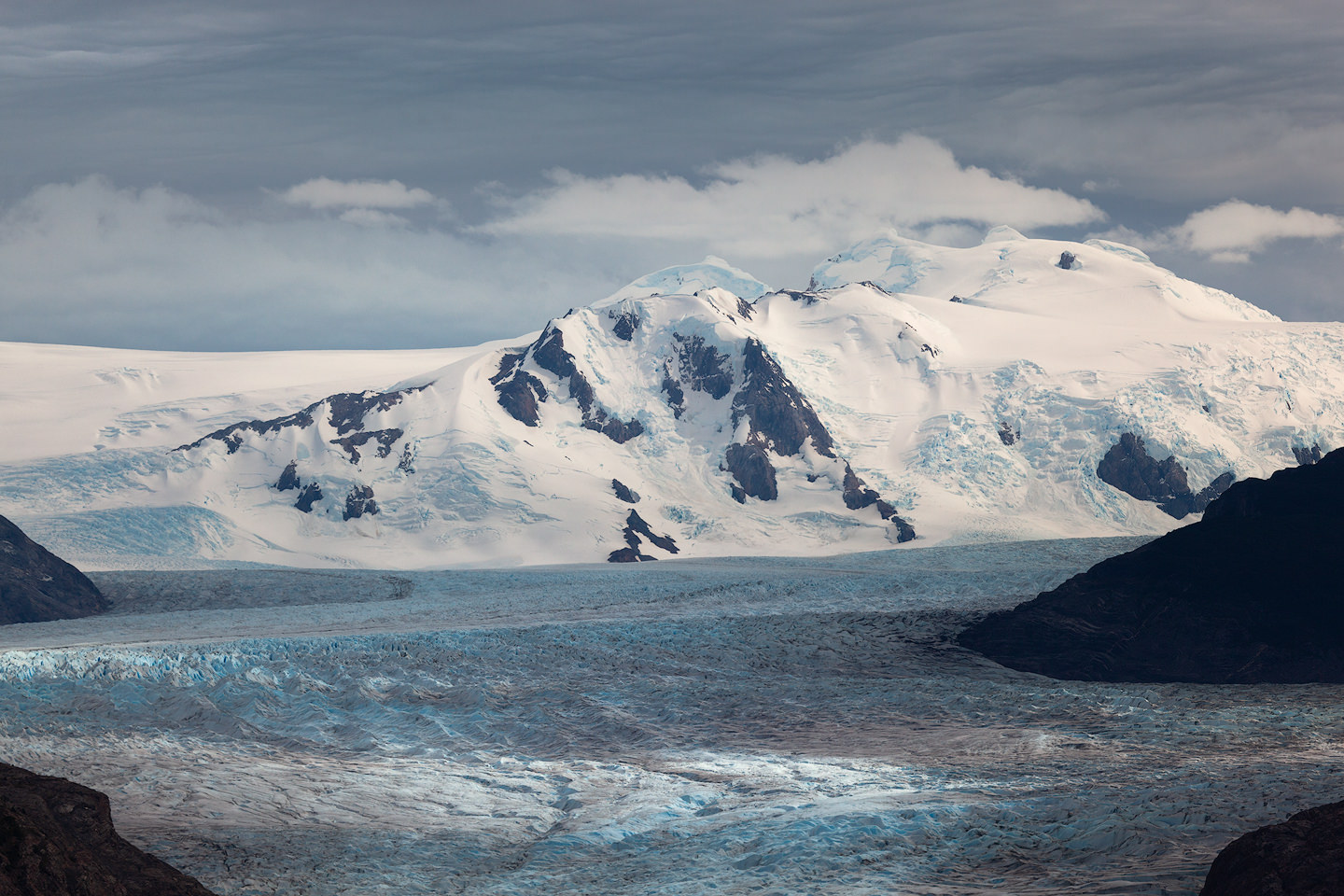
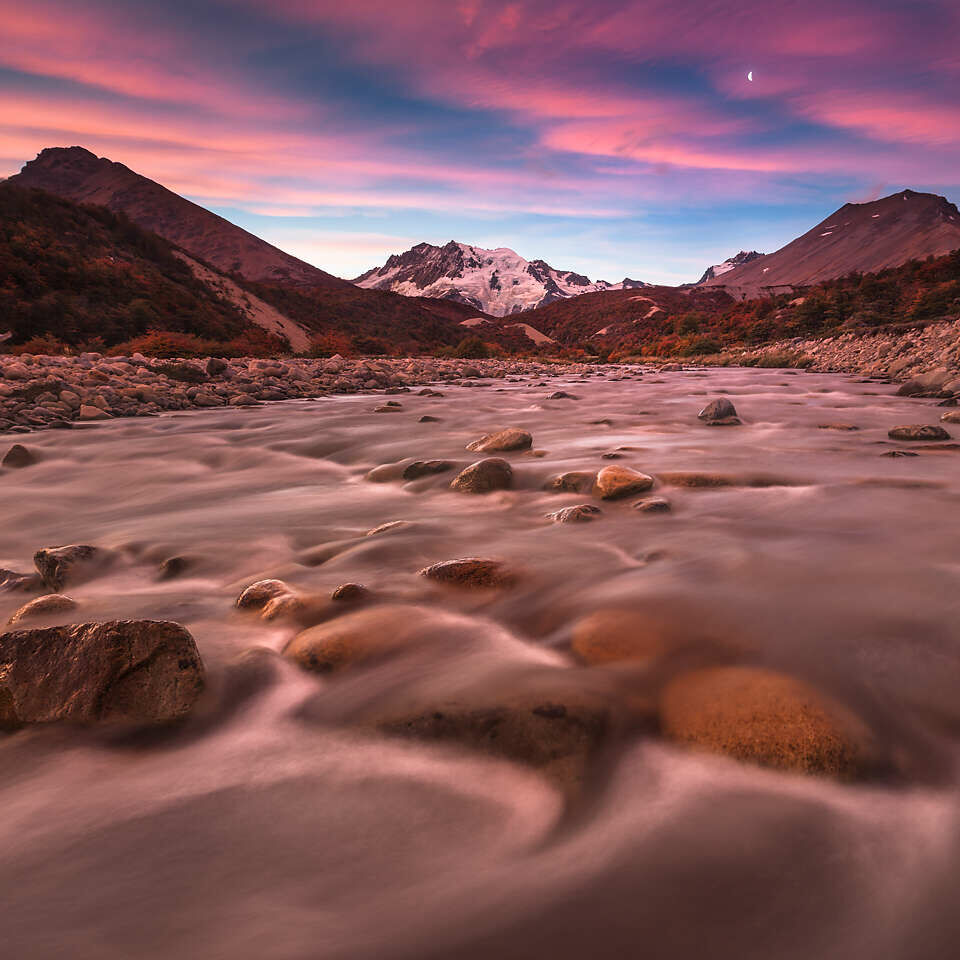
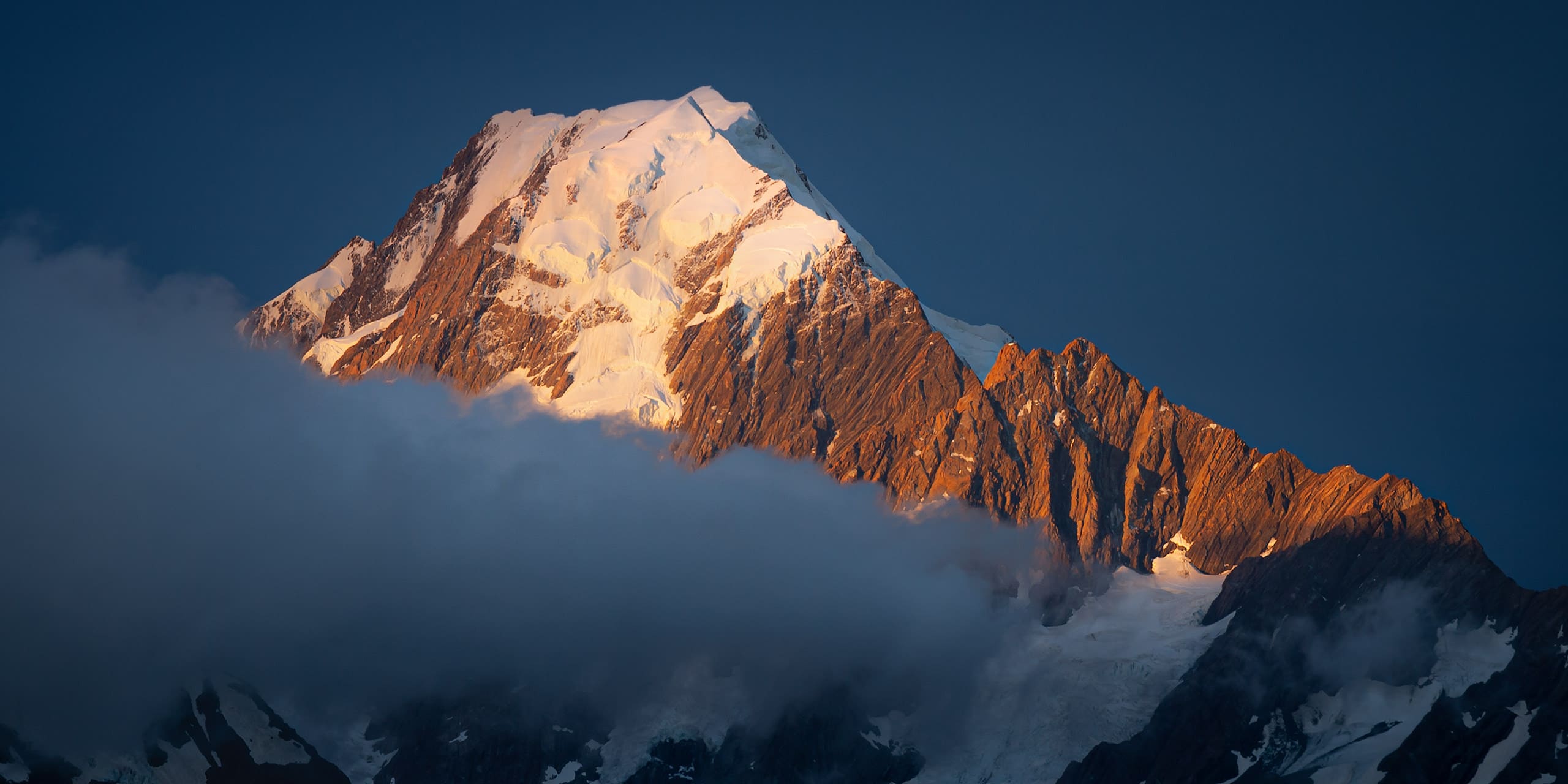
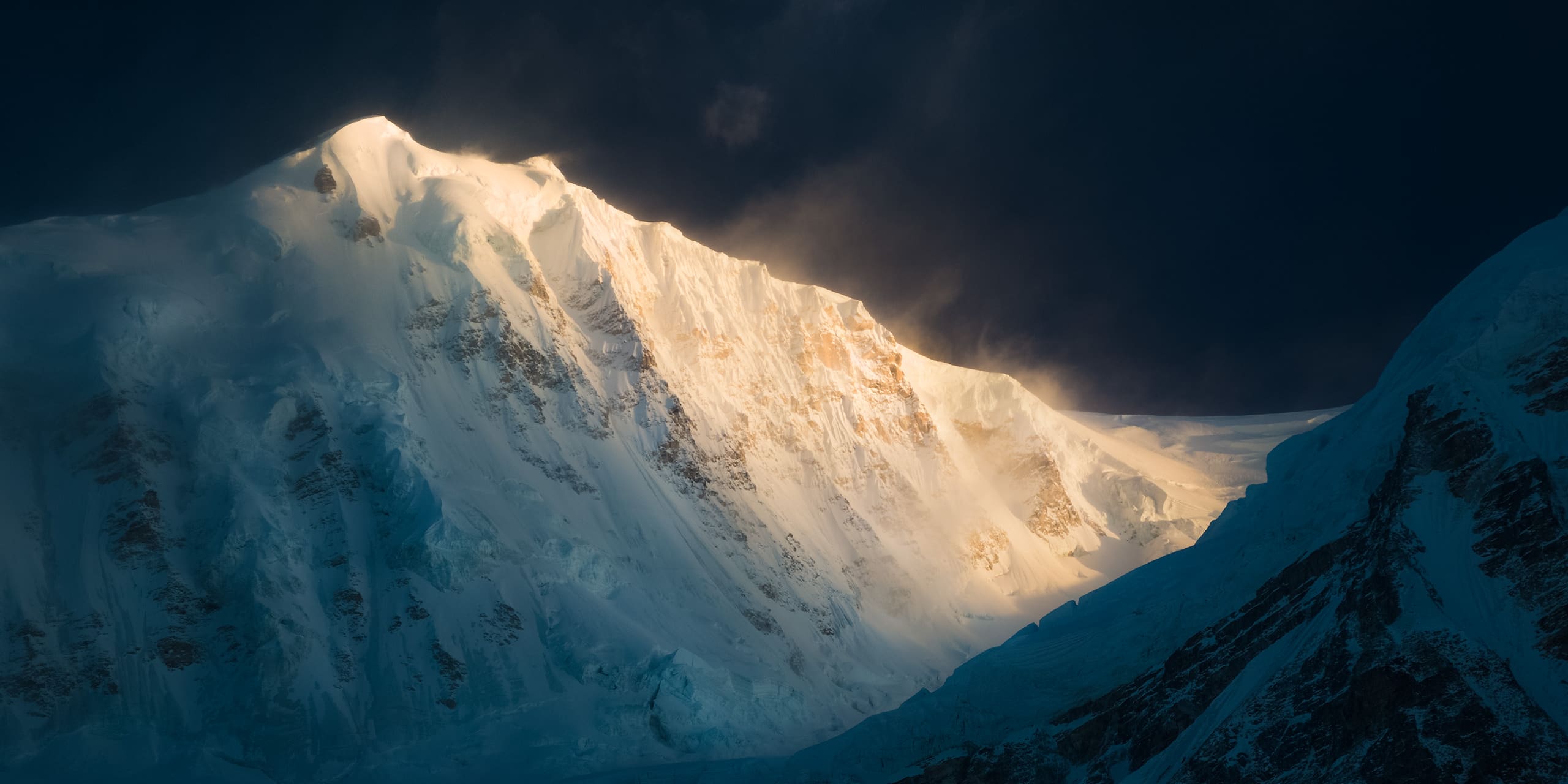
The images below document specific moments in the Cordillera Patagónica — light and conditions that are impossible to plan for, and as unique as impossible to describe with words.

Explore the Cordillera Patagónica!
The Cordillera Patagónica rewards deep exploration: the more time you invest, the more the range gives back. The articles below cover specific hikes, peaks, and photographic encounters — from multi-day circuits to single-morning light chases.
Since I'm being treated to some decent internet connection these days I thought I'd give you a little update about my whereabouts... I'm reciding in Ushuaia at…
Merry X-Mas everyone!! I'm lucky enough to be celebrating in Patagonia this year. Here's a shot from last week. I'll post some updates next week - if internet…
The last news about Patagonia that made it into austrian newspapers was when a tourist accidentially set Torres del Paine National Park on fire in December…
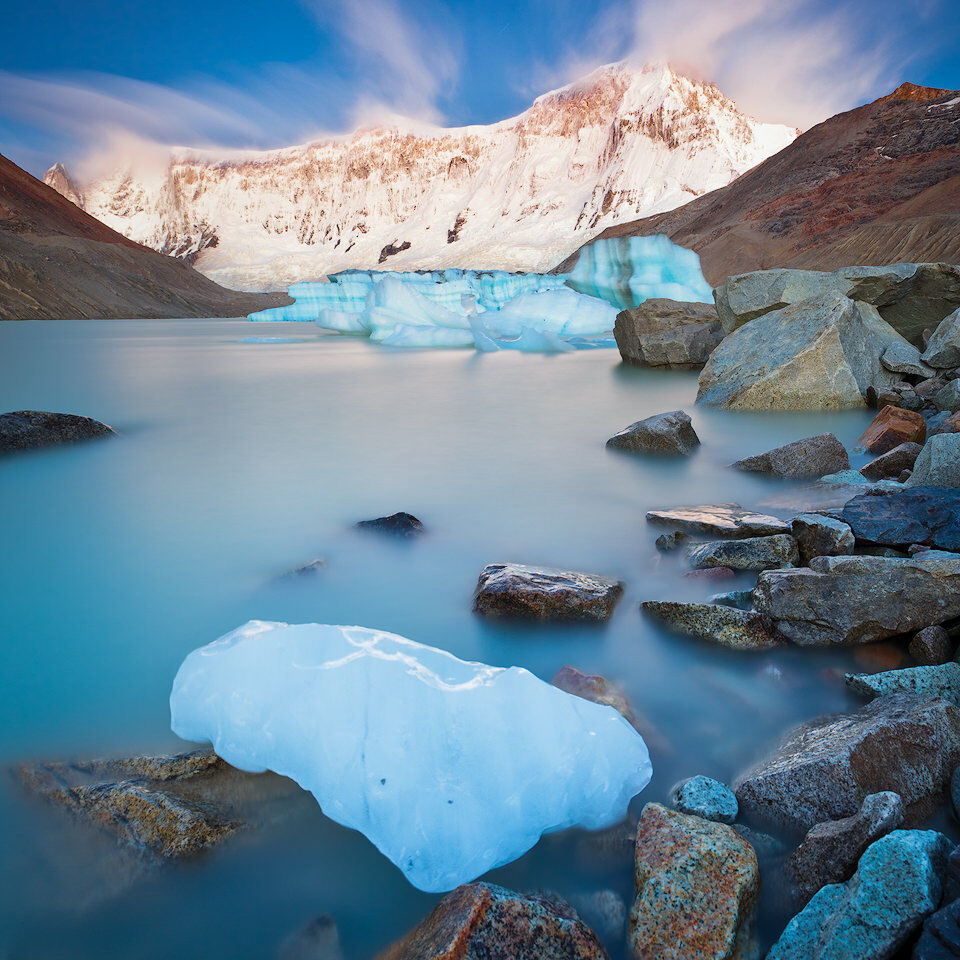
Almost nothing online — just a massive, unclimbed east face somewhere in the southern Andes. For a landscape photographer, an information gap that size is its…

Nothing found.
Nothing found.
Nothing found.